
Bees Have Third Eye, Applicable for Drones’ Night Vision: Study

Machine vision in drones is similar to human vision and cannot see colours clearly owing to light reflection and day and night difference but bees are different with a third eye, said a new study suggesting revamp of vision techniques in cameras, robots and drones.

A Melbourne-based researchers team has studied how bees have three special eyes on top of their head, in addition to two main eyes at the front. “The three eyes point skyward, and they directly sample the colour of the light above us,” said Dr Adrian Dyer of RMIT University in Mebourne, Australia.

The bee brain knows what kind of lighting conditions are in the surroundings and adjust accordingly when looking for a flower. The ability to distinguish colours in day and night or in a cloudy sky allows bees to find the best flowers to collect food, said researchers.

The third eye of bees, called ocelli, contains two colour receptors that are perfectly tuned for sensing the colour of ambient light and the information is integrated with the colours seen by the two front eyes, they explained.

Dr. Jair Garcia, Professor Marcello Rosa and Associate Professor Adrian Dyer. CREDIT: Monash University

To prove this was happening, the researchers from RMIT University, Monash University, University of Melbourne and Deakin University mapped “neural tracings” sent from the ocelli, showing how they feed into the areas of the bee’s brain that processes colours.

The findings were being published in the scientific journal, Proceedings of the National Academy of Sciences of the United States of America.

Extrapolating the findings, Dyer said a revamp of vision techniques in cameras, robots and drones will help deal with a major problem for machine vision – how to make reliable decisions when the colour of the light changes.

Based on a mathematical algorithm, drones can now fly around an orchid, even at night, and accurately detect the colour of different fruits. Same technique could be used by drones to inspect bridges or to analyse mineral sands, he suggested.

“These ideas have been around for a while, but the problem has been how to judge colour accurately,” Dr Dyer said.
Why Humans Still Live in Slow Motion World?

Small birds, which measure just one percent of Humans in mass, have vision that is incredibly twice the speed of human vision, found a team of Swedish scientists. It is known that perching birds (small passerines) do not only have good visual eyesight but they also see things at lightning speed. Compared to them, humans are still in slow-motion world, said scientists.

Scientists from Uppsala University, the Swedish University of Agricultural Sciences and Stockholm University, studied the visual speed of pied flycatchers, blue tits and collared flycatchers and say they have incredibly fast vision. Their paper in the journal PLOS ONE, probed perching birds’ ability to resolve visual details against the clock.

Lead author Anders Ödeen of Uppsala University’s Department of Ecology and Genetics, and his colleagues studied Visual acuity vs. speed of vision in these perching birds’ ability to resolve visual detail against the clock. He said:“Fast vision may, in fact, be a more typical feature of birds in general than visual acuity. Only birds of prey seem to have the ability to see in extremely sharp focus, while human visual acuity outshines that of all other bird species studied.”

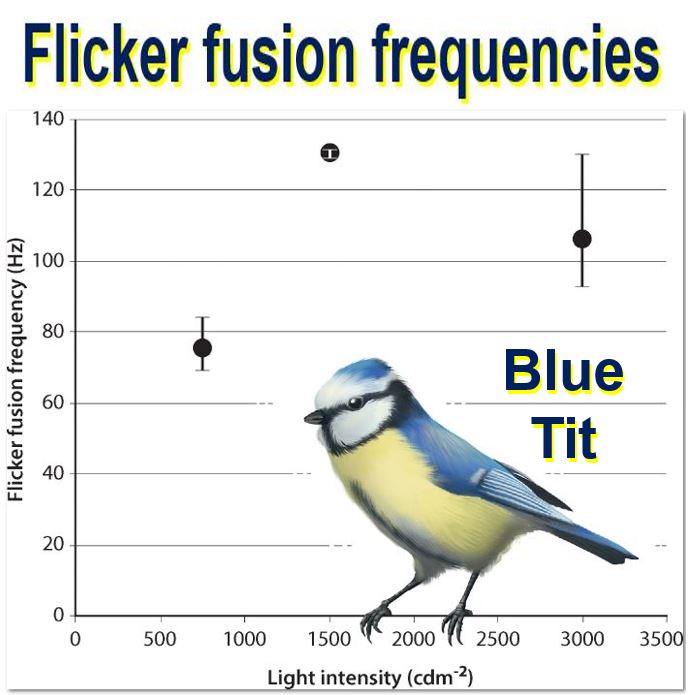
Twelve blue tits were tested once at one of the light intensities 750, 1500 (n = 3) and 3000 cdm-2 (n = 6) and the critical flicker fusion frequency (CFF), with a maximum of 131 Hz and 130.3 ± 0.94 Hz (±SD) on average, was reached at 1500 cdm-2.

In terms of visual acuity vs. speed of vision, referred as the temporal resolution of eyesight, the number of changes per second a bird, human or any other animals is capable of perceiving, scientists compared visual acuity (spatial resolution), which measures how many details per degree are detected in the field of vision.

The wild-caught birds were taught to receive a food reward whenever they were able to distinguish between a pair of lamps: one shining in a constant light and the other flickering. Temporal resolution was determined by raising the flicker rate to a point at which the birds could no longer tell the two lamps apart.

This threshold, called the Critical Flicker Fusion (CFF) rate, in three small bird species averaged between 129 and 137 Hz (hertz). A 146 Hz was recorded with one of the pied flycatchers, which is about 50 Hz higher than anything encountered for any other vertebrate. Similarly, flycatcher experiment was conducted on 7 collared and 8 pied flycatchers and they were repeatedly tested at up to 5 different light intensities each.

Researchers found that humans’ Critical Flicker Fusion (CFF) rate averages at about 60 Hz compared to 129 to 136 in passerines and hence, we humans live in a world where everything moves slowly.

The study, for the first time, established the fact scientifically and emperically that small and agile wild birds had extremely fast vision. In fact, researchers were surprised to find that flycatchers and blue tits had faster CFF rates than they would have predicted from their size and metabolic rates.

From the evolutionary history of natural selection for fast vision, it occurred in these species much faster than humans as these small airborne birds needed to detect and track tiny objects whose images move ultra-fast across the retina. The rapid vision was badly needed to hunt and avoid predators for these tiny birds.

The difference between a human and an eagle regarding visual acuity is about the same as a human’s versus the pied flycatcher’s vision speeds – 60 and 146 Hz respectively. In other words, the flycatcher’s vision is faster than ours roughly to the same extent as an eagle’s vision is sharper (than ours).

While eagles, hawks and other birds have the best visual acuity in the animal kingdom as they can see the most detail per square inch, small perching birds have the fastest vision as they can see the most movement per second.