
World News in Brief: Global investment plunges, hurricane season in Haiti, rising cholera and hunger in South Sudan

Their latest data shows that the outlook for international investment this year “is negative”, a sharp course correction from January, when “modest” growth seemed possible.

The reasons for this range from trade tensions and tariffs whose main effect has been a “dramatic increase in investor uncertainty”, said UNCTAD Secretary-General Rebeca Grynspan.

She said that investment in renewable energy, water and sanitation fell by some 30 per cent and that agriculture saw a 19 per cent drop in investor confidence.

Only the health sector saw an increase of nearly 20 per cent, Ms. Grynspan said, although that only accounts for “less than $15 billion globally”.

‘Very real consequences’

“Behind those numbers are very real consequences. Jobs not created,” she said. “Infrastructure not built, sustainable development delayed. What we see here is not just a downturn. It is a pattern.”

Ms. Grynspan also cited “growing geopolitical tensions” in addition to rising trade barriers around the world as reasons for the fall in global investment for development.

In critical sectors as hi-tech industries and rare earth minerals, governments are also tightening screening measures on proposed foreign investment, the UN agency noted.

Supplies to limit hurricane impact in Haiti critically low

The Humanitarian Country Team in Haiti warned Wednesday that funding and pre-positioned contingency supplies are critically low ahead of what is forecast to be an above-average hurricane season.

Haiti is highly vulnerable to extreme weather, with 96 per cent of the population at risk. Forecasts project 12 to 19 tropical storms and up to five major hurricanes this year.

The alert comes as the fragile island nation grapples with a worsening humanitarian crisis. Armed gangs control much of the country, the collapse of essential services and growing displacement have left 5.7 million people food insecure, 1.3 million displaced and 230,000 living in makeshift shelters ill-equipped to withstand severe weather.

Limited preparations  

Humanitarian actors have pre-positioned limited stocks of essential items, but they are at a record low for a hurricane season posing such high risk.  

For the first time, Haiti will begin the hurricane season without pre-positioned food supplies or the financial resources necessary to initiate a rapid response.  

Meanwhile, UN Humanitarian Office (OCHA) is coordinating missions with UN agencies and partners to assess how to safely resume aid operations in high-need areas, following their suspension on 26 May due to insecurity.

“I am deeply concerned for communities, families, and vulnerable groups who have already been affected by violence and are living in precarious conditions,” said Ulrika Richardson, Humanitarian Coordinator in Haiti, calling for immediate support.

As of mid-June, the $908 million Humanitarian Response Plan for Haiti is just 8 per cent funded.

Worsening cholera and hunger in South Sudan

OCHA raised the alarm on Thursday over rising malnutrition and cholera cases in war-torn South Sudan.

An estimated 2.3 million children under five urgently need treatment for acute malnutrition, a 10 per cent increase since last July.

This crisis is unfolding amid the world’s most severe cholera outbreak this year, with almost 74,000 cases and at least 1,362 deaths reported as of 16 June.  

The start of the rainy season and waning immunity risk a significant surge in infections.

UN response

The 2025 Humanitarian Needs and Response Plan for South Sudan is only 20 per cent funded.

Despite limited resources and many challenges, the UN and partners have scaled up efforts, delivering vaccines and life-saving aid to contain the disease and protect the most vulnerable.

“This dire situation is a stark reminder that we need funding urgently to expand food assistance, to expand nutrition and expand health services to those who need it the most,” said UN Spokesperson Stéphane Dujarric at the daily briefing in New York. 

Source link

Famine stalks two counties in South Sudan as fragile peace is threatened

The warning comes amidst increased violence and a worsening food security condition which has 11 out of 13 counties in the state facing emergency levels of hunger and 32,000 of these inhabitants facing catastrophic level hunger conditions, almost three times previous estimates.

We are seeing the devastating impact conflict has on food security in South Sudan,” said Mary-Ellen McGroarty, Country Director for the World Food Programme (WFP) in South Sudan.

“Conflict doesn’t just destroy homes and livelihoods, it tears communities apart, cuts off access to markets, and sends food prices spiralling upward,” Ms. McGroarty said.

Country-wide hunger

In total, 7.7 million people across South Sudan will face acute food insecurity, accounting for over half of the entire population. Additionally, 2.3 million children in South Sudan face malnutrition, a rise from 2.1 million at the beginning of the year. 

FAO expects these numbers to increase as the country prepares to enter the lean and wet season which will further diminish food supplies and potentially worsen displacement.

The agency did note that counties in which violence has been largely absent have seen improvements in food insecurity as a result of increased crop production and humanitarian efforts. However, hunger continues.

Despite such ongoing challenges, Meshack Malo, the country representative of FAO in South Sudan, said that these results are proof of the “dividends of peace.”

Descent into conflict

South Sudan, the world’s youngest country, gained independence in 2011 and immediately fell into a brutal and devastating civil war which ultimately ended in 2018 thanks to a peace agreement between political rivals which has largely held.

However, recent political tensions and increased violent attacks, especially in the Upper Nile State, threaten to unravel the peace agreement and plunge the nation back into conflict.

South Sudan cannot afford to sink into conflict at this point in time. It will plunge already vulnerable communities into severe food insecurity, leading to widespread hunger,” said Meshack Malo, Country Representative of FAO in South Sudan.

Humanitarian difficulties

FAO said that humanitarian access must be improved in order to address the worsening hunger situation.

The FAO report also emphasized that peace and capacity building is the only sustainable solution for food insecurity in South Sudan.

“Long-term peace is essential, but right now, it is critical our teams are able to access and safely distribute food to families caught in conflict in Upper Nile, to bring them back from the brink and prevent famine,” said Ms. McGroarty.

As displacement surges in South Sudan, regional humanitarian crisis deepens

Violence between armed groups in Upper Nile state and other flashpoints has crippled essential services, triggered food insecurity and worsened disease outbreaks, including cholera – forcing some to be displaced repeatedly.

Roughly 65,000 have been internally displaced in Upper Nile state alone. 

Access to aid in conflict hotspots is limited, with fighting and movement restrictions cutting off assistance.

Lifesaving supplies, including medicine and healthcare to curb rising cholera cases, have halted, while rains threaten to worsen the crisis, flooding roads and driving up transport costs.

South Sudan has also absorbed over a million people fleeing conflict in Sudan.

Regional crisis

Another 103,000 South Sudanese have sought refuge in neighbouring countries, pushing the total number of South Sudanese refugees to 2.3 million.

“This emergency could not have come at a worse time,” said Mamadou Dian Balde, UNHCR’s Regional Director for the East, Horn of Africa and Great Lakes region.

“Many of the refugees are seeking safety in countries which have challenges of their own or are already dealing with emergencies amidst ongoing brutal funding cuts, straining our ability to provide even basic life-saving assistance.”

Despite the conflict in Sudan, 41,000 South Sudanese have sought refuge there – 26,000 in White Nile state, where over 410,000 South Sudanese already live, many repeatedly displaced due to ongoing violence in their host country.

The surge in arrivals in Sudan has created an urgent need for additional space, while essential services are overwhelmed due to cholera outbreaks and ongoing security challenges.

In the Democratic Republic of the Congo (DRC), 23,000 have arrived amid the country’s own insecurity.

Some 21,000 South Sudanese have sought refuge in Ethiopia. Previously living in makeshift shelters along riverbanks near the border, new arrivals are now receiving UNHCR aid further from the border; however, infrastructure and services in the area remain severely overstretched, worsened by a cholera outbreak.

Uganda, which hosts one million South Sudanese refugees, has taken in 18,000 since March – a 135 per cent year-on-year increase. Nearly 70 per cent are children; many forced to take longer and more hazardous routes to safety.

Call for support

UNHCR is providing refugees with critical relief items, documentation and specialised support to survivors of gender-based violence. 

But to provide necessary support for the next six months – including shelter, water, health and nutrition screening, as well as cash assistance – the agency requires $36 million. 

Calling for an immediate end to hostilities, UNHCR urged all parties to spare civilians further suffering. 

Unrest in Warrap state

In related developments, the UN Mission in South Sudan (UNMISS) voiced deep concern over escalating intercommunal violence in Tonj East county, Warrap state, urging the Government to intervene and deploy security services to address the situation. 

The violence has been driven by attempts to recover stolen cattle and revenge for the previous loss of lives, resulting in more than 80 casualties, although the numbers are yet to be verified. 

UNMISS is intensively engaging with state and local authorities to calm the situation, in addition to increasing patrols, however peacekeepers are experiencing significant challenges reaching some of the impacted areas due to a proliferation of checkpoints manned by armed youth.

Source link

UN rights chief calls on South Sudan’s warring parties to end renewed fighting

At least 75 civilians have been killed in hostilities between the national army (SSPDF) and the Sudan People’s Liberation Army-In Opposition (SPLA-IO) – which is both a political party and militia group loyal to First Vice President Riek Machar – and their respective allied armed groups, said UN human rights office, OHCHR, in a press release.

Thousands have been displaced from their homes.

South Sudan was plunged into civil war in 2013 between supporters of the President Salva Kiir and his rival Mr. Machar but a 2018 peace accord led to a fragile power-sharing agreement.

Escalating hostilities “portend a real risk of further exacerbating the already dire human rights and humanitarian situation,” said Volker Türk, head of the UN human rights office (OHCHR), urging all parties to the conflict to “urgently pull back from the brink.”

Intensifying hostilities

The latest armed violence erupted in February when a militia group identified as the White Army reportedly launched a series of attacks in Upper Nile State, OHCHR said.

Hostilities intensified between 3 May and 20 May with reports of indiscriminate aerial bombardments and river and ground offensives by the SSPDF on SPLA-IO positions in the states of Jonglei and Upper Nile.

Civilian displacement further increased on 21 May because of the SPLA-IO and allies’ counter-offensive in Jonglei State.

I urge all parties to uphold the 2018 peace agreement,” said the UN human rights chief, calling for the warring parties to “ensure protection of civilians and civilian objects,” and facilitating “humanitarian access in line with their obligations under international law.”

Concern of arbitrary detention

Between 5 and 26 March, at least 55 high-ranking government officials affiliated with the SPLM-IP, among them civilians, have been arrested across the country. Notably, South Sudan’s first vice-president, ministers, members of parliament and military officers were among the dozens of politicians who have been detained.

“I am concerned that many of the detentions are arbitrary in nature,” Mr Türk said, as these arrests were conducted without warrant or due process.”

Mr Türk called for the immediate and unconditional release of those arbitrarily detained, as he urged for authorities to grant the UN Mission in South Sudan (UNMISS) access to National Security Service detention sites to assess the welfare of those detained there.

Finally, the UN also urged the authorities to take “prompt, effective and meaningful” steps to halt the spread of hate speech in the country.

Source link

UN Security Council extends South Sudan mission amid rising instability

Introduced by the United States and supported by 11 other Council members, the resolution extended the mandate of UNMISS until 30 April next year.

This action follows a short nine-day “technical rollover” approved by the Council on 30 April to allow more time for negotiations.

Through the text – adopted on Thursday – the Security Council authorized the peacekeeping mission to “use all necessary means” to implement its mandate – including the protection of civilians, assisting aid delivery, supporting implementation of the 2018 peace agreement, and investigating violations of international law.

Three nations – China, Pakistan, and Russia – abstained.

Volatile situation on the ground

The renewal comes amid an increasingly volatile political and security situation in South Sudan.

Head of UNMISS Nicholas Haysom warned ambassadors in April that the fragile 2018 Revitalized Peace Agreement – signed by historic rivals President Salva Kiir and former First Vice President Riek Machar – is unravelling.

The political standoff, including the arrest of Mr. Machar, has reportedly escalated into open military confrontation, while misinformation and hate speech are fuelling ethnic divisions and instability.

“This situation is darkly reminiscent of the conflicts of 2013 and 2016, which cost over 400,000 lives,” Mr. Haysom said.

UNMISS mandate

The resolution maintains the mission’s overall force ceilings at 17,000 troops and 2,101 police, including 88 justice and corrections advisors.

The Council also expressed its readiness to consider adjusting force levels and capacity-building based on future conditions.

The resolution expressed “deep concern” over delays in implementing the 2018 agreement, urging South Sudan’s leaders to urgently show political will and build mutual trust. It urged the parties to engage in open and constructive dialogue.

It also stressed that the “organization and funding of free and fair elections is the responsibility of the South Sudanese authorities”, calling on the transitional government to adopt an appropriate legislative framework to fund national elections.

The resolution also condemned the use of sexual violence, recruitment of child soldiers and interference in any humanitarian operations.

UNMISS was initially established by the Security Council in 2011, following South Sudan’s independence from Sudan, to help maintain peace and stability at the time when the young nation faced significant internal conflicts and humanitarian challenges.

Broadcast of the Security Council meeting.

Ditch ‘ideological goals’: US

Speaking before the adoption, US Acting Representative Dorothy Shea called on the international community to bring South Sudan “back from the brink.”

She cited deteriorating conditions on the ground, including recent attacks against civilians and infrastructure. She also noted ongoing challenges facing UNMISS – including being asked to vacate its Tomping base – which undermine the mission’s ability to carry out its mandate.

“In short, as I hope we can all agree, the goal of UNMISS should be to render itself unnecessary by ushering in a lasting peace. The day that a peacekeeping operation is no longer required in South Sudan will be a bright one,” Ambassador Shea said.

She added that UN peacekeeping mandates, including UNMISS, “should not pursue ideological goals that are difficult to define and even more challenging to implement on the ground, but rather focus on core Chapter VII functions,” referring to the Chapter of the UN Charter stressing action to further international peace and security.

Unnecessarily politicised: Pakistan

Pakistan, which abstained from the resolution alongside China and Russia, explained its position.

Deputy Permanent Representative Muhammad Usman Iqbal Jadoon said UN Peacekeeping Missons should enjoy “complete and unified support” of the Security Council.

“However, this task is complicated when mandate resolutions are unnecessarily politicised,” he said, stating that mission mandates “must be tailored to the needs on the ground, not the political priorities of Council members.”

The resolution contained issues “which have no direct link” with UNMISS, preventing consensus among the 15 Council member States, he added.

That said, Mr. Jadoon reiterated his country’s full support for UNMISS and its leadership.

“UNMISS remains a force of stability in South Sudan. We greatly appreciate the dedication of its personnel and peacekeepers, who are performing their duties under difficult conditions.”

Source link

World News in Brief: South Sudan urged to avoid slide to war, Türk calls on EU not to weaken landmark law, Ukraine and Mali updates

The Quartet is calling on the country’s leaders to end hostilities and return to dialogue to fully implement the 2018 peace agreement known as the Revitalized Agreement on the Resolution of the Conflict in the Republic of South Sudan (R-ARCSS).

South Sudan, the world’s youngest nation, gained independence in 2011 but soon descended into a brutal civil war. A 2018 peace agreement has held together but now threatens to fully unwind between the president and his vice presidential rival.

Regional pressure

In recent weeks, the Quartet has observed air and ground attacks that have led to loss of life, the destruction of homes, and the displacement of civilians. Humanitarian facilities have also been targeted, while hate speech and ethnic tensions are on the rise.

The Quartet welcomed a recent joint visit by the African Union and IGAD to South Sudan as a sign of regional support for peace. It also called on all sides to cooperate with ceasefire monitors investigating recent violence.

South Sudan’s leaders must commit to inclusive dialogue, the release of political detainees, and renewed efforts to carry out the peace deal, the Quartet stressed.

A return to war would betray the people’s hope for peace and stability, they warned. Only a political solution can ensure free and fair elections at the end of the current transitional period.

UN rights chief urges EU not to weaken landmark corporate responsibility law

UN human rights chief Volker Türk has called on the European Union to protect a key law that holds large companies accountable for human rights and environmental harm.

The EU’s Corporate Sustainability Due Diligence Directive (CSDDD), adopted last year, requires businesses to identify and address any negative impact their activities may have on people or the planet.

But changes now being discussed in Brussels as part of a broader reform package could weaken the law, Mr. Türk warned on Wednesday.

“The CSDDD, by far the most ambitious business and human rights regulatory initiative anywhere in the world, has rightly been welcomed by companies, policy makers, civil society, and national human rights institutions alike,” he said.

“A large number of businesses have already taken steps to ensure they comply with it.”

Detailed review

UN human rights office, OHCHR, has published a detailed review of the EU proposal, pointing to ways it could undermine this groundbreaking directive.

Mr. Türk urged lawmakers to keep the law in line with global standards, such as the UN Guiding Principles on Business and Human Rights.

“While some streamlining… could be advantageous, it would be counterproductive to water down its alignment with international standards,” he said.

April deadliest month for civilians in Ukraine since September

April was the deadliest month for civilians in Ukraine since September 2024, with at least 209 people killed and 1,146 injured, the UN Human Rights Monitoring Mission in Ukraine (HRMMU) reported on Wednesday.

In its monthly update, the Mission said that 97 per cent of casualties occurred in areas controlled by Ukraine, with nearly half caused by missile and loitering munitions attacks by Russian forces.

“Kryvyi Rih, Sumy, Dnipro, Zaporizhzhia, Kyiv, and Kharkiv all endured devastating attacks,” said Danielle Bell, Head of HRMMU. “The sharp rise in casualties was mainly due to the intensified use of ballistic missiles in major cities.”

Among the deadliest incidents:

  • On 4 April, a missile strike on Kryvyi Rih killed 20 civilians and injured 63.
  • On Palm Sunday (13 April), two missiles hit Sumy, killing at least 31 and injuring 105.
  • A 24 April attack on Kyiv killed 11 and injured 81.

Children were especially affected. At least 19 were killed and 78 injured in April – the highest monthly total since June 2022.

The wave of attacks continued into May, with cities including Kharkiv, Odesa and Kyiv again coming under fire.

UN experts raise alarm over Mali’s suspension of political parties

Independent UN human rights experts have strongly criticised Mali’s military authorities for suspending all political parties and activities, calling the move a clear violation of basic rights.

© MINUSMA/Harandane Dicko

A detention centre in Bamako, Mali. (file)

The decision, announced on 7 May via state television, halts political activity “until further notice.” The junta, which took power following coups in 2020 and 2021, said the suspension was necessary to maintain public order.

The three UN Human Rights Council-appointed experts described it as a direct violation of human rights and called for the order’s immediate repeal.

They also called on the National Transitional Council to strike down a bill introduced on 30 April, which repealed legislation governing how political parties operate.

“If passed into law, the 30 April bill will place Mali in contravention of its human rights obligations, notably on freedoms of association and expression,” the experts stressed.”

Protests

In response to the 30 April bill, opposition parties organised a pro-democracy rally in the capital Bamako on 3 May which drew hundreds of demonstrators. The parties reportedly demanded a timeline to end military rule and a return to constitutional order.

Another protest is planned for Friday to oppose the decree against political parties.

The experts said Malian authorities must work to counteract “the current climate of suppression of the civic space”.

“The right to peacefully assembly is essential to the health of a vibrant political community,” the experts said. “The Malian Transitional authorities must scrupulously respect it and abstain from acts of intimidation and repression that risk the physical integrity and the rights of demonstrators.”

Special Rapporteurs and Independent Experts are appointed by the Geneva-based Human Rights Council. They serve in their individual capacity, independent of the UN system and national governments. They are not UN staff and draw no salary

Source link

Hospital bombing deepens bleak situation for war-weary South Sudanese

“Every time this happens, people lose access to health services – and sometimes, to hope,” said Dr Humphrey Karamagi, the UN World Health Organization (WHO)’s Representative in South Sudan. “Health is the last safety net. If it fails, everything else will also fall.”

The apparent airstrike on the hospital run by Médecins Sans Frontières (MSF) in Old Fangak in eastern Jonglei state, killed seven civilians and injured another 20, according to the UN humanitarian affairs coordination office (OCHA).

Healthcare not a target

The attack is the eighth time healthcare has been targeted since January “with health workers killed, facilities and essential supplies looted or destroyed”, the WHO official told journalists in Geneva.

“More attacks may lead to closing half the health facilities along the Nile,” he added.

Dr. Karamagi explained that humanitarian convoys and essential cold chain infrastructure had come under fire, at a time of escalating violence that has impacted civilians since South Sudan gained independence in 2011, descending shortly afterwards into civil war.  

Since March, tensions have escalated in Upper Nile state, with deadly clashes between Government forces and armed groups. This has uprooted an estimated 80,000 people in three of the most affected counties, the WHO official said.

He added that clashes have also been reported in parts of Western Equatoria, Central Equatoria and Unity states, forcing communities – “mostly women and children” – to flee into neighbouring countries, including 23,000 arrivals in Ethiopia.

Diseases spreading

Back in South Sudan, outbreaks of cholera, malaria, measles and mpox are spreading rapidly, prompting the UN health agency to deploy rapid response teams and coordinate with local partners where possible, amid access restrictions linked to the escalating violence.

“The alternative, if we do nothing, would be bleak,” the WHO official warned, pointing to cholera cases that may double in just six weeks and measles deaths that could increase by up by 40 per cent.

Cholera alone has infected more than 55,000 people since September, killing over 1,000, the UN health agency said.

‘War crime’ condemnation

In a related development, the UN Commission on Human Rights (OHCHR) in South Sudan condemned the bombing as a potential war crime.

“This was not a tragic accident,” said Yasmin Sooka, Chair of the Commission. “It was a calculated, unlawful attack on a protected medical facility.”

MSF confirmed the hospital’s complete destruction, including its pharmacy and emergency care units. Further aerial bombardments were also reported in New Fangak, raising fears that such attacks are part of a broader military campaign.

The airstrike followed public threats by South Sudanese military forces who demanded the return of seized boats and labelled multiple Nuer-majority counties, including Fangak, as “hostile”.

“Designating entire communities as hostile is deeply irresponsible and may amount to collective punishment,” said Commissioner Barney Afako.

Plea for action

The UN Commission has urged immediate investigations into the bombing and warned that repeated violations threaten to derail South Sudan’s fragile peace.

With high-level delegations from the African Union and IGAD now in the capital Juba, calls for renewed dialogue are growing louder. “The path South Sudan is currently on is perilous,” Ms. Sooka warned. “If attacks like these continue with impunity, the Peace Agreement risks becoming meaningless.”

In his final appeal, Dr Karamagi emphasised the cost of inaction: “Help us make sure this doesn’t become the moment health – and hope – finally give way.”

Source link

World News in Brief: Deadly attacks in South Sudan and Ukraine, World Court rejects Sudan case, lifesaving aid in Yemen

According to the UN relief coordination office (OCHA), the hospital in Old Fangak was struck early Saturday, killing seven civilians and injuring at least 20 more. The attack also destroyed vital supplies and forced the withdrawal of aid workers, leaving the town’s population without access to critical care.

“People in these areas are already battling flooding, food shortages and disease,” said Marie-Helene Verney, the UN’s acting Humanitarian Coordinator in South Sudan.

Too many lives at risk

“The destruction of critical health infrastructure and continued fighting puts innocent South Sudanese lives at risk.”

The bombing follows a wave of similar attacks in Upper Nile state, where health facilities in Ulang and Nasir have been targeted in recent months. The latest strike has heightened fears of renewed conflict as political and ethnic tensions rise nationwide.

The UN is now airlifting essential supplies to the area, but access remains limited. The violence has displaced over 130,000 people in the past two months, and aid agencies warn that South Sudan’s broader $1.7 billion humanitarian plan remains only 16 per cent funded.

Large scale attacks on densely populated cities across Ukraine

The UN’s top humanitarian official in Ukraine on Monday condemned a series of Russian strikes this weekend on densely populated towns and cities.

Between Friday and Monday, at least 12 people were killed and more than 100 others injured in attacks thar targeted Kharkiv, Kyiv and Cherkasy, and other regions in Ukraine.

These attacks also damaged homes, schools, a hospital and other civilian infrastructure, according to local authorities and partners, UN Deputy Spokesperson Farhan Haq told journalists in New York.

In the aftermath of the strikes, “humanitarian organizations provided first aid, psychosocial support, emergency shelter kits, repair materials, meals and drinks,” Mr. Haq said.

In the Kharkiv region, a fire triggered by a strike near the city of Izium on Sunday, burned 85 hectares of land and damaged over a dozen buildings. There were no casualties reported, Mr. Haq added.

Meanwhile, UN agencies alongside partners reached 600,000 people so far this year with first aid, medical transport, primary care and mental health support, including at transit centres for displaced people.

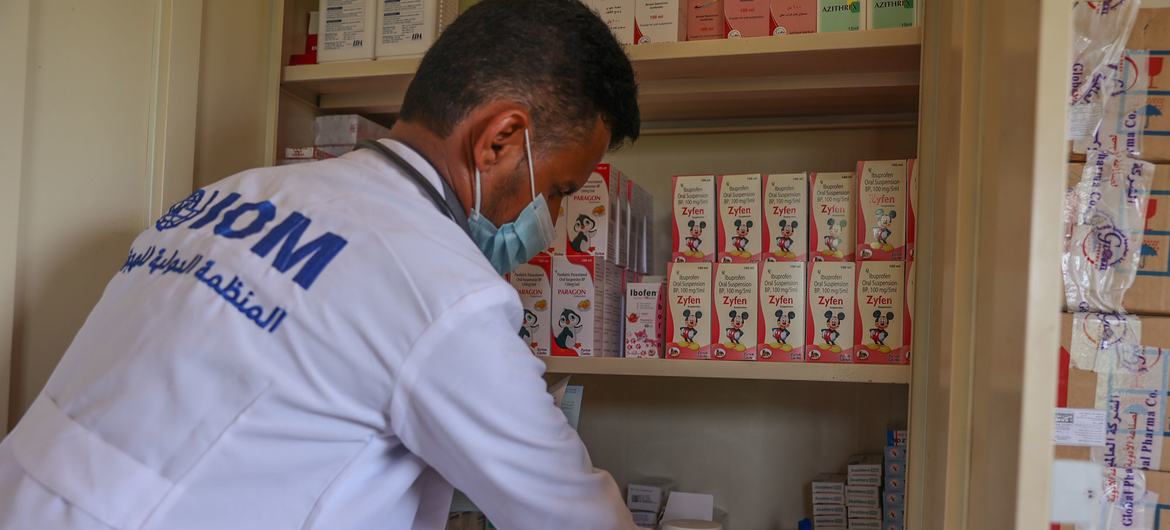
An IOM-supported health worker in Yemen accesses medical supplies.

Yemen: UN delivers lifesaving medical supplies

The UN International Organization for Migration (IOM) on Monday delivered critical medical supplies to seven health facilities in Yemen, where a collapsing health system and chronic shortages continue to endanger millions.

With support from the Government of the United Kingdom, IOM shipments are reaching hospitals and clinics in Aden, Lahj, Shabwah, Al Bayda and Sana’a – facilities serving both migrants and local communities.

“Every day, our teams see the impact of empty medicine shelves and overwhelmed clinics, on families and entire communities,” said Abdusattor Esoev, head of IOM in Yemen.

“By delivering essential supplies and supporting frontline staff, we are not just responding to urgent needs – we are keeping health services running for those who have nowhere else to turn.”

Crisis on crisis

The intervention comes amid an alarming health crisis.

Nearly 20 million people in Yemen require medical assistance in 2025, but over half of the country’s health facilities are only partially functioning or have shut down altogether. Funding gaps have left 382 facilities unsupported, forcing many to close or drastically cut services.

IOM’s assistance includes essential medicines, surgical equipment and infection prevention tools, as well as infrastructure repairs and support for health workers.

For many in the strife-torn country, IOM-supported clinics remain the only source of free medical care.

ICJ rejects Sudan’s genocide case against UAE

The International Court of Justice (ICJ) has rejected Sudan’s case accusing the United Arab Emirates (UAE) of complicity in genocide in Darfur, citing a lack of jurisdiction.

In the decision, the UN’s top judicial body ruled on Monday by a vote of 14 to two that it could not proceed with the case brought by Sudan under the Convention on the Prevention and Punishment of the Crime of Genocide (Genocide Convention) and declined to impose any provisional measures, as Sudan had requested.

The Court also removed the case from its general list by a vote of nine to seven.

“Having come to the conclusion that it manifestly lacks jurisdiction, the Court is precluded from taking any position on the merits of the claims made by Sudan,” the ruling stated.

Complicity charge

Sudan had accused the UAE of backing the paramilitary Rapid Support Forces (RSF), alleging its support amounted to complicity in genocidal acts against the non-Arab Masalit population in West Darfur.

The conflict between the RSF and the Sudanese army has claimed thousands of lives and displaced over 12.7 million people since April 2023.

The Court noted that while it could not hear the case, all States remain bound by their obligations under the Genocide Convention.

Source link