Who’s Neha Bora? A journey from Delhi University to JNU pushes AISA leader to forefront now

Neha Bora, the national president of the All India Students’ Association (AISA) who emerged as a prominent face of protests over alleged electoral irregularities, joined Rahul Gandhi and Priyanka Gandhi Vadra on Monday during the INDIA bloc’s march towards the Supreme Court in New Delhi.

Bora’s sudden appearance alongside the Congress leadership marked a new development in ongoing youth-led protests demanding Chief Election Commissioner Gyanesh Kumar’s resignation. The march sought a halt to the Special Intensive Revision (SIR) of electoral rolls and challenged alleged voter deletions.

Neha Bora’s rise from theatre and academic research to the forefront of student protests has drawn national attention after her detention during demonstrations in Delhi against alleged electoral irregularities. The 29-year-old doctoral researcher at Jawaharlal Nehru University (JNU) is the national president of the All India Students’ Association (AISA), a left-wing student organisation.

Bora became a prominent figure in protests demanding the resignation of Chief Election Commissioner Gyanesh Kumar, with videos of her speeches and appeals to demonstrators circulating widely on social media. Her academic background, particularly her association with theatre and performance studies, offers a glimpse into the experiences that preceded her emergence as a student leader.

Bora pursued undergraduate studies at the University of Delhi before completing postgraduate studies at Dr BR Ambedkar University Delhi. Later, she joined JNU’s School of Arts and Aesthetics for doctoral research in Theatre and Performance Studies.

How JNU and Theatre Shaped Neha Bora’s Political Journey

Bora’s connection with theatre predates her emergence in national student politics. In an interview with Reuters, she described how joining a theatre group as an undergraduate exposed her to people and perspectives beyond her own experiences.

“There might be a character that if you meet in your real life, you will disagree with, you will not like. But to do theatre is to understand where that person comes from,” she told Reuters.

Her academic interest in performance studies and her experience in theatre developed alongside her political involvement. However, publicly available reporting provides limited detail about her doctoral thesis, specific research projects or academic work at JNU. Her theatre background should therefore not be confused with a documented account of how her doctoral research directly influenced her political positions.

Bora has traced her entry into activism to the student-led protests against the Citizenship Amendment Act in 2019 and 2020. She told Reuters that she watched students turn ideas encountered in books, films and documentaries into political action.

Her subsequent activism has covered education-related grievances, examination controversies, unemployment and questions of government accountability. As AISA president, she has become a regular participant in demonstrations and campaigns concerning student rights and public policy.

From Student Activism to the Centre of Delhi’s Protests

Bora’s profile expanded further during protests over alleged examination irregularities in July. Her speeches at Jantar Mantar criticising the government’s response to demonstrators gained traction online, according to Reuters.

More recently, she joined protests organised by the Cockroach Janta Party and other groups demanding Gyanesh Kumar’s resignation over allegations of irregularities in electoral rolls. The Election Commission has denied favouring any political group, while the BJP has rejected allegations that the electoral process was manipulated to benefit it.

On October 10, police detained Bora and other activists after demonstrators were prevented from reaching Jantar Mantar. She urged supporters to regroup at Dilli Haat, approximately 10 km away, before she too was detained.

“I am in detention. The movement is not,” she said in a video posted online, calling on supporters to continue demonstrating.

Bora was released later that day. Her public profile has since grown as she has used speeches in Hindi and English to connect student concerns with wider questions of constitutional rights, inequality and accountability.

Bora has argued that the protests reflect accumulated grievances rather than a single political issue. “Fear is infectious, of course. But hope is also infectious,” she told Reuters.

Her emergence places her among a new generation of student activists seeking to turn campus-level concerns into wider political mobilisation. Whether that visibility translates into a sustained movement will depend on the protesters’ ability to maintain public support and advance their demands beyond the immediate demonstrations.

Rahul Gandhi’s Bharat Jodo Nyay Yatra ends in Mumbai today, INDIA bloc leaders to join

Congress leader Rahul Gandhi’s Bharat Jodo Nyay Yatra, is set to culminate today (Sunday, March 17, 2024) in Mumbai after covering a staggering 6,700 kilometers from Manipur. The event marks a significant milestone in his journey across the country to connect with people from different walks of life.

Key political figures including Tamil Nadu Chief Minister MK Stalin, Samajwadi Party chief Akhilesh Yadav, and RJD leader Tejashwi Yadav are expected to grace the concluding ceremony at Shivaji Park, underscoring the solidarity among opposition leaders. Joining them will be Uddhav Thackeray and his son Aaditya, Sharad Pawar, and Jharkhand Chief Minister Champai Soren, reflecting a unified stance ahead of the forthcoming Lok Sabha elections.

Sources indicate the presence of Rahul Gandhi’s mother and former Congress chief, Sonia Gandhi, at the event, along with scheduled discussions with Maharashtra alliance leaders earlier in the day. The Congress’s general secretary, Priyanka Gandhi Vadra, has already arrived in Mumbai to partake in the finale of the yatra, emphasizing the journey’s objective of raising public awareness about the country’s realities.

Rahul Gandhi’s Bharat Jodo Nyay Yatra to enter Maharashtra on March 12, 2024 (INC)

“Today ‘Bharat Jodo Nyay Yatra’ is coming to an end. We both are very happy to be here. Rahul Gandhi ji did this journey so that you understand the reality of the country. This entire journey was to make the public aware,” she said.

Commencing from Imphal on January 14, the east-west Bharat Jodo Nyay Yatra traversed over 100 Lok Sabha constituencies across 15 states, including Assam, West Bengal, Gujarat, Uttar Pradesh, Bihar, and Maharashtra.

This nationwide Padayatra was launched in anticipation of the Lok Sabha elections, following the success of the party’s previous Bharat Jodo Yatra from Kanniyakumari to Kashmir last year, which contributed to electoral victories in Telangana and Karnataka assembly elections.

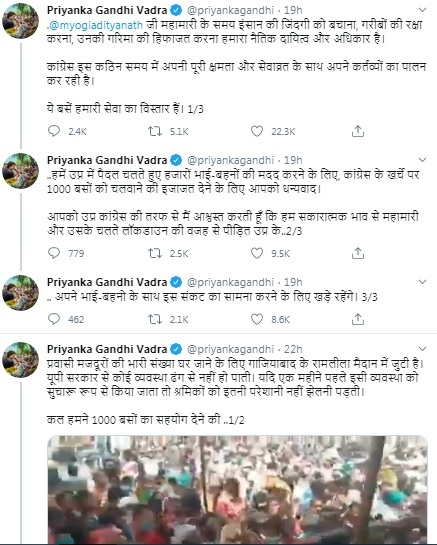
Priyanka Gandhi thanks UP govt for allowing offer of 1,000 buses to ply migrant workers home

Congress leader Priyanka Gandhi’s offer to ply 1,000 buses to transport stranded labourers and migrants in Delhi to their homes in Uttar Pradesh has been accepted by the UP government after dragging ts feet for over two days. The state Additional Chief Secretary Awanish Awasthi replied to Priyanka Gandhi’s private secretary accepting the offer and requesting more details including a list of the drivers and conductors.

In her May 16 letter soon after the tragic road accident when 25 migrants had died near Aurraiya, Congress general secretary Priyanka Gandhi wrote to CM Yogi Adityanath offering to bear the cost of 1,000 buses to transport migrants to UP. She said thousands of migrants from various parts of the country were walking down to their homes and 65 of them died on the road that was more than the COVID-19 tally in the state.

Priyanka Gandhi offered to provide 1,000 buses to transport migrants and bear the cost by the Congress Party and said 500 buses were being parked at Ghazipur border in Ghaziabad and another 500 buses at Noida. Amid adverse media reports, the UP Government has finally decided to give permission.

Earlier, Priyanka had deplored the poor mismanagement at Ghaziabad’s Ram Lila ground where a large uncontrollable crowd of migrants had gathered and were seen pushing each other, ignoring social distancing norms in the wake of coronavirus pandemic, to register to return home.

“If this exercise had started a month ago the migrants would not have had to undergo such hardship. I had offered 1,000 buses and had parked them at the UP border but the UP Government kept playing politics and did not give permission. The UP Government is not helping those hit by this pandemic and is neither allowing others to do it,” Priyanka had said in her earlier tweet.

After the approval of her request, she said, “The nation-building workers cannot be left like this to fend for themselves. The Congress party is committed to help them,” and thanked the state government for accepting the offer.

UP Police grabbed Priyanka Gandhi by neck, manhandled her, alleges Congress

When Indira Gandhi was insulted in the Lok Sabha in 1978, then Janata Dal did not realize that the person would return to power soon and that history repeats itself. On Friday, BJP-led UP government ignored this rule when its police turned violent against Priyanka Gandhi to stop her forcibly, allegedly manhandling her in a bid to stop her from visiting a retired IPS officer and an anti-CAA activist.

Priyanka Gandhi has alleged that she was manhandled by Uttar Pradesh Police personnel who grabbed her by her throat and pushed her when she tried to go to the house of retired IPS officer SR Darapuri on Saturday evening. Darapuri has been arrested in connection with the recent protests over the Citizenship (Amendment) Act (CAA).

Priyanka Gandhi

However, Priyanka Gandhi resisted the police and rode pillion on a scooter and reached the Indiranagar (sector-18) residence of Darapuri. Uttar Pradesh Congress spokesperson Ashok Singh told PTI that the Congress general secretary was stopped at the Lohia crossing and then she got down from her vehicle and started walking. Later, she got into her vehicle after a kilometre but again stopped in the Munshipulia area. She almost walked three kilometres to reach the residence of Darapuri.

After meeting Darapuri’s family members, Priyanka Gandhi said, “They do not have the right to stop me. If they want to arrest me, they should do so.” Uttar Pradesh Congress chief Ajay Kumar Lallu said, “This (UP) government is feeling scared of Priyankaji. Hence, she was stopped.”


However, UP Policewoman Archana Singh, who was blamed for the shocking episode later told higher officials in her report that she was heckled for stopping Priyanka Gandhi for deviating her route. She denied that she had manhandled Priyanka Gandhi but was performing her duty as fleet-in-charge officer.

The episode has now reached the National Human Rights Commission (NHRC), which may probe if not happy with the police version.