
AI threatens one in four jobs – but transformation, not replacement, is the real risk

One in four jobs worldwide is potentially exposed to what’s known as generative artificial intelligence – or Generative AI – according to a new joint study from the UN labour agency (ILO) and Poland’s National Research Institute. The study finds that transforming job descriptions, not widespread job loss, is the more likely result.

Generative AI (GenAI) refers to systems that can create content such as text, images, code or data summaries in response to user prompts. As such tools become more widely used, they are expected to reshape the tasks employees perform each day.

The new ILO-NASK index draws from nearly 30,000 real-world job descriptions using worker surveys, expert reviews and AI models to identify occupations most susceptible to AI driven change.

Few jobs consist of tasks that are fully automatable with current AI technology,” the authors write. “Transformation of jobs is the most likely impact of GenAI.”

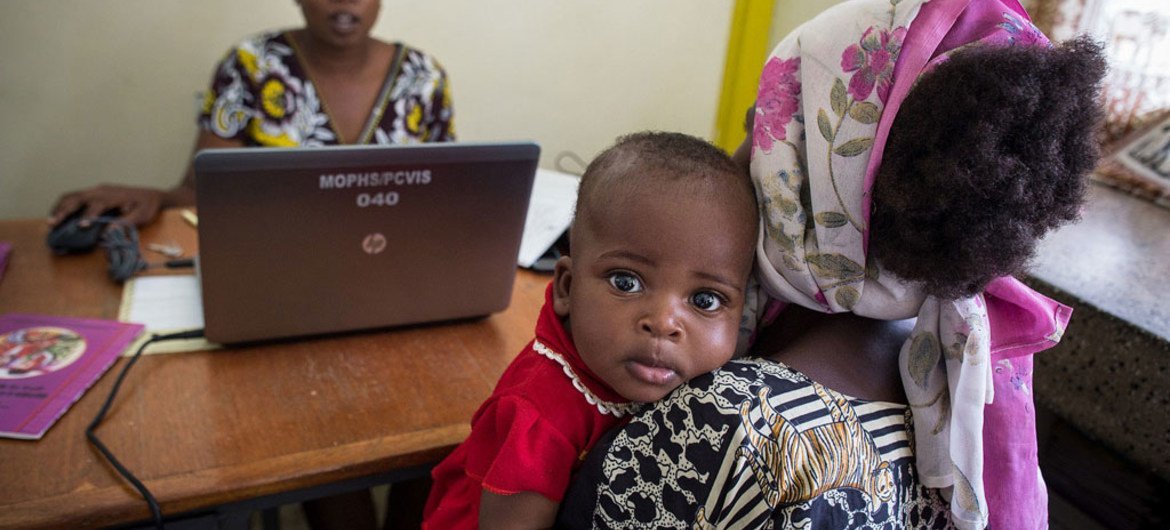
GAVI Alliance/Evelyn Hockstein

A baby has his general health recorded by a data clerk.

Women face disproportionate exposure

The study finds that in high-income countries, jobs considered at the highest risk of AI-driven task automation account for 9.6 per cent of female employment – nearly three times the share for men.

Worldwide, 4.7 per cent of women’s jobs fall into the highest-risk category, compared with 2.4 per cent for men.

This disparity is due largely to the overrepresentation of women in clerical and administrative roles, which are among the most exposed occupational groups.

These jobs often involve tasks such as data entry and document formatting and scheduling, functions that AI technologies can already perform efficiently.

While these roles are unlikely to disappear entirely, the report warns that partial automation could reduce job quality, leading to fewer responsibilities, stagnating wages and growing insecurity.

Without targeted training or role redesign, some workers – particularly women – may face limited opportunities to adapt.

A global, unequal picture

The report also identifies stark differences across regions. In high-income countries, 34 per cent of jobs are in occupations exposed to GenAI, compared to just 11 per cent in low-income countries.

Middle-income regions such as Latin America and parts of Asia fall somewhere in between.

Europe and Central Asia show the highest gender disparities, driven by high female employment in clerical roles and widespread digital adoption.

Regions such as sub-Saharan Africa, South Asia and the Arab States currently show lower overall exposure but could still experience significant disruption if AI technologies spread without safeguards.

The study cautions that lower exposure does not equal lower risk. In regions where digital access is limited or labour protections are weak, even small-scale automation could destabilise vulnerable sectors.

Turning insight into action

To ensure that the transition to generative AI supports rather than displaces workers, ILO urges governments, employers and workers’ organisations to act decisively.

Central to the recommended response is the need to strengthen access to digital skills and training, particularly for women and those working in clerical or administrative roles.

The agency also highlights the importance of integrating AI planning into broader labour market and education policies.

Preparing workforces for transformation will require not only technical training, but also supportive infrastructure, modernised curricula, and alignment between employers’ needs and national policies.

Inclusivity’s a must

At the heart of this transition, authors stress, must be inclusive social dialogue. Workers should have a say in how GenAI is introduced and used in the workplace, and their experiences must inform decisions about implementation.

Without this engagement, the risks of unequal outcomes, including widening gender gaps and declining job quality, will be much greater.

Finally, the report emphasises that regions with limited digital access must not be left behind. Expanding infrastructure and ensuring equitable access to technology are critical steps in enabling all countries to shape the future of work on their own terms.

Source link

2023’s first 15 days see 24K techies fired from jobs: Layoffs.FYI

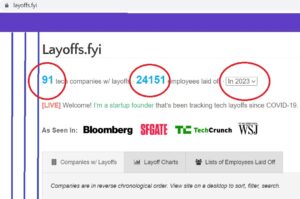
The year 2023 began on a bad note for tech workers globally and 91 companies have laid off more than 24,000 tech employees in the first 15 days this month, signaling worse days ahead, said job cuts tracker Layoffs.

About 24,151 tech workers lost their jobs, dominated by companies like Amazon, Salesforce, Coinbase and others, according to layoff tracking website Layoffs.fyi.

layoffs in 2023 so far

Crypto lending exchange Crypto.com last week announced that the company will reduce its global workforce by approximately 20 per cent amid ongoing economic headwinds and unforeseeable industry events.

In India, companies like Ola (which fired 200 employees), voice automated startup Skit.ai, dominated the headlines in January.In December last year, over 17,000 tech employees were shown the door.

According to the website which has been tracking job losses since the start of the pandemic, 153,110 workers were let go in 2022, led by companies like Meta, Twitter, Oracle, Nvidia, Snap, Uber, Spotify, Intel and Salesforce, among others.

The number of layoffs reached its nadir in November, which saw 51,489 tech workers lose their jobs.

Google is another Big Tech company expected to take harsh steps to reduce its headcount in early 2023. Approximately 6 per cent of Google employees could be sacked over “not having enough impact”, according to a report by The Information.

Google layoffs in 2023 could see as many as 11,000 employees lose their jobs. It means that 2023 is going to become the worst year in the history of the tech world. All eyes are now on the Big Tech quarterly results that will come out at the end of this month.

Crypto.com again fires hundreds of employees in 2nd round

Crypto lending exchange Crypto.com has laid off more employees in the second round and this time, the firing of employees is worse than the previous job cut, as the global crypto meltdown gets deeper.

According to a Decrypt report, the latest round of job cuts has not been announced publicly. During the call, “leadership expressed they had no intention of going public. Top management is unlikely to make an announcement as, after the June layoffs, they claimed that everyone’s job was safe, and that no more layoffs will happen,” the report said, citing sources.

According to the report, the Singapore-based company this time fired people from critical products like exchange, app and wallet. “The company is hiding the fact that they’ve laid off more than 1,000 employees even though they officially announced laying off 260,” a Crypto.com employee had said on LinkedIn.

“They’ve removed the company directory so we can’t see the numbers go down. It’s not good for morale to see that 1/3 of the invitation list on your next meeting is disabled accounts,” the employee had mentioned.

In June, Crypto.com announced it’s laying off around 260 employees, or nearly 5 per cent of its workforce. Its CEO Kris Marszalek said the company’s approach is to stay focused on executing against its roadmap and optimising for profitability.

“That means making difficult and necessary decisions to ensure continued and sustainable growth for the long term by making targeted reductions of approximately 260 or 5 per cent of our corporate workforce,” he had announced.

World Water Day 2016: Will Jobs Ever be Created?

As World Water Day is observed on March 22 since 1993 with the theme designated by the UN — "Better water, better jobs", several organisations such as UN-WATER and UN-HABITAT are organising the day officially on behest of the UN.

While the UN says that a billion people around the world still do not have access to safe drinking water, it has focused on creating more jobs related to water this year.

"Today, almost half of the world’s workers – 1.5 billion people – work in water related sectors and nearly all jobs depend on water and those that ensure its safe delivery. Yet the millions of people who work in water are often not recognized or protected by basic labour rights. The theme in 2016 — water and jobs — is focusing on how enough quantity and quality of water can change workers’ lives and livelihoods – and even transform societies and economies," it said.

The UN video on water revealed that half of all workers on Earth were employed in water-related sectors, though many of them were unrecognized and unprotected. The World Water Day is observed to create awareness about conservation and protection of water resources.

Also, a number of NGOs promoting water conservation, water harvesting and sustainable aquatic habitats organize activities to focus public awareness, attention and action on the local water issues.

Here are some key facts according to Water.org:

WATER


1 in 10 people lack access to safe water

SANITATION

1 in 3 people lack access to a toilet

WOMEN & CHILDREN

Women and children spend 125 million hours each day collecting water

DISEASE

Every 90 seconds a child dies from a water-related disease

ECONOMICS

Every $1 invested in water and sanitation provides a $4 economic return