

However, persistent nutritional gaps and mounting environmental pressures reveal a complex path ahead, according to a new study by the UN Food and Agriculture Organization (FAO) and the Organisation for Economic Cooperation and Development (OECD) – an influential international policy forum.
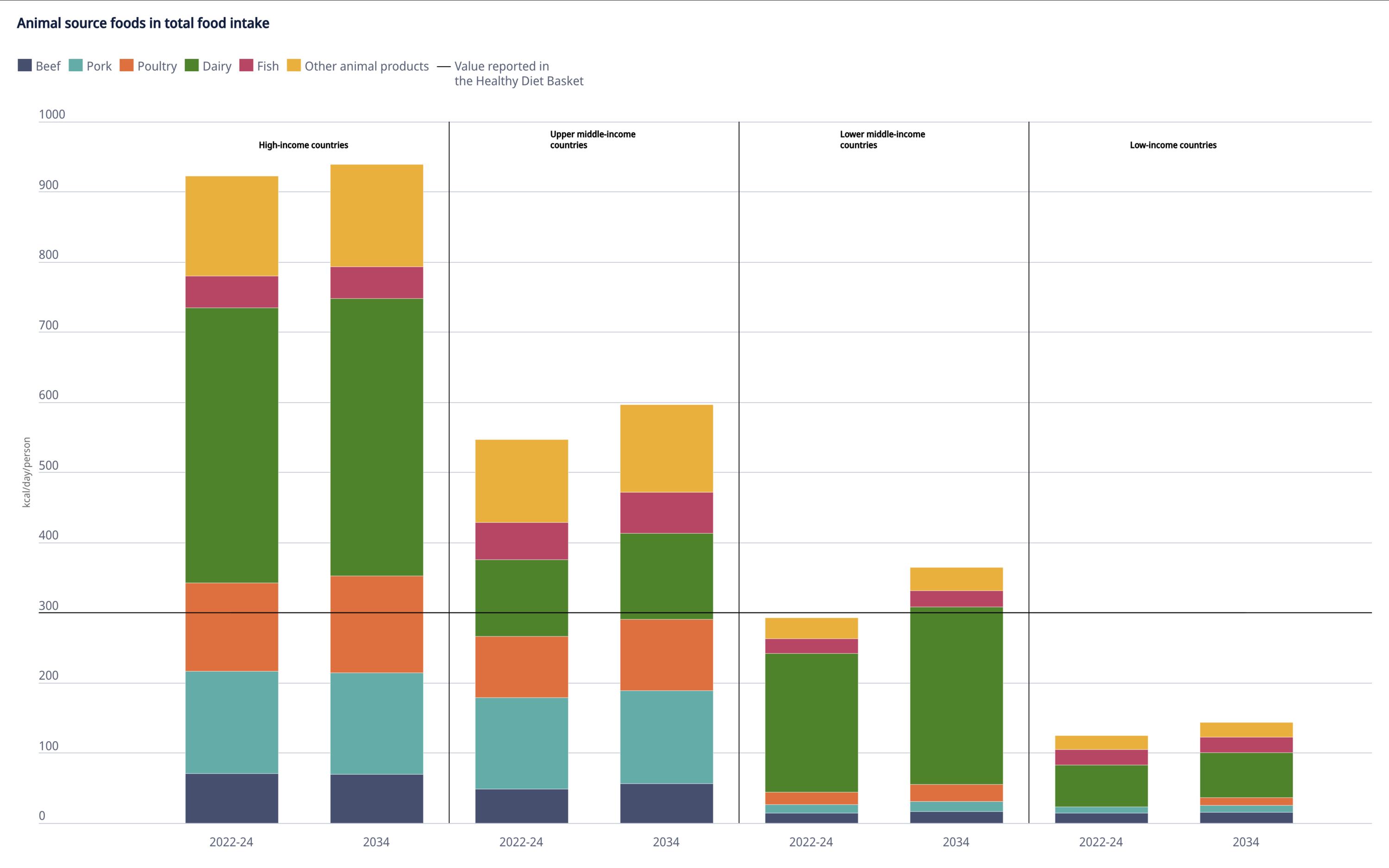
The Agricultural Outlook 2025-2034, released on Tuesday, projects a six per cent increase in global per capita consumption of animal-source foods by 2034 – beef, pork, poultry, fish, dairy and other animal products.
The trend is most pronounced in lower middle-income countries, where intake is expected to rise by 24 per cent, far outpacing the global average.
“These projections point to better nutrition for many people in developing countries,” said Qu Dongyu, Director-General of the FAO.


Agricultural Outlook 2025‑2034
Increased incomes, better diets – but not for all
The surge in consumption in middle-income economies is attributed largely to rising disposable incomes, changing dietary preferences and urbanisation. In these countries, daily per capita intake of animal-sourced foods is projected to reach 364 kilocalories, surpassing the 300 kcal benchmark.
At the same time, consumption in low-income countries will remain low – reaching just 143 kcal per day, less than half the amount deemed necessary for a healthy diet – highlighting stark inequalities in access to nutrient-rich diets and the challenges ahead to ensure everyone is food secure.
Mr. Qu urged greater efforts to ensure people in the lowest-income countries also benefit from improved nutrition and food security.
Production expanding but emissions rising
To meet rising demand, global agricultural and fish production is projected to increase by 14 per cent over the next decade, largely driven by productivity gains in middle-income nations.
Output of meat, dairy and eggs is expected to grow by 17 per cent, while total livestock inventories are projected to expand by seven per cent.
However, these gains come at an environmental cost: direct greenhouse gas (GHG) emissions from agriculture are set to rise by six per cent by 2034, despite improvements in emissions intensity.
As production becomes more efficient, the emissions generated per unit of output will decline, but the overall footprint will still grow unless additional measures are taken.

Agricultural Outlook 2025‑2034
Other key findings
- Cereal yields to grow 0.9 per cent annually, with harvested area expanding just 0.14 per cent per year – half the pace of the last decade
- By 2034, 40 per cent of cereals will go directly to human consumption, 33 per cent to animal feed, and the rest to biofuels and industry
- Biofuel demand set to rise 0.9 per cent annually, led by Brazil, India and Indonesia
- Sub-Saharan Africa’s beef herd projected to grow 15 per cent, though productivity remains just one-tenth of North America’s
- India and Southeast Asia will drive 39 per cent of global consumption growth by 2034; China’s share falling to 13 per cent from 32 per cent
- High-income countries to see drop in per capita fats and sweeteners intake due to health trends and policy shifts
A win-win: More nourishment, fewer emissions
The report outlines a scenario in which nourishment improves for all, and agricultural emissions are reduced by as much as seven per cent below current levels by 2034.
Achieving this dual outcome would require major investments to improve productivity, alongside widespread adoption of existing low-emission technologies such as precision farming, improved livestock feed and prioritising nutritional production.
Future progress will depend on a blend of policy coordination, technological innovation and targeted investments – especially in countries where the gap between demand and nutritional value is stark.
“We have the tools to end hunger and boost global food security,” said Mathias Cormann, Secretary-General of the OECD.
“Well-coordinated policies are needed to keep global food markets open, while fostering long-term productivity improvements and sustainability in the agriculture sector.”
Pivotal role for global trade
The Outlook also reiterates the importance of trade, given that 22 per cent of all calories eaten will have crossed international borders by 2034.
“International trade will remain indispensable to the global agri-food sector,” the report stressed.
“Multilateral cooperation and a rules-based agricultural trade are essential to facilitating these trade flows, balancing food deficits and surpluses across countries, stabilising prices and enhancing food security, nutrition and environmental sustainability.”