

An Indian-origin American who voted for Donald Trump and JD Vance has challenged the US Vice President over his rhetoric on skilled foreign workers, accusing the administration of scapegoating immigrants for problems it should be addressing itself.
Nivriti Agaram, a graduate of George Washington University, confronted Vance during a CBS News town hall, questioning his description of H-1B visa holders as “indentured servants” and raising concerns about the conduct of Immigration and Customs Enforcement (ICE).
Agaram told Vance that her first vote after becoming a US citizen went to the Trump-Vance ticket. She said her support was driven by concerns about border security, drugs and human trafficking, rather than a belief that immigrants were taking jobs away from American workers.
“After seeing ICE behave like military police and then you recently called H-1B visa workers foreign indentured servants — I think Americans are anything but safe,” she told Vance, asking why immigrants were being made scapegoats for problems the government should solve.
The exchange placed two contentious issues facing the administration in the same conversation: the treatment of immigrants by federal enforcement agencies and the role of foreign professionals in the American labour market.
Vance says criticism targeted companies, not H-1B workers
Vance acknowledged that his earlier rhetoric about H-1B workers had not been ideal, while arguing that his criticism was directed at employers who exploit the visa system rather than at foreign professionals themselves.
He described a practice in which companies recruit overseas workers while claiming that suitably qualified Americans are unavailable, then place those workers in employment arrangements that make it difficult for them to leave.
Vance said his use of the term “indentured servants” was intended to criticise companies that create such conditions, not to disparage every H-1B visa holder.
The distinction matters for Indian professionals because the H-1B programme is a major route through which US employers recruit skilled workers in technology, engineering, research and other specialised fields. India has historically accounted for a substantial share of H-1B beneficiaries, making changes in US immigration policy particularly consequential for Indian workers and their families.
However, employer dependence on immigration status, the threat of losing a job and uncertainty over the time required to secure permanent residency can create vulnerabilities for some foreign workers. The extent of those risks varies according to individual employment arrangements, immigration status and the protections available under US law.
Vance also invoked his family’s Indian connections, referring to the Indian origin of his in-laws, while rejecting the suggestion that his position amounted to vilification of immigrants as a whole.
He argued that the administration’s objective was to preserve social cohesion and manage the pace and scale of immigration.
“I don’t think it’s unreasonable for an American citizen to want to share their community with people they have something in common with,” Vance said, adding that the immigration system should reflect that preference.
His comments highlighted the tension within the administration’s position: distinguishing between opposition to immigration abuses and a broader argument that high levels of immigration can change American communities.
For H-1B workers, the practical question is whether proposed restrictions and enforcement measures will target demonstrable labour-market abuses or make it more difficult for employers to recruit foreign professionals generally.
Who is Nivriti Agaram?
Agaram is an Indian-origin US citizen who graduated from George Washington University. Her family moved to the United States around two decades ago, and she became a US citizen approximately five years ago. She said she voted for Trump and Vance in her first election as a citizen, citing border security and concerns about drugs and human trafficking. Her challenge to Vance reflects a distinction between supporting stricter border controls and endorsing every immigration enforcement practice or statement by the administration.

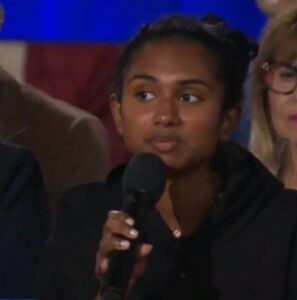
Niv Agaram
Agaram has also spoken publicly against ICE’s enforcement tactics. According to The Times of India, she travelled from Washington, DC, to Minneapolis to participate in protests against ICE. She told The Free Press at the time: “This is not the America I voted for.”
Her intervention at the town hall was notable because she questioned Vance from the standpoint of a former supporter rather than an opponent who had rejected the administration’s immigration agenda from the outset.
That distinction does not establish how widely her views are shared among Indian-American voters. It does, however, illustrate how immigration debates can divide voters who support border enforcement but object to what they see as excessive enforcement or sweeping rhetoric against immigrants.
For Indian professionals, the H-1B debate is not simply about whether foreign workers compete with American employees. It also concerns recruitment practices, job mobility, wage protections and the dependence of workers on employers for maintaining legal status.
Vance’s response sought to separate those concerns from hostility towards individual immigrants. Whether future policy measures follow that distinction will be more consequential than the wording of a single town-hall exchange.
For now, Agaram’s challenge has brought renewed attention to the competing claims at the centre of the debate: the administration’s promise to protect American workers, the vulnerabilities of some foreign employees and the role skilled immigration plays in the US economy.
FAQs
1. Who is Nivriti Agaram?
Nivriti Agaram is an Indian-origin US citizen and George Washington University graduate who challenged Vice President JD Vance over his comments on H-1B workers and immigration enforcement.
2. What did Agaram ask JD Vance?
She questioned his description of H-1B workers as “indentured servants” and asked why immigrants were being scapegoated for problems the government should address.
3. What did JD Vance say about H-1B visa holders?
Vance said his criticism was aimed at companies that exploit foreign workers and the visa system, rather than at all H-1B visa holders.
4. Did Agaram vote for Trump and Vance?
Yes. According to her remarks at the town hall, she voted for the Trump-Vance ticket in her first election after becoming a US citizen.
5. Why is the H-1B debate important to Indians?
Indian professionals represent a significant share of H-1B beneficiaries. Changes to the programme can affect recruitment, employment mobility and long-term immigration plans for Indian workers in the United States.