How Bengaluru’s costly metro, auto, taxi commute adds to peak housing options

Bengaluru’s expanding Namma Metro network offers commuters a faster and more predictable alternative to the city’s congested roads, but its relatively high cost and limited reach also add to the financial burden on residents.

Compared with Chennai, Delhi, Mumbai and Kolkata, Bengaluru has a smaller rail-based commuter network and lacks the extensive suburban railway systems that allow workers in those cities to live much farther from employment centres while keeping commuting costs relatively low.

For a commuter travelling about 15 km one way by Namma Metro, including an estimated cost for first- and last-mile connectivity, the monthly expense is around ₹3,520 for 22 working days. For someone earning ₹20,000 a month, that amounts to nearly 18% of monthly income. At a salary of ₹50,000, the same commute would account for about 7%.

Bengaluru has a smaller rail catchment

The difference becomes more pronounced when the distance between homes and employment centres is considered.

Mumbai, Kolkata and Chennai have long-established suburban rail networks that extend well beyond their core urban areas. Workers can live 50 km or more from central business districts and still commute by rail. Delhi’s extensive Metro network also connects the city with major parts of the National Capital Region.

Bengaluru’s rail network, by comparison, currently provides a much smaller practical commuter catchment. The metro connects areas such as Whitefield, Kengeri and Madavara with the city, but the rail-accessible distance from the core remains considerably shorter.

This has implications for housing. In cities with extensive suburban rail, workers can move farther from expensive central areas and still reach employment hubs at relatively low transport costs. Bengaluru’s smaller rail network gives commuters fewer such options.

Metro offers reliability, but at a premium

A comparison of monthly rail-based commuting costs for a 15-km one-way journey puts Bengaluru at roughly ₹3,520, compared with about ₹2,772 in Delhi, ₹2,200 in Chennai, ₹1,980 in Mumbai and ₹1,760 in Kolkata. The figures include assumptions about working days and last-mile connectivity and are therefore indicative rather than universal household expenses.

The underlying difference is partly historical. Mumbai and Kolkata inherited extensive suburban railway networks built decades before their modern metro systems. Chennai also has a long-established suburban rail network. These systems carry large numbers of passengers over long distances at comparatively low fares.

Bengaluru’s mass-transit infrastructure developed later and has relied heavily on Namma Metro. While the metro can provide more predictable journey times in a city known for severe road congestion, commuters bear a larger share of the cost through metro fares and connecting transport.

Road-based alternatives can be substantially more expensive. A 15-km daily commute by autorickshaw can cost more than ₹14,000 a month, according to the analysis, while app-based cabs and other road options also carry higher costs. A private car may cost around ₹6,000 a month when fuel, maintenance, depreciation, parking and other expenses are taken into account.

The comparison highlights a central trade-off for Bengaluru commuters: Namma Metro may not offer the lowest commuting cost among major Indian cities, but it provides greater predictability in a city where road congestion can make travel times highly uncertain.

Sasikala on comeback path, confident to lead AIADMK at appropriate time

Ousted interim general secretary of the AIADMK, V.K. Sasikala said that she was on a comeback path and will lead the party at an appropriate time. She also said that she and O. Panneerselvam were together and that she would soon visit the party headquarters in Chennai.

Sasikala in a statement on Friday said that the AIADMK would win all the Lok Sabha seats from Tamil Nadu in the 2024 general elections. The estranged leader said that the majority of the party cadres are with her and O. Panneerselvam and that she would soon be at the helm of affairs in the party.

The former aide of late Chief Minister, J. Jayalalithaa who was one of the most powerful figures in the AIADMK, said that the Chief Minister M.K. Stalin does not have any time for governance and was busy in photo shoots.

The former interim general secretary of the AIADMK said that the party cadres are for a change in the AIADMK and said that several leaders and cadres have approached her.

The powerful Thevar community, which has been a traditional support base for the AIADMK in South India, has been trying to bridge the gap between Sasikala and O. Panneerselvam who both are from the community. With O. Panneerselvam being targeted in the AIADMK, the Thevar community has been taking initiatives for an alliance between the two powerful Thevar leaders.

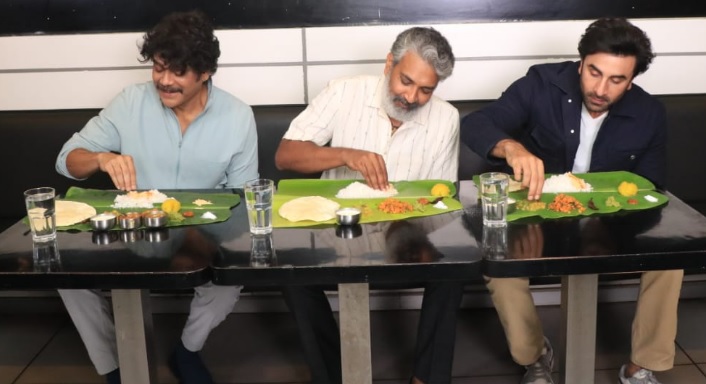
Ranbir shares South Indian Thali with Nagarjuna, Rajamouli in Chennai

Actor Ranbir Kapoor on Wednesday tried out a tasty south Indian meal along with ace director S.S. Rajamouli and Telugu superstar Nagarjuna, on the sidelines of promotion of Ayan Mukherji’s upcoming film ‘Brahmastra’.

Ranbi  tried the south Indian meal typically served on a plantain leaf in the traditional way.  Earlier, at a press conference called by the ‘Brahmastra’ team, Ranbir said, “I am so happy to share our vision of ‘Brahmastra’ with you. All of you are from a state that is so rich in culture, in music and performing arts. It is my privilege to be here.”

Brahmastra Promotional tour in Chennai

Ranbir remembered that “Brahmastra started for Ayan and me in 2013. We were doing a film called ‘Yeh Jawaani Hai Deewani’ and during one of the schedules in Manali, he came and told me that he had this idea of two friends (this was before ‘RRR’) one of whom had the power of fire and the other the power of water. Of course, the film didn’t turn out the way he thought at that time and it has turned out the way you guys are seeing it right now.”

He thanked his co-actors and said, “I had the honour of working with legends such as Amitabh Bachchan sir and Nag(arjuna) sir in this film.” Thanking Rajamouli, who is presenting the film, he said, “Never in my wildest dreams have I thought that I would have a poster with S.S. Rajamouli’s name and my face on it. That is such a big privilege. Thank you so much for this.”

Talking about Alia Bhatt, his wife and co-star in the film, Ranbir said she is one of the best actors he has ever worked with and he had the good fortune of finally marrying her.

“Alia is somebody whom I met on this film. Our romance started on this film’s set but by the time the film got over, we are married and expecting a baby also. So, you can really understand how long this journey has been,” the actor said, adding, “It is really an emotional moment for all of us.”

Construction of Visakhapatnam-Chennai Industrial Corridor

The 2nd meeting of Council of Trade Development and Promotion (CTDP) was held in New Delhi on 05.01.2017. Commerce & Industry Ministers of eight States who are Members of the Council, representatives of other 16 States and Heads of Trade Bodies like FIEO/ FICCI/ CII participated in the meeting.

During the course of the meeting, a reference about Chennai-Bengaluru Industrial Corridor came up for discussion from Government of Tamil Nadu. Government of Tamil Nadu requested for expediting detailed planning as well as the environmental impact assessment studies in respect of Ponneri Industrial Node for speedy implementation and also to keep the State Government closely associated at all stages of the project. The State Government also requested for adequate flexibility in the institutional structure for the governance of Industrial Nodes.

Delhi Mumbai Industrial Corridor Development Corporation (DMICDC), the nodal agency for Chennai-Bengaluru Industrial Corridor has already initiated the process for Master Planning of three identified Nodes, namely, Ponneri (Tamil Nadu), Krishnapatnam (Andhra Pradesh) & Tumkur (Karnataka).

This information was given by the Commerce and Industry Minister Smt. Nirmala Sitharaman in a written reply in Rajya Sabha today.

Post-Jayalalithaa, Tamil Nadu Braces Cyclone Vardah, Schools Closed

In less than a week after the demise of J.Jayalalithaa, Tamil Nadu is bracing for the worst storm on Monday, Dec. 12, called Cyclone Vardah with heavy rains and strong winds lashing the coast, forcing shut down of schools and cancellation of flights.

In Andhra Pradesh, the storm is feared to damage the paddy crops and orchards in Ongole and Nellore districts. Andhra Pradesh Chief Minister N Chandrababu Naidu reviewed the situation through teleconference on Sunday evening and advised the officials to keep food and other essential commodities ready.

The storm is likely to hit both Tamil Nadu and Andhra Pradesh coasts with the Indian Navy and the National Disaster Response Force on standby. The expected winds are in the range of 80 to 100 km an hour.

The government has not begun evacuation as the storm is expected to weaken by Monday afternoon. "Arrangements to be made for evacuating people in low lying and vulnerable areas. Relief centres to be kept in readiness along with necessary food, water and other arrangements. Army, Navy, Air-force and Coast Guard have been alerted to be on standby for deployment as and when necessary," a statement from the CM office said.

The Met office said the storm has weakened from very Severe to Severe storm. Already transportation was badly hit and 15 flights have been cancelled and 25 have been diverted so far with 9 of them reporting delay. All schools have been closed in coastal Tamil Nadu cities of Chennai, Kancheepuram, Tiruvallur, and Villupuram. Private firms have been advised to give a holidya to the staff or allow them to work from home on Monday.

The fishermen have been asked not to venture into the sea for the next 48 hours and people in low-lying areas have been advised to move to safer zones.

National Disaster Management Authority, in a tweet, asked people "to remain in safe places and cooperate with state government officials and disaster management agencies".

The Navy said it is ready with relief materials including additional divers, doctors, inflatable rubber boats, integral helicopters and relief material including food, tents, clothes, medicines and blankets to rescue more than 5,000 people.