From Cape Town to London, Deo Kato runs to challenge racism and reclaim the migration narrative

The 8,262-mile journey took him through 21 countries, transforming an extraordinary physical feat into a powerful act of activism, aimed at confronting racism and reshaping how migration is understood.

Born in Uganda and raised in the United Kingdom, Deo first took up running to manage his health. Over time, that personal discipline grew into a journey of purpose, connecting endurance with identity, protest and hope.

Turning point

In 2020, a moment of global reckoning around racial injustice – the murder of George Floyd in Minneapolis – became a turning point for Deo. He realised his running could serve a purpose beyond endurance.

 “I thought, ‘I have to do something about this. Whether it’s small or big, I want to use my running to create change and speak out against racial injustice,’” he explained. 

That conviction led him to run ten kilometres every day for 381 days, marking each day of the Montgomery Bus Boycott, a pivotal moment in the United States civil rights movement. 

He told himself, “I’m going to keep doing this for as long as I can because this is how change happens.”

Day after day, Deo pushed forward, turning physical endurance into a form of activism aimed at confronting racism and amplifying conversations around migration and justice.

Retracing migration routes 

From this commitment, Deo set out to run from Cape Town to London, symbolically retracing humanity’s earliest migration routes from Africa.

The road ahead was long and arduous. Scaling mountains, crossing deserts, and running through wildlife reserves, Deo moved through landscapes that constantly shifted around him. 

“It feels incredible just to be moving. Then, suddenly, I see elephants and children start running beside me,” he shared. 

Barriers and restrictions

Along the way, Deo witnessed how complex and restrictive migration can be, particularly for people displaced by climate impacts, economic pressure, or conflict. 

He saw how limited regular pathways and movement restrictions leave many people effectively unable to move within their own regions, trapping them in unsafe or uncertain situations and cutting off routes to safety.

“Some people end up detained simply for trying to flee conflict or because they are seen as outsiders. Even when they have the correct paperwork, they can still be held.”

The further I travelled along the migration route, the more I was viewed as an irregular migrant.

Deo himself faced similar barriers. At one point, he was detained despite having the correct documents. In other areas, he was forced to reroute his journey because of conflict or restricted access. 

As he travelled north towards Europe, the scrutiny intensified. 

“The further I travelled along the migration route, the more I was viewed as an irregular migrant. People would call the police simply because they saw someone they thought didn’t belong passing through their area,” he explained. 

Crossing some of the world’s most spectacular and unforgiving terrain, Deo experienced Africa on foot, where nature and movement shaped every mile of his journey.

Community support 

Despite the challenges, Deo’s journey was sustained by community support. Along the way, local runners, strangers, and online supporters joined him. Those moments of shared effort and solidarity kept him going. 

“Without that community support, I would not have succeeded on this journey. It’s what truly gave it meaning,” he said. 

His journey was never about endurance alone. It was about reclaiming the story of migration – a story rooted in resilience, human progress, and development. 

“People move for so many reasons, and each journey tells a human story,” Deo emphasised. 

Looking ahead, he plans to keep using his platform as a form of activism, continuing to speak about migration, belonging, and shared humanity. As he puts it, “Don’t limit yourself. Believe in your power to create change.”

Source link

‘The real challenge is still ahead’: UN warns on Afghan returnees

“The real challenge is still ahead of us,” Stephanie Loose, Programme Manager in Afghanistan, told journalists in Geneva on Friday.

We’re speaking about the reintegration of people who’ve lost their homes, who’ve lost their assets and also their hope.” 

Millions on the move

Afghanistan is currently facing an unprecedented returnee crisis. 

Since September 2023, some three million Afghans living in Pakistan and Iran were either deported or voluntarily repatriated, with over two million arriving so far this year.  For some, it’s not a return but a new start.

“Many in Afghanistan don’t have a place to go because they’ve never actually lived in Afghanistan,” Ms. Loose said.

“Sixty per cent of those who are returning now are below 18, so they don’t have any social ties, they don’t have any networks, and there is a real risk for them taking negative coping mechanisms.”

Concern for women and girls

Returnees are coming to a country under Taliban rule and where roughly half the population – 22.9 million people – requires humanitarian assistance amid economic, human rights and climate-related crises. 

Ms. Loose noted that Taliban edicts preventing women and girls from attending secondary school, getting a job, or going outside without a male chaperone, present a serious challenge to returnees.

“They’re being pushed back into a country where there’s no education for girls beyond 12, where they don’t actually know where to go, and where there’s actually specifically for women and girls no social and no economic development opportunities,” she said. 

“We also have women-headed households who return to the country. So, you can just imagine actually what it means to them. They cannot actually leave their houses without being accompanied by a mahram, a male guardian, even if they want to go and see a doctor.

Challenges to integration

She added that integration is likely to be further complicated by the high level of needs in Afghanistan, given the fragile political, economic and social situation, linked to more than four decades of conflict.

Afghanistan is also among the top 10 countries impacted by climate change, and droughts, floods and heatwaves have taken a toll on rural livelihoods. They also threaten people living in informal settlements in urban areas who account for up to 80 per cent of the population in these locations.

Given the scale of needs across Afghanistan, Ms. Loose stressed that rebuilding lives goes beyond emergency aid.

People need access to basic services, to water, to sanitation.  And overall, they do need livelihood opportunities…to lead their lives in dignity and to support their families,” she said.

International appeal

Reintegrating large numbers of displaced people will require huge efforts from the international community and the Afghan authorities, she said. 

It is a humanitarian crisis for individuals, but demands systemic, locally grounded approaches, and strong investment in basic services, infrastructures, housing solutions and livelihood opportunities,” she said.

Ms. Loose urged the international community not to forget about Afghanistan and its people, especially women and girls, and to ensure adequate funding is made available so that they can live in dignity. 

Source link

Plague of rats and insects provide latest challenge for war-shattered Gazans

One displaced woman told UN News’s correspondent in Gaza: “In all camps, we suffer from biting insects, especially fleas,” adding that “our children suffer from severe pain due to itching and stinging.

“We tried to treat it in simple ways, but the right medicines are not available at the medical centre.”

While biting insects found in Gaza are not immediately life-threatening, the presence of rodents, including rats, can increase the risk of the spread of infectious diseases which the health system in Gaza may be unable to treat.

Inadequate sanitation

The lack of adequate sanitation, including limited access to clean toilets, general overcrowding as people try to find places to live amongst the rubble of Gaza – and the challenges of removing rubbish from the streets – have amplified the threat posed by rats.

Teams from UNRWA, the UN agency which supports the people of Gaza, have initiated intensive clean-up operations as well as environmental and health awareness campaigns. The number of dermatology consultations in health facilities has also increased.

UNRWA workers are actively moving through tents for displaced people in Khan Younis in the southern part of the Gaza Strip spraying pesticides to counter the spread of insects, fleas and rodents.

Uncollected trash in Gaza is encouraging rats.

UNRWA teams have worked in approximately 50 displacement sites in the Mawasi area of ​​Khan Younis.

They have focused on locations where there is overcrowding, improper waste disposal, the presence of livestock and the lack of hygiene materials.

“Because of the intense heat and sleeping on the sand, we were exposed to biting insects, rodents, and mosquitoes,” said one resident as he watched an UNRWA environmental health officer spraying insecticides around temporary shelters.

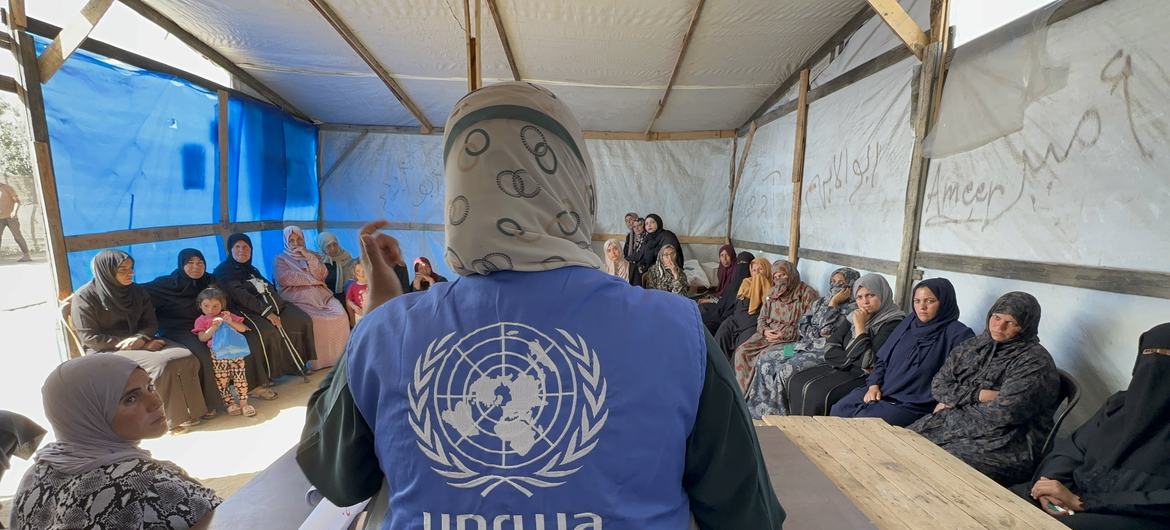
A doctor from UNRWA’s Environmental Health team explains to mothers how to treat insect bites.

Educational Sessions

In a nearby tent, a group of women gathered around awareness-raising instructors from the agency’s Environmental Health Office for an educational session on how to guard against insects and rodents.

The meetings target women, girls and adolescents to familiarize them with how to face this health challenge.

Meanwhile, Gaza continues to struggle since the 7 October 2023 attacks by Hamas on Israel precipitated the shattering conflict.

No humanitarian aid or supplies have entered the Gaza Strip since 2 March 2025, due to Israel’s total blockade.

UNRWA says vital humanitarian supplies, including food, fuel, medical aid and vaccines for children, are almost exhausted.

The agency warned that pesticide stocks are expected to run out within days in southern Gaza, while they have already run out in the central areas and north of the Strip.