Poshan Vatikas being set up across country to provide affordable access to fruits, vegetables, medicinal plants and herbs

Under various interventions taken up by the Ministry of Women and Child Development jointly with Ministry of Ayush, close to 4.37 lakh Anganwadi Centres have set up Poshan Vatikas. Additionally, so far, 1.10 lakh medicinal saplings have also been planted across some of the selected districts of 6 States.

Under ongoing Poshan Maah 2022, activities for setting-up nutri-gardens or retro-fitting Poshan Vatikas with backyard poultry / fishery units is being carried out in a big way across the country.

So far, more than 1.5 lakh events on retrofitting Poshan Vatikas with backyard poultry and fishery units have been reported. Also, more than 75 thousand sensitization camps have been conducted to promote millets and backyard kitchen gardens. Interestingly, to replicate the model of Poshan Vatikas at/around new AWCs, close to 40 thousand land identification drives for nutri-gardens/Poshan Vatikas have also been reported under Poshan Maah so far.

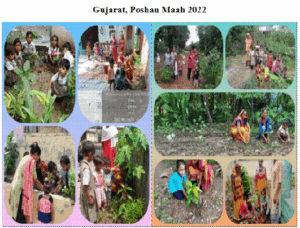
Poshan Vatikas or Nutri- gardens being set up across the country to provide easy and affordable access to fruits, vegetables, medicinal plants and herbs.

Launched on 8th March, 2018, by the Hon’ble Prime Minister, POSHAN Abhiyaan aims to improve nutritional outcomes for children, adolescents, pregnant women & lactating mothers.  The Abhiyaan is a key component of Mission Poshan 2.0 which seeks to address the challenges of malnutrition in children, adolescent girls, pregnant women and lactating mothers through a strategic shift in nutrition content and delivery and by creation of a convergent eco-system to develop and promote practices that nurture health, wellness and immunity.

A key plank of the goal to enable the right kind of nourishment are the Poshan Vatikas or Nutri-gardens that are being set up across the country to provide easy and affordable access to fruits, vegetables, medicinal plants and herbs.  The idea is simple; to provide a fresh and regular supply of locally produced fruits, vegetables and medicinal plants to women and children straight from a nutri-garden at or near an Anganwadi Centre.

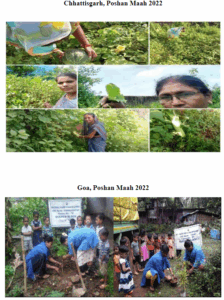
Poshan Vatikas or Nutri- gardens being set up across the country to provide easy and affordable access to fruits, vegetables, medicinal plants and herbs.

Poshan Vatikas can play an important role in enhancing dietary diversity by providing key micronutrients through local fruits and vegetables. Poshan Vatikas are a good example of convergent action on-ground. Beyond the reward of locally available wholesome produce, it will reduce external dependency and make communities atmanirbhar for their nutritional security.

Women in Jharkhand village launch campaign to stop tipplers from Bihar; Destroyed local breweries

Ranchi, Sep 14 (IANS) Peeved by the drinking habit of men coming from adjoining Bihar to villages of Jharkhand to consume liquor, women of a village in Jharkhand have embarked upon a unique liquor prohibition campaign where they stop such men from consuming liquor in their villages and have destroyed local breweries.

The liquor ban in Bihar has become a bane for many villages in Jharkhand.

Every day hundreds of group of men from Bihar cross over to the border areas of Jharkhand to consume liquor. Due to this the women living in villages across Jharkhand have decided to take up the onus upon themselves to protect their villages and banish such alcholic men from crossing over from neighbouring Bihar.

Women of Asnakoni village in Satgawan block of Jharkhand, located close to Nawada district of Bihar, have started guarding their village with sticks and wooden blocks to stop alcoholic men coming from outside the village outskirts. This campaign, which has been launched for the last one month has become the talk of the town.

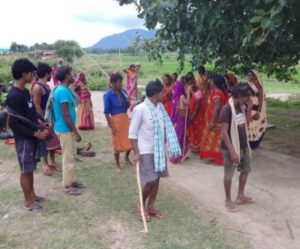
Women raised sticks to stop alcoholics coming from Bihar to Jharkhand’s border villages.

The women living in Asanbani village have also demolished half a dozen liquor breweries selling liquor illegally. Police are also helping the women of this village to keep this initiative alive. A meeting of men and women living in the village was held on the instructions of a self-help organisation in which it was decided that all people would form a group and guard the village border carrying sticks and logs all day and night. As a result, alcoholic men in Bihar dare to enter this village.

Similar to Asanbani village, now a meeting of locals is being held against liquor consumption in Danua and Chordaha villages as well as Chatra district of Chauparan in Jharkhand, adjoining Bihar’s Gaya district. In these areas too, locals have started a movement against liquor prohibition.

Asha Devi, one of the women leading the liquor prohibition campaign in Asanbani village, says that due to such men entering her village it has compelled the locals here to take such a step.

The situation was such that there used to be a gathering of alcoholic men coming from Bihar entering the village each day. Incidents of frequent scuffles and assaults had become common sight in the village which had an adverse impact on children and women.

alcohol

The locals living in Asanbani village warned those selling liquor illegally after which they demolished several liquor breweries selling liquor illegally.

Anita Devi, a Anganwadi centre social activist in Asanbani village, says the identity of her village had been tarnished due to such men entering her village from Bihar.

People have now started knowing this village by its original name Kalali Mod. She says that the locals living in her village also sought help from the police and district administration.

“Police station In-charge Uttam Baidya has also fully supported our campaign against liquor prohibition,” Anita said.

Local youth led by Manoj Dangi of a local self-help organisation have also come forward in this liquor prohibition campaign.

Last week, people travelling in a Bolero car, who had come to consume liquor from Bihar, got washed away in the Dhadhar river in Parsatari under Bhaghar panchayat in Chauparan, adjoining Bihar. Three drunk men in the Bolero car also drowned in the river and were rescued with the help of locals here. Now the people of this village are also running a campaign to stop miscreants coming from Bihar to consume liquor here.