Veteran Telugu Actor and Filmmaker Giri Babu Dies at 80 After Five-Decade Career

Veteran Telugu actor, filmmaker and producer Giri Babu passed away on Saturday, November 14, 2026, at a private hospital in Hyderabad. He was 80. Born Yerra Seshagiri Rao, the actor had been suffering from prolonged health complications and had reportedly been undergoing treatment in the city. His death marks the end of a career spanning more than five decades, during which he appeared in approximately 600 films and worked alongside several generations of Telugu cinema’s leading actors.

According to his son and actor Raghu Babu, Giri Babu had been battling Alzheimer’s disease, Parkinson’s disease and a lung infection for around three years. He had been bedridden for the last six months and was admitted to hospital four days before his death. His condition deteriorated on Saturday afternoon. His last rites are scheduled to be performed on November 15 in his native village of Ravinuthala, near Ongole in Andhra Pradesh’s Prakasam district.

From Theatre to a Career Spanning Over 600 Films

Born on June 8, 1946, in Ravinuthala village, Giri Babu developed an interest in acting during his childhood and began his journey as a theatre artiste. He eventually moved towards the Telugu film industry, making his screen debut with Jagame Maya in 1973. Although his early career included leading roles, he gradually established himself as a versatile performer, particularly through his portrayals of antagonists and supporting characters.

Over the years, Giri Babu demonstrated considerable range, moving between villainous, comic and character roles. His filmography includes notable productions such as Kurukshetram, Jyothi, Mallepoovu, Pasivadi Pranam, Hello Brother, Little Soldiers, Ninne Pelladata, Khadgam and Athadu. He also worked with prominent actors, including N. T. Rama Rao, Akkineni Nageswara Rao, Krishna, Chiranjeevi, Mohan Babu and Nandamuri Balakrishna.

His contribution to cinema extended beyond acting. Giri Babu ventured into film production in 1977 with Devathalara Deevinchandi. He subsequently produced films including Simha Garjana and Merupu Daadi. He also directed films such as Ranarangam (1985), Indrajith (1990) and Nee Sukhame Ne Korukunna (2008). His final reported film appearance was in the 2023 family drama Anni Manchi Sakunamule, directed by B. V. Nandini Reddy.

Film Industry Mourns the Veteran Actor

News of Giri Babu’s death prompted tributes from several prominent figures in the Telugu film industry. Actor Chiranjeevi expressed shock over his passing, remembering his contributions as an actor, producer and director. He described the loss as irreparable and extended his condolences to the actor’s family and admirers.

Actor Mohan Babu recalled his close personal association with Giri Babu, revealing that the two had shared accommodation during their early struggling days in Madras. He remembered their friendship and their subsequent collaborations in films. Nandamuri Balakrishna also paid tribute, recalling working with the veteran actor early in his own career, particularly in Annadammula Anubandham.

Giri Babu is survived by his sons Raghu Babu and Bose Babu, both of whom pursued careers in cinema, and a daughter. Raghu Babu went on to establish himself as a popular comedian and character actor in Telugu films.

With a filmography spanning approximately 600 productions, Giri Babu leaves behind a substantial body of work that reflects his versatility and enduring association with Telugu cinema.


Read More :

Tanker Colludes With Cruiser in Mississippi River Crash, Prompts $1 Million Port Suit

FAA Investigates Miami Taxiway Collision Between Copa and UPS Jets, Two Injured

Argentina Faces Recession Test in December GDP Report

When Argentina releases its third-quarter GDP figures on Dec. 16, a reading even slightly below zero would put the country in a technical recession. Economists surveyed by the central bank now expect a much larger decline: 2.3% from the previous quarter, compared with 0.9% in the preceding survey. The size of the drop, and whether household spending or business investment drove it, will help show how much ground the economy needs to recover.

Argentina’s national statistics agency, INDEC, reported that seasonally adjusted GDP fell 0.6% in the second quarter. A second consecutive quarterly decline would meet the usual definition of a technical recession. Output was still 2.0% higher than a year earlier in the second quarter. The two figures capture different periods: the quarterly comparison measures recent momentum, while the annual comparison shows where output stands relative to 2025.

The central bank published the survey on Nov. 5 after collecting responses from 45 consultancies, research centers and financial institutions. Those forecasters also expect GDP to rise 2.0% in the fourth quarter. Even if that rebound materializes, it would leave output slightly below its second-quarter level if the estimated third-quarter drop holds. The survey puts full-year growth at 0.7%, down from 1.5% in the previous round.

The weakening was already visible in July, when INDEC’s monthly economic activity index fell 2.8% from June. It rose just 0.1% in August, against a 1.5% median forecast in a Bloomberg survey, and was 1.7% below its level a year earlier. Bloomberg Economics’ Jimena Zúñiga said in October that the recovery in manufacturing and construction was “not nearly compelling enough to support the hope of avoiding technical recession.”

September data offer first test

INDEC will publish its economy-wide September activity estimate on Nov. 24. Individual sectors have already reported some gains. Construction activity rose 7.8% from August, seasonally adjusted, and was 5.1% higher than a year earlier. Factory output rose 0.7% on the month but remained 1.8% below September 2025. A stronger September could soften the quarterly decline. The November release will show whether the gains reached enough sectors to offset the weakness earlier in the quarter.

The central bank offered a more upbeat reading in its third-quarter monetary policy presentation. It attributed part of July’s weakness to temporary disruptions in natural gas supply to industrial users as cold weather raised household demand. It said “cyclical sectors may have begun to recover” in September and pointed to strength in export-oriented industries such as mining, agriculture and fishing. The December GDP breakdown will show how much those industries offset weakness elsewhere.

Household spending presents a tougher test. INDEC said wages rose 1.3% in September, below that month’s 1.9% inflation rate. Wages in the formal private sector rose 1.9%, while pay in the unregistered private sector fell 0.8%. Consumer prices then rose 2.2% in October. For President Javier Milei’s government, the GDP report’s private consumption figures will help show how households responded as purchasing power came under pressure.

The two dates answer different questions. The Nov. 24 activity report will show whether the economy was picking up speed as the quarter ended. The Dec. 16 release will measure output across the full quarter and show how consumption, investment and trade contributed. A late pickup could leave Argentina better positioned for the fourth quarter even if the three months through September mark a second straight contraction.

Tanker Colludes With Cruiser in Mississippi River Crash, Prompts $1 Million Port Suit

A federal judge authorized the seizure of the Atlantic Asphalt after the Port of New Orleans alleged that the tanker caused at least $1 million in terminal damage when it struck a docked cruise boat on the Mississippi River. Federal investigators have recovered the tanker’s voyage data recorder. Across the river from where the tanker was towed, the capsized American Heritage still holds an estimated 16,000 gallons of fuel that the Coast Guard plans to remove before the wreck can be moved.

Roughly 100 Pulled From Mississippi River

Everyone aboard both vessels survived Friday’s collision. Officials said 32 people were taken to hospitals, including two harbor police officers who went into the river when the cruise boat rolled. Eight remained hospitalized Saturday. The port initially reported about 129 passengers aboard, plus crew. Later accounts differed on the combined total. Mayor Helena Moreno put it at 191, while The Associated Press reported 197.

The port’s board filed suit Friday in the U.S. District Court for the Eastern District of Louisiana, naming the tanker, owner Nave Shipping SA and manager Thome Ship Management as defendants. The complaint alleges negligence and seeks compensation for repairs to the Thalia Street Terminal, cleanup and inspections. The court warrant gave federal authorities temporary control of the tanker while investigators worked to determine what happened.

Coast Guard Capt. Melanie Burnham said the tanker appeared to experience “some type of loss of steering” before impact. Investigators have yet to establish the cause. The recovered recorder captures the ship’s speed and audio from its bridge, giving investigators evidence to compare with crew accounts. National Transportation Safety Board member John DeLeeuw said a 16-member team would spend about a week in New Orleans. He expects a preliminary report within 30 days and a final report in 18 to 24 months.

The tanker struck at about 12:30 p.m. Friday. The American Heritage had been docked for about two hours and was finishing an eight-day Mississippi River cruise. About 87 people got off immediately after the impact, Moreno said. The riverboat then began to topple, sending passengers and crew into the water. Roughly 100 people were pulled from the river as tugboat operators, police and others rushed to help. “We have zero people unaccounted for,” Moreno said Friday.

Asphalt Tanker Built in 2017

Passenger Joe Knab told WDSU that he heard the tanker sound its horn before impact. He estimated that he spent 15 minutes in the river. “I thought I was drowning because I kept bobbing underneath,” he said. Harbor Police Chief Melanie Montroll credited the crew’s decision to put passengers in life jackets before the boat rolled, saying the flotation helped rescuers reach people in the water.

American Cruise Lines said Capt. Leonard Stewart stayed on the bridge as the boat capsized, radioing for help and keeping it alongside the dock as long as he could. The company said it was arranging flights and hotel rooms for passengers and crew. OSM Thome said the tanker’s captain immediately notified the Coast Guard and that the company was cooperating with authorities. It identified the Atlantic Asphalt as a Marshall Islands-registered asphalt tanker built in 2017.

The tanker was moved to Perry Street Wharf. A 500-foot safety zone remained around the American Heritage on Saturday as river traffic resumed under restrictions. Divers were expected to assess the hull, and pollution response crews were monitoring for leaks. Burnham said removing the riverboat could take weeks. “Our top priority now is the safe removal of the hazardous material on board the American Heritage,” she said. The wreck remained on its side against the terminal where passengers had been preparing to leave.

FAA Investigates Miami Taxiway Collision Between Copa and UPS Jets, Two Injured

A Copa Airlines passenger jet and a UPS cargo plane collided at a taxiway intersection at Miami International Airport on Saturday night after air traffic controllers instructed the UPS crew to give way, the Federal Aviation Administration said. Miami-Dade Fire Rescue treated two people for minor injuries at the scene. Neither needed to go to a hospital.

The collision happened at about 9:15 p.m. local time, according to airport communications director Greg Chin. Copa Flight 427, a Boeing 737-800 from Panama City, had landed about 15 minutes earlier and was taxiing to its gate. UPS Flight 358, a Boeing 767 freighter, was taxiing for departure to Bogotá, Colombia. The FAA said the Copa jet’s wingtip struck the nose of the UPS aircraft.

“Somebody hit us,” the Copa pilot radioed ground control, according to air traffic control audio reported by NDTV. A controller then asked the UPS crew whether the two aircraft had made contact. “Yeah, we went too far, and then he clipped us with the wing,” the UPS pilot replied. The Copa pilot later reported that the jet appeared to be missing its left wingtip. Photographs published by ABC News showed damage to the freighter’s nose.

All 172 Safe, 2 of Them Slightly Injured

Copa said the two people treated were passengers, according to aviation news outlet Aviacionline. The airline had 166 passengers and six crew members aboard. All 172 got off after the aircraft was towed to the gate. Copa said it would cooperate with investigators. UPS said its crew was safe and that the company was “committed to working with authorities to determine what happened.”

Miami International diverted aircraft onto other taxiways and reported no disruption to airport operations from the collision. The FAA’s preliminary account identifies the instruction to yield and the points of contact on the two aircraft. As of Sunday, the agency had yet to issue a finding on what caused the collision.

The collision came a day after a nationwide FAA ground stop, which had already disrupted travel through Miami. By 9 a.m. Saturday, more than 12 hours before the jets collided, FlightAware had logged 128 cancellations and 149 delays at Miami International, CBS Miami reported. The FAA had lifted the ground stop at about 8:15 p.m. Friday after more than four hours. Transportation Secretary Sean Duffy said the recovery would take time as airlines moved aircraft and crews back into position.

Federal officials attributed Friday’s stoppage to a communications outage affecting air traffic control centers. The FAA’s preliminary account of Saturday’s collision did not link it to that outage. Nationally, FlightAware recorded about 9,200 cancellations and 7,500 delays on Friday, Reuters reported.

By Saturday night, more than 6,400 of roughly 41,000 scheduled Saturday flights had been canceled, and more than 800 Sunday flights were already off the schedule, according to FlightAware figures reported by The Associated Press. FAA Administrator Bryan Bedford said Saturday that he expected airline schedules to be largely back to normal by late Sunday.

Trader Order Patterns Could Reveal Early Warning Signs of Stock Market Instability, Study Finds

Changes in how groups of traders place orders may offer early indications of stock market instability, according to a study by researchers from the University of Tokyo and Rikkyo University. The team found that fluctuations in the trading activity of certain market participants increased in the days preceding several periods of market turmoil.

Published in EPJ Data Science, the research applies a mathematical framework called Dynamical Network Markers (DNM) theory to trading data from the Tokyo Stock Exchange. The approach could eventually help financial authorities and stock exchanges identify emerging instability before it becomes visible through sharp price movements.

Mathematical theory originally developed for disease detection

Dynamical Network Markers theory was developed by Kazuyuki Aihara, a senior author of the study at the University of Tokyo, and his colleagues to identify changes associated with pre-disease states.

The theory examines interactions within complex systems and looks for changes in key elements that may indicate an approaching transition or instability. Researchers explored whether the same approach could be applied to financial markets, where traders, orders and transactions form interconnected systems.

To investigate this possibility, the team analysed order and execution data from the Tokyo Stock Exchange. They grouped anonymised virtual server IDs displaying similar trading activities to identify market participants and collected measurements of their activity at one-minute intervals.

Lead author Mariko Ito of the University of Tokyo explained, “Our insight into the Tokyo Stock Exchange was taken from market participants identified by grouping anonymized virtual server IDs that displayed similar trading activities. To assess a snapshot of participant activities, we gathered one-minute measures of data.”

Collective trading behaviour showed signs before market turmoil

The researchers examined trading activity from 186 anonymised market participants using data collected between late 2019 and 2020.

They focused on five days when the market experienced clear instability. In several instances, fluctuations in indicators representing the trading activity of certain participants increased in the days leading up to these events.

However, when researchers examined participants individually, they found no statistically clear early warning signs. The pattern emerged more clearly when the activities of groups of participants were considered together.

This suggests that potential signs of instability may be embedded in collective trading behaviour rather than the actions of individual market participants.

Order activity sometimes changed before conventional volatility measures

Previous research into financial market instability has often relied on aggregate indicators, including historical price movements. The University of Tokyo study instead examined the behaviour of market participants through their trading activity.

In some cases, fluctuations in group trading indicators increased before a market turmoil day, while lagged volatility, a conventional measure based on past price changes, rose only afterwards.

The findings suggest that order activity may contain information about emerging instability that is not immediately apparent from price movements alone.

However, the researchers cautioned that the approach is not yet capable of predicting sharp price changes with practical accuracy. External events can also influence markets and complicate the detection of warning signs. For example, during February and March 2020, repeated external shocks affected market conditions, but the researchers did not observe a clear increase in group-level fluctuations.

Researchers explore potential early warning applications

Despite these limitations, the team considers the findings an initial step towards developing tools that could help financial authorities and stock exchanges monitor market conditions more closely.

Corresponding author Yudai Honma of the University of Tokyo explained the motivation behind the research:

“My field is using mathematics to design systems that keep the flows in society moving smoothly. A stock market is also such a flow, with orders moving all the time,” he said. “Instead of looking for the cause after prices change sharply, we want to look for signs of instability in the flow of orders before that happens.”


Read More :

India Strengthens Global Diamond Industry Cooperation Ahead of Kimberley Process Plenary

SEBI Clears Overseas Digital KYC for NRIs From Dec 3, What You Should Know

Astronomers Identify Rare Binary Star System Producing Radio Pulses Every Eight Minutes

Astronomers have traced mysterious repeating radio signals from space to an unusual pair of stars located more than 5,000 light-years from Earth. The system, designated GPM J071507−114153, consists of a rapidly rotating white dwarf and a companion star similar to the Sun.

The discovery was made by researchers at the Curtin University node of the International Centre for Radio Astronomy Research (ICRAR). It marks the first time astronomers have detected radio pulses from a white dwarf orbiting a Sun-like star, offering new insights into a rare class of astronomical objects.

White dwarf and Sun-like star form an unusual pairing

The newly identified system contains two stars orbiting each other: a white dwarf, the dense core left behind after a star dies, and a G-type star comparable to the Sun.

The white dwarf produces radio pulses at intervals of approximately eight minutes. Such signals are associated with a class of astronomical objects known as long-period transients (LPTs), which emit radio waves intermittently over periods ranging from minutes to hours.

Around a dozen LPT systems have been identified since the first discovery by the same ICRAR research team in 2021. Although several previously identified systems contain a white dwarf and another star, astronomers have struggled to establish which star produces the radio emissions.

The latest observation provides clearer evidence by revealing the white dwarf’s movement as it orbits its companion.

“This is the first time the pulses are clear enough to see the white dwarf moving in its orbit around its companion, so we know that the pulsations are coming from a region close to the white dwarf, or possibly even from the white dwarf itself,” said lead author Dr Sam McSweeney, a commissioning scientist with the Square Kilometre Array Observatory (SKAO).

Radio signals reveal stellar activity thousands of light-years away

The researchers analysed more than 100 hours of radio observations using the Pawsey Supercomputing Research Centre to validate and understand the white dwarf’s orbital movement.

The observations also revealed activity on the companion star. Associate Professor Natasha Hurley-Walker, a co-author of the study, said the white dwarf’s radio pulses helped the team detect stellar flares on the Sun-like star. These flares are similar to the solar activity responsible for producing auroras on Earth.

The team also observed the white dwarf moving behind a region with a strong magnetic field, which they believe is likely to be a stellar prominence. Such structures are large loops of plasma that erupt from a star’s surface.

Hurley-Walker said, “It’s amazing that by using radio wavelengths we can detect the storms on a star over 5000 light-years away.”

Multiple observatories helped identify the star system

The discovery began with a large survey conducted using the Murchison Widefield Array (MWA), which scans the Milky Way visible from Australia. Researchers subsequently used South Africa’s MeerKAT radio telescope to establish the system’s precise location.

Optical observations from the W. M. Keck Observatory in Hawaii then confirmed its association with a G-type star.

The research involved several radio astronomy facilities that also serve as precursors to the Square Kilometre Array telescopes. These include the MWA at the CSIRO Murchison Radio-Astronomy Observatory in Western Australia and MeerKAT, operated by the South African Radio Astronomy Observatory.

Discovery offers a preview of future radio astronomy capabilities

The identification of GPM J071507−114153 adds to the growing number of known long-period transient systems and provides stronger evidence about the origins of their radio emissions.

Researchers expect future observations to help establish how these unusual stellar pairs generate their signals and how their magnetic environments influence the process.

Dr McSweeney said, “If we are already making such discoveries with precursor telescopes, just imagine how many more star systems we will be able to find, and what a beautifully detailed view of their signals we will have, once the SKAO telescopes are completely built.”


Read More :

X-Ray Observations Could Help Astronomers Predict Black Hole Jet Ejections Days in Advance

Graphene-Based Network Could Make Lithium-Ion Batteries More Powerful and Efficient

125,000-Year-Old Archaeological Site in Saudi Arabia Reveals How Early Humans Lived During a Greener Era

Archaeological discoveries at an ancient lakeside settlement in southern Saudi Arabia are offering new insights into how early humans hunted, processed plants and adapted to their surroundings around 125,000 years ago. Fossils, stone tools and preserved plant residues recovered from Uruq al-Julaybah near the ancient Mundafan lake provide an unusually detailed picture of human activity during a period known as Green Arabia.

The research was jointly conducted by the Saudi Heritage Commission, King Abdullah University of Science and Technology (KAUST) and Griffith University. Published in Science, the study brings together archaeological and environmental evidence to reconstruct life in the Arabian Peninsula during the last Interglacial period, when the region experienced warmer and wetter conditions.

Ancient Lake Mundafan supported a diverse ecosystem

Researchers used satellite-based terrain modelling to map the ancient lake, which covered approximately 340 square kilometres and reached a maximum depth of 29 metres. Analysis of sediments, landforms and aquatic remains indicated that it was a relatively stable freshwater body surrounded by vegetation and open grasslands.

The team documented more than 500 fossil specimens of plants and animals across over 130 locations. The animal remains included hippopotamuses, extinct long-horned buffaloes, camels, Arabian oryx, gazelles and ostriches.

These discoveries suggest that the lake supported a diverse ecosystem, providing early human populations with access to freshwater, vegetation, animals and raw materials.

Thousands of stone tools reveal hunting and plant-processing techniques

The archaeological survey recovered 5,511 stone tools measuring more than two centimetres from the main study area. Over 98% were made from flint, and researchers identified the use of Levallois techniques, a method of stone tool production involving carefully prepared cores.

Microscopic and chemical residue analyses revealed traces of various plants on the tools, including species containing toxic compounds. Residues of resin and woody tissue also suggested that some tools were used as hafted weapon tips, potentially attached to wooden shafts.

Other plant traces indicated that early humans processed tubers, bushes and palm leaves. These findings point to a range of activities involving food preparation, hunting equipment and everyday materials.

One particularly significant discovery was the potential use of toxic plant compounds in hunting technology. According to the researchers, this represents some of the earliest evidence of such practices recorded in Saudi Arabia. The site also contains some of the earliest evidence of palm-related vegetation in the region.

Evidence offers a detailed picture of daily life in Green Arabia

The researchers combined systematic archaeological surveys with two dating techniques applied to sand and fossil teeth. They also used three-dimensional stone tool refitting, alongside microscopic and chemical examinations of tool surfaces.

What makes Uruq al-Julaybah particularly important is that animal remains, stone tools and plant material were recovered together within a single dated archaeological context. This allowed researchers to connect environmental conditions with specific human activities.

The evidence indicates that people living near Lake Mundafan engaged in stone tool production, hunting equipment preparation, animal and plant resource processing, and fibre working. The availability of freshwater, vegetation and animal resources appears to have supported a variety of activities during the humid period.

Professor Frans van Buchem, KAUST Professor of Geology and co-lead scientist, said, “It is very exciting to see how the collaboration of so many different specialists allows to reconstruct this uniquely complete picture of life, behavior and the environment in the distant past.”

Dr Faisal Al-Jibreen, a Saudi Heritage Commission researcher and professor of Paleolithic archaeology, described the discovery in the sands of Lake Mundafan in the Empty Quarter as an important archaeological find that sheds light on the ancient environment and its relationship with humans and animals in southern Saudi Arabia’s early prehistory.

Discovery adds to understanding of early human movement across Arabia

Professor Chris Clarkson, co-lead scientist and Professor of Archaeology at Griffith University’s Australian Research Centre for Human Evolution, highlighted the significance of finding different forms of archaeological evidence together.

“This site gives us a rare and richly detailed view of how people lived in a landscape that looks nothing like Arabia today,” he said. “The combination of animal remains, stone tools and plant material in a single, dated context is what makes this discovery so significant.”

The research also contributes to wider efforts to understand how early human populations occupied and moved through the Arabian Peninsula as environmental conditions changed.

Professor Laurence Hapiot, co-author and Head of Heritage Research at KAUST, said, “Saudi Arabia has an exceptional archaeological heritage. Building Heritage Science capabilities in the Kingdom will enable us to turn the smallest traces into the biggest stories.”


Read More :

New Book Examines How the Vatican Opposed Nuremberg Trials and Helped Nazi War Criminals Evade Justice

Delhi Overtakes Lahore as World’s Most Polluted City, AQI Hits 403

Linköping University Develops Organ-on-a-Chip Model to Study How Cancer Interacts With Its Surroundings

Researchers at Linköping University in Sweden, in collaboration with scientists from Politecnico di Milano in Italy, have developed an organ-on-a-chip model that recreates how head and neck cancer interacts with surrounding blood vessels, nerves and tissue.

The system, which fits on a plate roughly the size of a postage stamp, allows researchers to examine tumour growth, invasion and responses to chemotherapy under controlled laboratory conditions. The findings have been published in the Proceedings of the National Academy of Sciences (PNAS).

Three-dimensional model recreates the tumour environment

Solid tumours do not consist solely of cancer cells. They interact with surrounding tissues, blood vessels and nerves, all of which can influence how cancer develops, spreads and responds to treatment.

To recreate these interactions, the research team built the model in three stages. The first involved developing a material that imitates the extracellular matrix (ECM), the network of proteins and carbohydrates surrounding cells in the human body.

The researchers used hyaluronic acid, collagen and laminins, which are important components of the natural ECM. They found that changes in the matrix composition significantly affected cancer cell behaviour and their response to chemotherapy.

This suggests that the material surrounding cancer cells is an important factor when designing laboratory models intended to replicate human disease.

Blood vessels reveal how cancer cells spread

In the second stage, the researchers introduced blood vessel-like structures into the chip. Blood vessels supply tumours with oxygen and nutrients, provide a route for cancer cells to spread to other parts of the body and transport anticancer medicines to tumour sites.

The team observed that cancer cells responded to nearby blood vessels by moving towards them and eventually invading them, representing an early step in tumour spread. However, their behaviour varied depending on the composition of the surrounding extracellular matrix.

The researchers also used the blood vessel structures to administer cisplatin, a chemotherapy drug commonly used to treat head and neck cancer. The effectiveness of the treatment varied with the type of ECM material surrounding the cancer cells.

Pierfrancesco Pagella, Senior Associate Professor at Linköping University and lead researcher, said, “We saw that the cancer cells responded to the nearby blood vessel, moved rapidly towards it and invaded it, which is the first step in tumour spread. However, the cells behaved very differently depending on the material surrounding them.”

Nerve interactions influence tumour growth

To complete the model, the researchers used stem cells to recreate trigeminal ganglia, structures associated with nerves responsible for sensation and pain in the mouth and face.

Within a few days, the nerves had grown around the tumours, allowing the team to examine how nerve interactions affected cancer behaviour.

The researchers found that tumours in contact with nerves were less likely to invade blood vessels but grew larger. This suggests that nerves can influence tumour development in more complex ways than simply providing pathways for cancer spread.

Pagella said, “In our three-dimensional system, we saw that tumours in contact with nerves were less likely to invade blood vessels, but at the same time grew larger. Our model enables us to study nerves as an active component of the tumour microenvironment. This is particularly interesting in head and neck cancer, where nerves are involved both in regulating tumour behaviour and aggressiveness, and in cancer-related pain.”

Potential applications in drug screening and treatment research

The researchers believe the organ-on-a-chip approach could be adapted to other solid tumour types where interactions with surrounding tissues and structures play an important role.

By allowing scientists to study cancer cells, blood vessels, nerves and the extracellular matrix within one controlled system, the model could help improve understanding of tumour behaviour and treatment resistance.


Read More :

Delhi Overtakes Lahore as World’s Most Polluted City, AQI Hits 403

New Book Examines How the Vatican Opposed Nuremberg Trials and Helped Nazi War Criminals Evade Justice

NPPA Orders Strict Monitoring of Revised Prices for 137 Anti-Cancer Drugs

The National Pharmaceutical Pricing Authority (NPPA) has directed State Drug Controllers to closely monitor the implementation of revised prices for 137 non-scheduled anti-cancer drugs, with the aim of ensuring that patients receive the benefits of reduced medicine costs.

The revised prices, introduced under the Trade Margin Rationalisation (TMR) framework, came into effect on November 9, 2026, following a Gazette Order issued on October 17, 2026. The NPPA operates under the Department of Pharmaceuticals.

The latest revised price lists, prepared using company submissions received up to November 11, 2026, are available on the NPPA website and through the Pharma Sahi Daam app and portal.

The authority has directed manufacturers, retailers, dealers, stockists, hospitals and medical institutions to comply with the revised prices. They must also prominently display the updated price lists at their premises and on their websites.

State Drug Controllers to monitor compliance

State Drug Controllers have been instructed to monitor manufacturers, medicine dealers, hospitals and medical institutions to ensure that the revised maximum retail prices (MRPs) are being followed.

The NPPA has warned that violations may lead to proceedings for overcharging under the provisions of the Drugs (Prices Control) Order, 2013 (DPCO).

State Drug Controllers have also been asked to submit their Action Taken Reports to the NPPA by November 16, 2026.

Patients can report overcharging and medicine shortages

Consumers can report complaints involving overcharging, shortages or the non-availability of medicines through the following channels:

The monitoring directive is intended to ensure that the revised prices are implemented across the supply chain and that patients benefit from the price changes.


Read More :

India Bans Export of Lithium-Ion Battery Black Mass to Boost Critical Mineral Recycling

Microsoft Outage Chronology: 24 Major Disruptions Since 2001 Reflect Vulnerability

CCPA Fines Ola ₹10 Lakh Over Pre-Ride Tip Prompts, Orders Platform to End Practice

The Central Consumer Protection Authority (CCPA) has imposed a penalty of ₹10 lakh on ANI Technologies Private Limited, which operates Ola, for asking passengers to make additional payments before their journeys were completed. The authority has directed the ride-hailing platform to immediately stop displaying pre-ride payment prompts, ruling that the practice amounts to an unfair trade practice and a dark pattern.

The order was issued by the CCPA, headed by Chief Commissioner Nidhi Khare and Commissioner Anupam Mishra, following an examination of Ola’s in-app payment feature. Although the company renamed the option from ‘tip’ to ‘add-on’, the authority found that the underlying practice remained unchanged.

CCPA finds additional payment prompts misleading

The authority examined different versions of Ola’s app interface, which displayed messages such as “Adding a tip might help increase the chances of getting a ride faster”, “Tip now to boost the chances of getting a ride sooner” and “Improve your chances of quicker ride confirmation!”

These prompts appeared while the app was searching for a driver, directly above suggested payment amounts. According to the CCPA, the wording created the impression that passengers could improve their chances of securing a ride quickly by paying extra. The use of qualifying terms such as ‘might’ and ‘chance’ did not change the overall impression.

The authority also examined Ola’s booking data for June 1-15, 2026. The figures showed that ride requests carrying an add-on were accepted less frequently than requests without one.

City With add-on Without add-on
Delhi 38% 62%
Bengaluru 40% 68%
Mumbai 39% 68%

The CCPA noted that Ola’s position was contradictory. While the company maintained that add-on payments did not influence ride allocation, its app suggested that paying extra could improve the likelihood of faster confirmation.

Passengers were also not informed about the lower acceptance rates recorded for requests carrying add-ons or how the suggested payment amounts were calculated. The authority held that withholding this information amounted to concealment of material information under Section 2(28)(iv) of the Consumer Protection Act, 2019.

Pre-ride tipping held to be an unfair trade practice

The CCPA observed that a tip is generally a voluntary payment made after a service has been delivered. Requesting it before a journey is completed effectively turns a voluntary gratuity into an additional pre-service payment.

The authority also identified several concerns with the feature:

  • Passengers had already booked rides at an upfront fare that accounted for factors such as peak pricing and the driver’s distance from the pickup location. Seeking another payment for the same supply constraints amounted to an additional premium.
  • Suggested add-on amounts were generated using an undisclosed method. They increased from ₹10-₹40 in May 2025 to as much as ₹140, while the interface allowed payments of up to ₹499.
  • Passengers could not independently verify whether an additional payment was necessary because information about driver availability remained under the platform’s control.
  • The prompts raised concerns about unfair contract terms by suggesting that an additional payment was needed for timely acceptance of an already-booked ride.

The authority further found that the practice violated Clause 14.15 of the Motor Vehicles Aggregators Guidelines, 2025, which provides for a tipping feature only after a journey has been completed.

The CCPA noted that Ola continued displaying the prompts even after the Ministry of Road Transport and Highways clarified on August 11, 2026, that such requests could not be displayed before the completion of a ride.

Under Section 2(47) of the Consumer Protection Act, 2019, unfair trade practices include deceptive methods and misleading representations about the benefits or usefulness of a service. The authority held that Ola’s payment prompts fell within this definition.

CCPA identifies ‘Confirm Shaming’ as a dark pattern

The authority also examined Ola’s interface under the Guidelines for Prevention and Regulation of Dark Patterns, 2023.

It found that displaying payment prompts while passengers were waiting for driver confirmation could create anxiety about whether their ride would be accepted. By suggesting that paying extra could improve the chances of securing a vehicle, the interface implied that passengers who declined might face delays or fail to get a ride.

The CCPA classified this practice as ‘Confirm Shaming’ under Clause 3 of Annexure 1 to the dark patterns guidelines.

Other interface elements that contributed to the finding included:

  • Pre-set payment amounts that anchored passengers to suggested figures.
  • The message “Generous Add On!” encouraging additional payments.
  • The absence of an option to close the prompt.
  • The timing of the prompt, which appeared after booking when passengers had limited information about driver availability.

The authority also noted that such payment requests appeared in bookings originating from hospitals, railway stations, inter-state bus terminals and airports. It identified patients, elderly passengers, travellers carrying luggage, people travelling alone and those travelling at night as potentially vulnerable to these prompts.

Ola ordered to remove pre-ride payment prompts

The CCPA has issued the following directions to ANI Technologies:

  1. Immediately discontinue all prompts, messages, pre-set payment amounts and interface designs that solicit payments beyond the upfront fare before completion of a journey. This prohibition applies regardless of whether the payment is described as a tip, add-on, additional fare or another term.
  2. Ensure compliance with the Consumer Protection Act, 2019, the Guidelines for Prevention and Regulation of Dark Patterns, 2023, and the Guidelines for Prevention of Misleading Advertisements and Endorsements for Misleading Advertisements, 2022.
  3. Pay a penalty of ₹10 lakh.

The authority has also initiated suo motu proceedings against other cab aggregator platforms over similar practices. It previously imposed a ₹10 lakh penalty on Rapido’s operator, Roppen Transportation Services Pvt. Ltd. Proceedings against Uber and Namma Yatri remain under investigation.


Read More :

New Book Examines How the Vatican Opposed Nuremberg Trials and Helped Nazi War Criminals Evade Justice

India Bans Export of Lithium-Ion Battery Black Mass to Boost Critical Mineral Recycling

Sony India Launches Lightweight FE 100-400mm Super Telephoto Zoom Lens for Wildlife and Sports Photography

Sony India has introduced the FE 100-400mm F5.6-8 OSS, a new super telephoto zoom lens for its full-frame Alpha E-mount camera system. Launched on August 20, 2026, the lens is aimed at wildlife photographers, sports enthusiasts, travellers and content creators seeking greater zoom capabilities in a portable design.

Weighing 654 grams and measuring 165.5mm in length, the lens offers a focal range of 100-400mm. It also supports optional teleconverters, extending its reach up to 800mm for photographing distant subjects.

Advanced optics designed for sharp images and smooth bokeh

The FE 100-400mm F5.6-8 OSS features two Extra-low Dispersion (ED) glass elements and two aspherical elements to maintain image resolution and contrast across the zoom range. This optical arrangement is designed to deliver sharp images from the centre to the edges of the frame.

Its nine-blade circular aperture produces smooth background bokeh, helping photographers separate subjects from their surroundings. The lens also supports close-up photography, with a maximum magnification of 0.41x and a minimum focusing distance of 0.86 metres.

These specifications make it suitable for capturing details in wildlife, nature photography and other situations requiring tighter framing.

Dual linear motors enable fast autofocus and stabilisation

The lens uses dual linear motors to provide fast, precise and quiet autofocus. The system is designed to track moving subjects, including birds, wildlife and athletes.

Built-in Optical SteadyShot (OSS) image stabilisation helps reduce camera shake during handheld photography, particularly when shooting at longer focal lengths. This allows photographers to capture sharper images without always relying on a tripod.

Sony has equipped the lens with several controls for easier operation in the field. These include a focus hold button, a focus-mode and focus-range switch, and a zoom lock switch.

Its dust- and moisture-resistant construction is intended to support use in challenging outdoor environments, making it suitable for travel and wildlife photography.

Recycled materials feature in lens construction

The new lens also incorporates recycled materials as part of Sony’s Road to Zero environmental initiative.

According to the company, recycled materials account for more than 41% of the total plastic weight used in the lens. This includes over 32% of the plastic in the lens barrel, more than 89% in the lens hood and over 88% in the lens caps.

Sony is also moving towards recyclable, non-plastic packaging materials. Plant-based non-woven fabrics are being used for product bags as part of this effort.

Pricing and availability in India

The Sony FE 100-400mm F5.6-8 OSS lens became available across India from August 20, 2026.

Customers can purchase it through Sony Centre outlets, Alpha Flagship stores, authorised Sony dealers and major electronics retailers. It is also available through e-commerce platforms, including Amazon and Flipkart.


Read More :

Delhi Overtakes Lahore as World’s Most Polluted City, AQI Hits 403

New Book Examines How the Vatican Opposed Nuremberg Trials and Helped Nazi War Criminals Evade Justice

Sony India Expands ULT POWER SOUND Range With Three New Tower Party Speakers

Sony India has expanded its ULT POWER SOUND speaker portfolio with three new models: the ULT TOWER 5, ULT TOWER 7 and ULT TOWER MAX. Announced on October 7, 2026, the second-generation lineup combines high-powered audio, enhanced bass technology and redesigned lighting systems for home parties and larger gatherings.

The new speakers feature DJ-oriented connectivity, karaoke functions and improved portability. The ULT TOWER 5 and ULT TOWER 7 come with built-in batteries, while the ULT TOWER MAX is designed for larger venues and operates without a built-in battery.

ULT TOWER 5 delivers 300W output in a portable design

The ULT TOWER 5 is designed for smaller gatherings and indoor or outdoor entertainment. It delivers 300W of sound output through a newly developed 230mm woofer, two tweeters and Sony’s ULT DUCT technology.

The speaker offers up to 20 hours of battery life under specified conditions and carries an IPX4 water-resistance rating. Four handles and support for vertical and horizontal placement make it easier to transport and position.

Its lighting system features 56 LEDs and three modes: Beat, Wave and Mellow. Sony’s Sound Field Optimization technology automatically adjusts audio output according to the surrounding environment.

Connectivity options include Bluetooth 5.3, USB-C, USB-A, RCA, XLR input and output, and a microphone input. The model also supports DJ input, karaoke, Party Chain by AuraCast and Stereo Pair functions. A low-latency digital signal processing system is intended to improve wireless audio performance.

The ULT TOWER 5 measures 358 × 534 × 280mm and weighs 12.7kg.

ULT TOWER 7 offers 420W output and 360-degree sound

The ULT TOWER 7 is the flagship battery-powered model in the new lineup, delivering 420W of sound output. Its audio system combines a 280mm woofer, rear tweeter, ULT DUCT technology and a front-and-rear arrangement of two midrange drivers and four tweeters.

The speaker supports LIVE Sound and a 10-band equaliser, alongside ULT1, ULT2 and LIVE FLAT sound modes. These features are designed to deliver deep bass and distribute sound across a wider area.

It also includes an updated lighting system with 72 LEDs, nine times the number featured in its predecessor, according to Sony. Other features include IPX4 water resistance when positioned vertically, four handles and upgraded rear wheels for easier movement.

For party hosts and DJs, the ULT TOWER 7 offers XLR/RCA DJ input, USB-C connectivity, wired multi-speaker chaining and karaoke controls for microphone volume and echo. Its battery can provide up to 30 hours of playback.

ULT TOWER MAX targets large-scale parties with 2,150W output

The ULT TOWER MAX is the most powerful model in the new range, with a claimed power output of 2,150W. Its speaker arrangement includes three 280mm woofers, two midrange drivers and four tweeters, supported by ULT DUCT technology.

The system is designed to deliver 360-degree sound and powerful bass. It includes ULT1, ULT2 and LIVE FLAT modes, a 10-band equaliser and Sound Field Optimization technology that adjusts output according to surrounding conditions.

The ULT TOWER MAX also features 100 LEDs, compared with the 34 LEDs on its predecessor, the TOWER 10. Its design includes four handles, side wheels, a splash-resistant top panel and support for both vertical and horizontal placement.

Connectivity and entertainment features include XLR/RCA DJ input, USB-C, wired multi-speaker connections, stereo pairing and karaoke controls. Users can adjust microphone volume and echo through the rear panel or the companion app.

Unlike the other two models, the ULT TOWER MAX does not include a built-in battery.

Launch offers, pricing and availability

Sony India has announced promotional offers across all three speakers:

  • ULT TOWER MAX: A dual wireless microphone set worth ₹19,990, along with cashback of up to ₹15,000.
  • ULT TOWER 7: Cashback of ₹4,999.
  • ULT TOWER 5: Cashback of ₹3,000.

The ULT TOWER 5 and ULT TOWER 7 became available from October 8, 2026, while the ULT TOWER MAX is scheduled to go on sale from November 15.


Read More :

Microsoft Outage Chronology: 24 Major Disruptions Since 2001 Reflect Vulnerability

Delhi Overtakes Lahore as World’s Most Polluted City, AQI Hits 403

Microsoft Outage Sends Japan Back to 80s as Fax Machines’ Era Revived

Japan’s long-standing attachment to fax machines, often criticized as a symbol of the country’s slow transition to digital technology, has acquired fresh relevance after a worldwide Microsoft outage forced businesses to reconsider how they communicate when modern cloud systems become unavailable.

The November 12–13 disruption affected Microsoft Outlook, Teams and other Microsoft 365 services, interrupting corporate communications across dozens of countries. Financial institutions, multinational companies and public agencies scrambled to find alternative ways of exchanging documents, confirming transactions and coordinating operations.

The episode has revived an uncomfortable question for governments and businesses that have spent billions replacing paper-based processes with cloud platforms: Could the technology they abandoned provide a measure of resilience when their digital infrastructure fails?

The irony is particularly striking in Japan, where fax machines have survived decades of technological change and remain associated with business paperwork, administrative procedures and traditional office practices.

But the distinction between resilience and technological nostalgia is important. A fax machine may provide an alternative way to transmit a document, but it cannot replace an entire cloud-based business system. Its usefulness depends on functioning telecommunications networks, access to physical equipment and established procedures for handling sensitive information.

The Microsoft outage nevertheless illustrates why the disappearance of older communication methods can create new operational vulnerabilities when organizations have no independent alternatives.

Japan’s Digital Transformation Meets an Analog Reality

Japan’s experience was especially revealing because the country has spent years trying to reduce its reliance on fax machines, paper documents and physical administrative procedures.

On Friday morning, Japanese employees arriving at work encountered error messages instead of their usual email inboxes. Meetings were postponed, correspondence was interrupted and some workers were unable to perform routine tasks.

One employee described the confusion on social media: “I couldn’t open Outlook and panicked … I got in touch with my boss and was told to stay home,” according to The Japan Times.

The problems reached Japan’s government. Deputy Chief Cabinet Secretary Masanao Ozaki confirmed that the disruption had affected government IT infrastructure, including services used by public employees.

Financial institutions also faced difficulties. Japanese securities firms and asset managers reportedly used fax machines and other alternative methods to confirm transactions when email services failed. Some investment trust benchmark-price announcements were delayed, according to reporting attributed to Nikkei.

Credit Saison reported delays in responding to customer inquiries, while Kyushu University and Waseda University were among educational institutions experiencing disruptions.

Japan’s exposure to Microsoft is considerable. A 2025 survey by technology publication Keyman’s Net found that more than 78% of responding companies used Microsoft products. That figure illustrates widespread adoption among surveyed businesses, rather than a measured share of all Japanese companies.

Japan’s government has repeatedly sought to eliminate administrative practices requiring faxed documents, physical seals and paper-based submissions. Its Digital Agency, established in 2021, was intended to accelerate the modernization of government services.

Yet the latest outage demonstrated that digitalization does not necessarily eliminate the need for independent communication channels.

For some organizations, fax machines remained available precisely because they had never been completely removed from offices.

Unlike cloud email, a conventional fax machine can transmit documents through a functioning telephone connection without depending on Microsoft’s servers. That independence can be useful during a cloud outage, although modern internet-based fax services may share some of the same vulnerabilities as other digital systems.

Fax Machines Return to Financial Trading

Japan was not alone in rediscovering older communications technology.

In Taiwan, a financial institution resorted to fax machines to confirm purchases and sales of short-term bills after its normal email systems became unavailable, Reuters reported.

Another financial institution canceled a bond repurchase transaction, while securities firms, life insurers and investment trust companies experienced interruptions to fund-management activities.

Foreign financial institutions were particularly vulnerable because many depended on Microsoft email systems to exchange information with overseas headquarters.

The problems spread to major financial centers elsewhere. Euronext instructed listed companies to communicate by telephone when email services became unreliable. British insurer Aviva used backup telephone arrangements and Bluetooth transfers to maintain communications around its earnings announcement.

Danish shipping group Maersk urged customers to telephone representatives about urgent matters.

The improvised responses demonstrated that even multinational companies with sophisticated IT departments sometimes needed relatively simple communication methods to maintain essential business functions.

“The pressure is mounting to invest in contingency plans and test whether those backups actually work when needed,” said Paolo Pescatore, an analyst at PP Foresight.

The financial consequences remain difficult to calculate. Downdetector recorded more than 7.4 million outage reports worldwide, while insurance ratings agency Morningstar DBRS estimated potential insured losses of $300 million to $500 million.

Microsoft attributed the disruption to server problems and said it had found no evidence of malicious activity. The company reported improving service stability on Friday after deploying additional fixes.

The return of fax machines does not establish that paper-based systems are superior to digital communications. Fax transmissions can be slow, difficult to audit and vulnerable to confidentiality problems if documents are sent to incorrect numbers or left unattended.

But Japan’s experience has exposed a weakness in the assumption that replacing older technologies automatically makes organizations more resilient.

Modern cloud systems offer enormous advantages in speed, scale and efficiency. Their vulnerability arises when too many critical activities depend on a single provider or closely interconnected infrastructure.

For Japan, the episode presents an unusual dilemma. The country has been criticized for retaining outdated office technology while simultaneously pursuing an ambitious digital transformation. Yet some of those older systems provided a useful fallback when modern communications failed.

The challenge now is not whether Japanese businesses should return permanently to fax machines. It is whether governments, banks and corporations should preserve independent backup channels capable of functioning during major technology outages.

The Microsoft disruption has given that debate new urgency. In an economy increasingly dependent on cloud computing and artificial intelligence, Japan’s aging fax machines have offered an unexpected reminder that technological progress and operational resilience are not always the same thing.

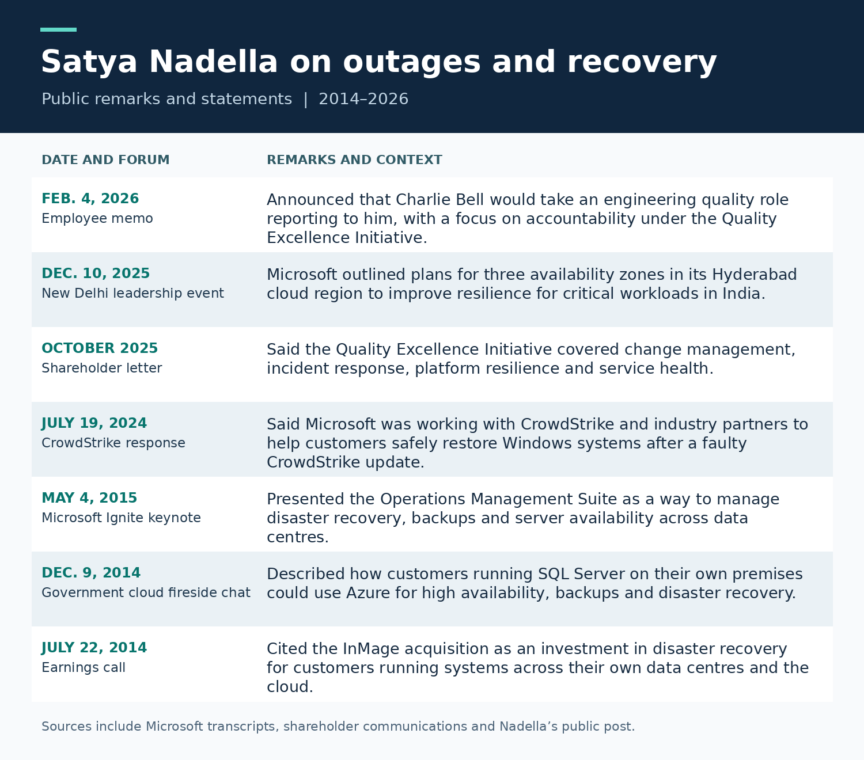
What Satya Nadella Has Said About Microsoft Outages and Recovery

Microsoft’s Outlook, Teams and Copilot services were disrupted on Nov. 12, 2026, in a Microsoft 365 outage that stretched into Friday business hours across Asia-Pacific, including India. Microsoft reported a partial recovery as it worked to stabilise affected servers. Downdetector logged more than 130,000 U.S. reports of Outlook problems at the peak.

The Microsoft outage affected services that rely on Exchange Online, Microsoft’s cloud email and calendar platform. Some Outlook users struggled to open their mailboxes or receive email, while Teams users encountered problems viewing calendars, scheduling meetings and sending invitations. Most Teams calls, meetings and group chats remained available, Microsoft said. A separate Teams chat outage earlier on Thursday lasted 68 minutes and caused delayed or failed messages for some users whose connections were hosted in or routed through North and South America.

The latest episode is among 24 major disruptions since 2001 to 2026. In January 2001, a router configuration change made Microsoft.com, MSN.com and other company websites unreachable. A decade later, a domain-name system problem disrupted Office 365, Hotmail and SkyDrive for several hours. Early Azure failures included a leap-day software bug in 2012 and an expired security certificate that disrupted secure connections to cloud storage worldwide in 2013.

More recent incidents show how a failure in shared infrastructure can affect several products at once. In January 2023, a network outage disrupted Azure, Teams and Outlook worldwide. An October 2025 configuration change in Azure Front Door, Microsoft’s global traffic delivery service, also disrupted Microsoft 365. In January 2026, another Microsoft 365 outage affected Outlook email and the creation of Teams chats and meetings. The chronology also covers consumer disruptions, from intermittent Xbox Live failures over the 2007 holiday period to the 2009 Sidekick server failure.

The published earnings-call transcripts from Oct. 29, 2025, the day of the Azure Front Door outage, and Jan. 28, 2026, six days after the Microsoft 365 outage began, contain no discussion by Nadella of those incidents. For the chronology, attribute the causes, recovery timelines and fixes to Microsoft’s service notices or engineering reviews.

Microsoft Outage Chronology: 24 Major Disruptions Since 2001 Reflect Vulnerability

A Microsoft 365 outage disrupted Outlook, Teams and Copilot on Thursday and continued into Friday business hours across Asia-Pacific, including India. Microsoft reported a partial recovery as it worked to stabilise affected servers.

The chronology below covers 24 major disruptions from 2001 to 2026, spanning Microsoft’s websites, email, gaming and cloud services. The incidents ranged from a router configuration error that took company websites offline in 2001 to failures in Azure and Microsoft 365 that disrupted work for businesses and government agencies. Microsoft reported a partial recovery on Friday as it worked to stabilise servers.

Here are selected major outages across Microsoft’s cloud, workplace and consumer services, most recent first.

Nov. 13, 2026 — A Microsoft 365 outage disrupted Outlook, Teams and Copilot on Thursday and continued into Friday business hours across Asia-Pacific, including India. Microsoft reported a partial recovery as it worked to stabilise affected servers.

Here are selected major outages across Microsoft’s cloud, workplace and consumer services, most recent first.

Nov. 12–13, 2026 — The Microsoft 365 outage disrupted access to Outlook mailboxes and affected Teams calendars, invitations and meeting scheduling. Most Teams calls, meetings and group chats remained available, Microsoft said. An earlier Teams chat outage affecting users routed through North and South America lasted 68 minutes.

Sept. 30–Oct. 1, 2026 — Azure customers in multiple regions experienced intermittent connectivity and network management failures affecting services including Azure Firewall, VPN Gateway and ExpressRoute Gateway.

Jan. 22–23, 2026 — Microsoft 365 users reported problems sending and receiving Outlook email and creating Teams chats and meetings. Microsoft said on Jan. 23 that it had restored access to its productivity suite.

Oct. 29, 2025 — A configuration change in Azure Front Door, Microsoft’s global traffic delivery service, caused errors and timeouts for Azure customers and disrupted Microsoft 365. Microsoft said it restored services later that day.

Nov. 25, 2024 — A Microsoft 365 outage disrupted Outlook and Teams, prompting thousands of user reports to outage tracker Downdetector.

Sept. 12, 2024 — Microsoft said its productivity suite recovered after a disruption that generated more than 90,000 U.S. reports for Microsoft 365 on Downdetector. The tracker also recorded a rise in reports for Azure, Teams and Xbox.

July 30, 2024 — Azure Front Door and Microsoft’s content delivery network suffered connection errors and timeouts across multiple regions. Microsoft said a network misconfiguration following its response to a denial-of-service attack caused congestion and disrupted some Microsoft 365 services.

July 18–19, 2024 — An Azure Storage failure disrupted cloud services in Microsoft’s Central U.S. region. In a separate incident on July 19, a faulty update from cybersecurity company CrowdStrike crashed an estimated 8.5 million Windows devices.

June 5–9, 2023 — Denial-of-service attacks disrupted Microsoft services including Outlook webmail. U.S. prosecutors later alleged that members of the group Anonymous Sudan were behind the attacks.

Jan. 25, 2023 — A network outage disrupted Azure, Teams and Outlook worldwide. Microsoft said it restored its cloud services that day.

July 21, 2022 — A global Teams outage disrupted the workplace messaging app for several hours. Microsoft said it restored access for most users.

April 1, 2021 — A Domain Name System (DNS) problem caused intermittent access failures for Azure, Dynamics and Xbox Live for about an hour.

March 15, 2021 — An Azure Active Directory outage prevented some users from signing in to Teams, Office, Dynamics, Xbox Live and the Azure portal.

Sept. 28–29, 2020 — An Azure Active Directory failure disrupted sign-ins to Microsoft and third-party services that relied on it, including Teams and OneDrive.

May 2, 2019 — A DNS configuration problem disrupted Azure connectivity and affected cloud computing, storage and database services.

Sept. 4, 2018 — Severe weather knocked out cooling at an Azure data centre in Texas, disrupting dozens of cloud services.

March 21, 2017 — Users reported problems with Outlook.com, Azure, Office 365, Skype and Xbox Live during a disruption across Microsoft’s online services.

Nov. 18, 2014 — An Azure Storage performance update reduced capacity and interrupted services including Azure Virtual Machines.

Feb. 22, 2013 — An expired security certificate disrupted secure connections to Azure Storage worldwide.

Feb. 29, 2012 — A leap-day software bug prevented parts of Windows Azure from generating valid security certificates, disrupting cloud computing services.

Sept. 8–9, 2011 — A DNS problem disrupted Office 365, Hotmail and SkyDrive for several hours, less than three months after Microsoft launched Office 365.

October 2009 — A server failure at Microsoft’s Danger unit disrupted T-Mobile’s Sidekick service. T-Mobile warned that some customers could lose contacts, calendar entries and photos stored on the servers.

December 2007–January 2008 — Xbox Live users experienced intermittent sign-in, account recovery and matchmaking problems over the holiday period. Microsoft cited record sign-ups and usage.

Jan. 24, 2001 — A router configuration change disrupted Microsoft’s domain-name infrastructure, making Microsoft.com, MSN.com and other company websites unreachable.

Microsoft Teams Outage: Employees go jobless in 74 countries across world

A massive Microsoft outage disrupted business operations across 74 countries and territories, leaving employees unable to access essential workplace tools as problems with Outlook, Teams and Microsoft 365 stretched from Thursday into Friday.

The disruption affected corporate communications, online meetings, email access and cloud-based collaboration services, creating difficulties for businesses, government agencies and employees dependent on Microsoft’s software.

Outage monitoring service Downdetector reported that complaints spread to 74 countries and territories within approximately one hour of the disruption beginning Thursday. The affected regions included North America, Europe, Asia and parts of Africa.

The disruption was particularly severe for Outlook, Microsoft’s widely used email service. Nearly 140,000 global problem reports were recorded around 1800 GMT Thursday, according to Downdetector data cited by news organizations. The number represents submitted reports, not a confirmed count of affected users.

Reuters reported more than 97,000 Outlook complaints in the United States at 2:07 p.m. Eastern Time, alongside more than 38,000 Microsoft 365 reports and approximately 4,500 Teams complaints.

The actual number of affected users could be considerably higher, although Microsoft has not published a comprehensive figure.

Microsoft Says Recovery Attempts Have Failed to Deliver Expected Results

Microsoft attributed the disruption to infrastructure problems that reduced available server capacity and placed additional pressure on functioning systems.

The company initially attempted to restore services by restarting affected servers, pausing software deployments and redirecting traffic away from overloaded infrastructure.

However, some recovered servers became unresponsive again when traffic returned, complicating restoration efforts.

“We’re aggressively pursuing all pathways to reduce impact,” Microsoft said during its response to the outage.

In a subsequent update, the company acknowledged that its recovery measures were not producing the anticipated results.

Microsoft said engineers were examining alternative methods to increase capacity and restore connections without overwhelming the remaining infrastructure.

The company also indicated there was no evidence of a cyberattack behind the disruption.

Global Workplaces Disrupted as Outage Spreads to Asia

The outage extended beyond Microsoft’s traditional email and messaging services, affecting SharePoint, OneDrive, Copilot and connections used by other technology companies.

OpenAI and Anthropic reported problems involving their Microsoft 365 connectors, illustrating how failures within one major cloud ecosystem can affect services operated by other companies.

The disruption also reached government systems. Officials in Japan reported problems affecting government IT infrastructure, while authorities in Western Australia said Microsoft was prioritizing critical government and safety-related services.

Singapore users were among those affected, according to Channel NewsAsia, as the disruption continued into Asian business hours Friday.

For employees relying on Teams for meetings, Outlook for business correspondence and SharePoint for document access, the disruption interrupted routine work and delayed communications.

However, the phrase “employees go jobless” would be misleading. There is no evidence that workers lost their jobs because of the outage. The verified impact concerns temporary interruptions to workplace systems rather than employment losses.

The incident highlights the risks of businesses depending heavily on a single technology provider for multiple critical functions.

When email, messaging, document sharing and AI integrations rely on interconnected infrastructure, a server failure can disrupt several workflows simultaneously.

As of Friday morning, Microsoft was continuing restoration efforts, with some services recovering gradually while others remained affected.

The company had not announced a confirmed time for full restoration.

Delhi Overtakes Lahore as World’s Most Polluted City, AQI Hits 403

Delhi emerged as the world’s most polluted major city Friday morning, with air quality deteriorating to hazardous levels as a dense layer of smog enveloped the Indian capital, exposing millions of residents to dangerous concentrations of airborne pollutants.

The city’s Air Quality Index (AQI) reached 403 on India’s official pollution monitoring scale, placing it in the “severe” category, according to the Central Pollution Control Board (CPCB). The reading indicates pollution levels that can affect even healthy individuals and pose particularly serious risks to children, older adults and people with existing respiratory or cardiovascular conditions.

Swiss air quality monitoring company IQAir separately recorded an AQI of 334, classified as “hazardous” under the U.S.-based scale it uses. That reading placed Delhi ahead of Lahore, Pakistan, in IQAir’s live ranking of major cities worldwide.

The two readings are not directly comparable because the Indian and U.S. AQI systems use different calculation methods, pollutant breakpoints and health classifications.

Friday’s conditions offered another stark illustration of northern India’s recurring winter pollution crisis, which has become a major public health challenge despite years of government restrictions, emergency measures and investments in pollution-control infrastructure.

Delhi, home to roughly 20 million people, was covered in a thick gray haze that reduced visibility along major roads. Video footage released by Indian news agency ANI showed cars and motorcycles emerging from the smog, with streetlights appearing faint against the polluted skyline.

Mist-spraying systems installed along roads were operating as authorities attempted to suppress airborne dust and improve local conditions. Such measures, however, have limited effectiveness against the fine particulate pollution responsible for much of Delhi’s winter smog.

Why Delhi’s Air Pollution Has Reached Dangerous Levels

Delhi’s latest pollution episode reflects a combination of seasonal weather conditions, local emissions and pollution transported from surrounding regions.

As temperatures decline across northern India in November, cooler air near the ground can become trapped beneath warmer layers above it, creating what meteorologists call a temperature inversion.

This atmospheric condition restricts the vertical movement of air, allowing pollutants from vehicles, industrial facilities, construction sites and other sources to accumulate close to the ground.

Weak winds can further intensify the problem by preventing pollutants from dispersing.

Agricultural burning in parts of northern India also contributes to seasonal pollution. Farmers sometimes burn leftover crop residue after harvesting to prepare fields for the next planting season, releasing smoke and fine particles that can travel considerable distances.

However, the relative contribution of agricultural fires, traffic, road dust, industry and other sources changes from day to day. Friday’s AQI readings alone do not establish which source was responsible for the largest share of the pollution.

Vehicle exhaust remains an important contributor to Delhi’s air pollution, particularly emissions from diesel-powered vehicles and congestion on heavily traveled roads.

Construction activity, resuspended road dust, industrial emissions, waste burning and household fuel combustion add to the pollution burden.

The crisis is not confined to India.

Across the border, Lahore faces many of the same seasonal challenges, including stagnant winter air, traffic emissions, industrial pollution and smoke from agricultural burning.

The two cities frequently feature among the world’s most polluted major urban centers during the colder months, underscoring the regional nature of the problem.

Delhi’s move ahead of Lahore in Friday’s ranking reflects conditions at the time of measurement rather than a permanent change in their relative pollution levels. Live rankings can change throughout the day as weather conditions and pollutant concentrations fluctuate.

Severe Pollution Raises Health Risks for Millions

The most immediate concern is the health impact of prolonged exposure to fine particulate matter, particularly PM2.5, which consists of airborne particles measuring 2.5 micrometers or less in diameter.

These particles are small enough to penetrate deep into the lungs, with some components capable of entering the bloodstream. Exposure is associated with respiratory and cardiovascular disease, while repeated exposure over longer periods increases the risk of serious health complications.

Unlike ordinary fog, which consists primarily of suspended water droplets, smog contains a mixture of particles and gaseous pollutants. Its presence can signal dangerous breathing conditions even when the air appears relatively clear at street level.

India’s AQI classification system illustrates the severity of Friday’s conditions.

AQI range Indian classification
0–50 Good
51–100 Satisfactory
101–200 Moderate
201–300 Poor
301–400 Very Poor
401–500 Severe

Source: Central Pollution Control Board.

At an AQI of 403, Delhi crossed into the highest category of India’s standard index, where official health guidance recommends avoiding outdoor physical activity.

Children, pregnant women, older adults and people with asthma, chronic lung disease or heart conditions face particularly elevated risks.

Health authorities advise vulnerable residents to remain indoors where possible, reduce physical exertion and limit exposure to outdoor air. Properly fitted N95 respirators can help reduce exposure to fine particles when outdoor travel is unavoidable, while effective indoor air filtration can offer additional protection.

The implications extend beyond respiratory health. Severe pollution can affect daily commuting, outdoor employment, school activities and productivity, particularly among people who must spend long hours outside.

For traffic police officers, delivery workers, street vendors, construction laborers and other outdoor workers, avoiding exposure may not be practical.

Delhi’s deteriorating air quality therefore presents both a public health problem and an economic challenge.

The pollution crisis has also exposed the limitations of short-term interventions. Roadside misting and dust suppression may address some localized sources, but sustained improvements require reductions in emissions across transportation, industry, construction, waste management and agriculture.

The Commission for Air Quality Management’s Graded Response Action Plan provides a framework for escalating restrictions as pollution worsens. However, an AQI reading alone does not establish which restrictions were in force Friday, and no new emergency order was confirmed in the Reuters report.

Delhi’s return to the top of the global pollution ranking also highlights the difficulty of addressing an environmental problem that extends across administrative and international borders.

Air pollution does not stop at state boundaries or national frontiers. Emissions generated hundreds of miles away can contribute to deteriorating conditions when atmospheric circulation carries pollutants into densely populated urban areas.

The latest readings are a warning of what northern India and neighboring Pakistan may face as winter advances.

Whether Delhi’s air quality improves in the coming days will depend partly on wind speed, temperature, atmospheric mixing and the volume of emissions entering the region’s air.

For now, the capital’s 403 AQI reading marks a serious deterioration in air quality and renews questions about whether existing pollution-control measures can deliver lasting improvements.


Pumpkin Seed Protein Emerges as a Potential Ingredient for Plant-Based Coffee Creamer

Researchers have developed a nondairy coffee creamer using protein extracted from pumpkin seeds, offering a possible new use for seeds that are often discarded or processed for oil. Initial taste tests found that the pumpkin seed-based alternative improved coffee’s texture while preserving its characteristic flavour and aroma.

The findings, published in the Journal of Agricultural and Food Chemistry by researchers reporting to the American Chemical Society, suggest that pumpkin seed protein could become a useful ingredient in plant-based beverages.

Food-grade phosphates help pumpkin seed protein blend with oil and water

Although pumpkin seeds contain substantial amounts of protein, their use in plant-based drinks has been limited by the tendency of the protein to clump when mixed with water. This makes it difficult to incorporate into beverages that require a smooth and stable texture.

To address this problem, Jicheng Chen, Jianyu Huang and their colleagues treated pumpkin seed protein extracts with different proportions of two food-grade phosphate salts. These compounds help proteins form stable emulsions, which are mixtures of oil and water.

The researchers found that a combination of sodium tripolyphosphate and sodium trimetaphosphate, mixed in a 4:1 ratio, produced the best results. They combined the resulting powder with water and camellia oil, also known as tea seed oil, before whipping the mixture into a prototype coffee creamer.

Taste testers preferred the pumpkin seed alternative

The team added the prototype to instant black coffee prepared with room-temperature water. For the taste evaluation, researchers selected a 10% creamer concentration, which slightly lightened the coffee without substantially affecting its aroma.

In a taste test involving 12 participants, coffee prepared with the pumpkin seed protein creamer was preferred over coffee containing a commercial nondairy creamer.

Participants found that the commercial product improved the coffee’s texture but did less to reduce its bitterness and sometimes introduced unwanted flavours. The pumpkin seed alternative, meanwhile, improved the drink’s appearance, body and smoothness while retaining its expected coffee flavour and aroma.

Jicheng Chen said, “A plant-based coffee creamer can improve mouthfeel without sacrificing the coffee’s own flavor.”

Researchers plan further testing before commercial development

The findings point to a potential way of turning an underused agricultural byproduct into a value-added food ingredient. Most pumpkin seeds are either discarded or processed for oil, leaving behind protein-rich material that could be put to further use.

However, the prototype requires additional testing before it can become a commercial product. The researchers plan to examine how stable the creamer remains in coffee and other beverages, including beer, while also evaluating its flavour and consumer acceptance.

The team also intends to develop the formulation into liquid concentrates or powders that would be easier to store and transport. Further development could eventually bring pumpkin seed-based creamer to supermarket shelves.


Read More :

University of Queensland Researchers Develop Biodegradable Hydrogel With Potential Medical Applications

Penn Engineers Develop Placenta-on-a-Chip Model to Study Effects of Environmental Toxins

Language Barriers May Delay Early Peanut Introduction Among Infants

Families who speak languages other than English at home are less likely to introduce peanut-containing foods to their babies during the first nine months of life, according to a new study. The findings suggest that language barriers may prevent some families from receiving or acting on medical guidance intended to reduce the risk of peanut allergies.

The research, presented at the 2026 Annual Scientific Meeting of the American College of Allergy, Asthma and Immunology (ACAAI) in Phoenix on November 12, highlights differences in access to early allergy-prevention advice.

Early peanut introduction can reduce allergy risk

Introducing peanut-containing foods to infants between four and six months of age can significantly lower their likelihood of developing a peanut allergy later in life. As a result, early peanut introduction has become a standard recommendation in infant care in the United States.

However, researchers have had limited information about whether families from different language backgrounds receive and follow this guidance at similar rates.

“Early peanut introduction is one of the few tools we have to actually prevent a food allergy before it starts, so it matters that every family has equal access to this guidance, regardless of the language they speak at home,” said James Senter, MD, MPH, lead author and ACAAI member. “Our findings suggest that language, on its own, is a barrier. This isn’t about families not caring about their child’s health — it’s about making sure our medical guidance actually reaches every family in a way they can understand and act on.”

Study finds lower introduction rates among non-English-speaking families

The researchers examined medical records for 3,170 children who visited two paediatric primary care clinics within a large US children’s hospital between 2021 and 2026. Of these children, 240 came from households where a language other than English was spoken. The families represented 25 different languages.

Across the study population, approximately 28% of infants had been introduced to peanut foods by their six-month checkup. That figure rose to around 68% by the nine-month visit.

However, infants from non-English-speaking households were significantly less likely to have received peanut foods by both milestones. The difference remained even after researchers accounted for other factors, including household income and neighbourhood.

The researchers also found that the gap did not narrow between the two checkups. Non-English-speaking families were not catching up with English-speaking families by the nine-month visit.

Researchers call for more accessible medical guidance

The findings suggest that language accessibility remains an important challenge in delivering preventive healthcare. Although early peanut introduction can help reduce food allergy risk, families may miss this opportunity if recommendations are not communicated in a language they understand.

The researchers suggest that paediatric clinics need better ways to reach families who speak different languages at home. Providing accessible guidance could help ensure that recommendations on early allergen introduction reach more families and that children have an equal opportunity to benefit from allergy prevention.


Read More :

Nearly 1 in 5 US Adults Frequently Think About Food Even When They Are Not Hungry, Study Finds

Online Communication With Different Friend Groups Linked to Teenagers’ Mental Well-Being, Study Finds

New Book Examines How the Vatican Opposed Nuremberg Trials and Helped Nazi War Criminals Evade Justice

A new book by University of Nebraska–Lincoln historian Gerald J. Steinacher examines how the Vatican responded to the Allied prosecution of Nazi war criminals after World War II, revealing efforts by Catholic officials to protect former Nazi perpetrators from postwar justice.

Titled The Pope Against Nuremberg: How the Vatican Helped Nazis Escape Postwar Justice, the book was published by NYU Press in early November 2026. It draws on recently accessible Vatican records, intelligence documents, and material from more than 60 archives across Europe and the Americas.

Although the Nuremberg Trials have been extensively studied, the Vatican’s opposition to war crimes prosecutions and denazification has received comparatively little historical attention.

Newly Accessible Vatican Archives Reveal Postwar Activities

Steinacher’s research draws on Church records from the pontificate of Pope Pius XII, alongside intelligence files and other archival material.

The documents reveal how papal diplomats and individual bishops sought to influence Allied decisions on the prosecution of Nazi war criminals. According to the book, Catholic officials submitted petitions to Allied leaders, supported defence efforts, organised press campaigns against the trials, and opposed the extradition of suspects.

Some members of the clergy also reportedly provided hiding places for Nazi and fascist war criminals on Church premises.

The research challenges the perception of the Vatican’s postwar position as primarily one of silence. While Pius XII has frequently faced criticism over his public response to the Holocaust, Steinacher’s findings highlight the Vatican’s more active involvement in defending Nazi perpetrators after 1945.

Vatican Opposition Grew During the Early Cold War

According to Steinacher, the Vatican criticised the Nuremberg proceedings from their beginning, with its opposition increasing as war crimes trials and denazification continued.

Church leaders eventually advocated a broad amnesty and called for forgiveness of Germany’s wartime crimes, alongside efforts to rebuild the country.

The book examines these developments within the context of the emerging Cold War. As concerns about communism gained prominence, the Vatican increasingly prioritised political considerations over continued efforts to hold Nazi perpetrators accountable, Steinacher argues.

The research also explores how these efforts intersected with the wider postwar debate over punishment, reconciliation, and Germany’s place in the international community.

Book Revisits the Legacy of the Nuremberg Trials

The publication comes 80 years after the Nuremberg verdicts and examines the trials’ role in establishing principles of international criminal accountability.

Steinacher argues that the proceedings were intended not only to punish individuals responsible for Nazi crimes but also to educate the public about the atrocities committed by the regime.

“World War II and the Holocaust left behind immense suffering, and there was no simple way forward,” Steinacher said. “The Allies chose punishment. War crimes trials and denazification were meant to break with the Nazi past and to show people what crimes the regime had committed. Nuremberg was as much a classroom as a courtroom. Not every perpetrator could be tried, and Allied crimes never came before the court. But simply forgetting and pardoning ignored the victims. For many of them, justice was done at Nuremberg, even if it was imperfect.”

The book also examines the ambitions of American policymakers who sought to establish international legal standards capable of preventing future aggression and holding political and military leaders accountable.

“Instead of a jungle where the strongest rule, the Americans behind Nuremberg envisioned an international order grounded in the rule of law,” Steinacher said. “It was not a perfect project, but its standards were meant to apply to everyone in the future, victors as well as vanquished. The lesson from Nuremberg is clear: the international order must rest on the rule of law, with no one above it. Even the most powerful heads of state and military leaders must be held accountable for their crimes.”


Read More :

India Bans Export of Lithium-Ion Battery Black Mass to Boost Critical Mineral Recycling

NHAI Bars Bijwasan Toll Collection Agency From Tenders for One Month, Imposes ₹15 Lakh Fine