India and Finland sign MOU for environmental protection and biodiversity conservation

India and Finland on Thursday, Nov 26, 2020 signed an MOU for developing cooperation between two countries in the field of Environment protection and biodiversity conservation. 

The MoU is a platform to further advance Indian and Finnish partnership and support, exchange best practices in areas like prevention of Air and water pollution; Waste management; Promotion of circular economy, low-carbon solutions and sustainable management of natural resources including forests; Climate change; Conservation of Marine and Coastal Resources; etc.

The MoU was signed virtually by Prakash Javadekar, Minister of Environment, Forest and Climate Change from the Indian side and Krista Mikkonen, Minister of the Environment and Climate Change, Government of Finland from the Finnish side.
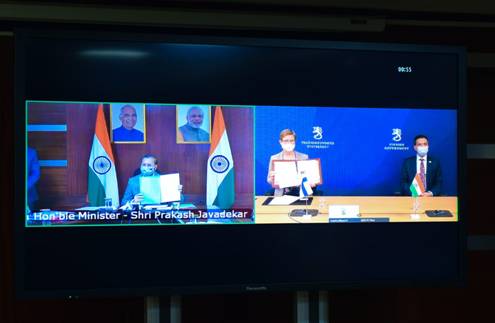
Speaking at the event Javadekar said that the MoU also provides the possibility to have joint projects in areas of mutual interest. “This MOU will definitely commits us to work together more closely towards on the fulfilment of commitments made under Paris Agreement.”, said the Environment Minister.

Javadekar also informed that India has achieved its voluntary target of reducing emissions intensity of its GDP by 21% over 2005 levels, by 2020 and is poised to achieve 35% reduction well before the target year of 2030.

As part of its Nationally Determined Contributions submitted under the Paris Agreement , India has taken three quantitative climate change goals viz. reduction in the emissions intensity of Gross Domestic Product  by 33 to 35 percent by 2030 from 2005 level, achieving about 40 percent cumulative electric power installed capacity from non-fossil fuel based energy resources by 2030 and creating an additional carbon sink of 2.5 to 3 billion tonnes of carbon dioxide equivalent through additional forest and tree cover by 2030.

The MoU will strengthen technological, scientific and management capabilities and develop bilateral cooperation in the field of environmental protection and biodiversity conservation on the basis of equality, reciprocity and mutual benefit with due respect to promotion of sustainable development.


 

All Fixed landline phone users should use ‘0’ to call mobile phones from Jan 15, 2021

The Department of Telecommunications has decided to implement the compulsory dialing of 0 to call mobile phones after TRAI Recommendation on “Ensuring Adequate Numbering Resources for Fixed Line and Mobile Services.”

All Fixed to Mobile calls will be dialed with prefix ‘0’ from 15th January, 2021 and there will be no change in dialing plan from fixed to fixed, mobile to fixed and mobile to mobile calls, it said.

Pending a detailed announcement to be made soon, the statement said whenever a subscriber dials a fixed to mobile call without prefixing ‘0’, he will be asked to do so. All fixed line subscribers will be provided with ‘0’ dialing facility.

A total of approximately 2539 million numbering series is expected to be generated from the above. This will free up sufficient numbering resources for future use. “With the freeing up of sufficient numbering resources, more number ofconnections can be added in future which will be beneficial to the mobile customers at large,” said the statement.

The above changes have been done in order to have minimum inconvenience to the subscribers and freeing up essential numbering resources.

Cabinet approves merger of Lakshmi Vilas Bank with DBS Bank

The Union Cabinet has given its approval to the Scheme of Amalgamation of Lakshmi Vilas Bank Limited (LVB) with DBS Bank India Limited (DBIL). The approval follows the move to protect depositors’ interest and in the interest of financial and banking stability, on RBI’s application under section 45 of the Banking Regulation Act, 1949.

LVB had been under moratorium for a period of 30 days. In parallel, RBI, in consultation with Government, superseded the Board of Directors of LVB and appointed an Administrator to protect the depositors’ interest.

After inviting suggestions and objections from the public and stakeholders, RBI prepared and provided a scheme for the bank’s amalgamation for the Government’s sanction, well in. advance of end of the period of moratorium so that restrictions on withdrawal faced by the depositors are minimised. With the approval of the scheme, LVB will be amalgamated with DBIL from the appointed date, and with this there will no further restrictions on the depositors regarding withdrawal of their deposits.

DBIL is a banking company licenced by RBI and operating in India through wholly owned subsidiary model, DBIL has a strong balance-sheet, with strong capital support and it has the advantage of a strong parentage of DBS, a leading financial services group in Asia, with presence in 18 markets and headquartered and listed in Singapore. The combined balance-sheet of DBIL would remain healthy even after amalgamation and its branches would increase to 600.

The speedy amalgamation and resolution of the stress in LVB is in line with Government’s commitment to a clean banking system while protecting the interests of depositors and the public as well as the financial system.

Most lungs recover well after COVID-19: Study

The most common complaints after three months are fatigue, shortness of breath and chest pains. Many people also still experience limitations in their daily life as well as a decreased quality of life. Main researcher and pulmonologist Bram van den Borst explains: “The patterns we see in these patients show similarities with recovery after acute pneumonia or acute respiratory distress syndrome (ARDS), in which fluid accumulates in the lungs. Recovery from these conditions also generally takes a long time. It is encouraging to see that lungs after COVID-19 infections exhibit this level of recovery.”

Referred patients do not recover as well as admitted patients

Patients were divided into three categories for the study: a group with patients who were admitted to the ICU, a group of patients who were admitted to a nursing ward in the hospital, and finally a group with patients who could stay home but experienced persisting symptoms that eventually warranted a referral from their GP.

The study assessed how patients fared after three months and revealed that the patients who were referred to the aftercare clinic by their GP showed the worst recovery in the following period. Of course, this latter group of patients was referred because of their persisting symptoms.

“However, it does seem that there is a clear subgroup of patients who initially experienced mild COVID-19 symptoms and later kept experiencing persistent long-term complaints and limitations”, Bram van den Borst explained. “What is striking is that we barely found any anomalies in the lungs of these patients. Considering the variety and seriousness of the complaints and the plausible size of this subgroup, there is an urgent need for further research into explanations and treatment options.”

Aftercare clinic for patients with persisting symptoms

Radboud university medical center established the corona aftercare clinic at the Dekkerswald location as a reaction to an observed increase in the signals that a substantial number of COVID-19 patients was experiencing long-term complaints, ranging from coughing, fatigue and shortness of breath to anxiety and physical limitations.

At the aftercare clinic, an extensive analysis is performed involving multiple disciplines. Based on this analysis, the care requirements of the patients and the subsequent steps are determined. Patients who were admitted at Radboud university medical center with COVID-19 will receive an invitation from the corona aftercare clinic. People who went through COVID-19 from home and are still experiencing symptoms can get a referral from their GP to visit the aftercare clinic as well.

Doctors use old CPAP treatment to cure patients from Covid-19


The lives of patients hospitalised with COVID-19 are being saved by doctors who are using an existing medical treatment at an earlier stage. Dr Luigi Sedda of Lancaster University analysed the results from the team at Wrightington, Wigan and Leigh Teaching Hospitals NHS Trust (WWL). Their research has now been published in the prestigious medical journal BMJ Respiratory Open.

He said: “We show that Continuous Positive Airway Pressure (CPAP) in the first days of hospitalisation seems to save between 10% to 20% of patients. However it is important to underline that this was a pilot study with a small sample size, although comforting evidence is starting to emerge elsewhere.”

According to NHS England, 96% of people who died with Covid had at least one serious health condition and the majority are over the age of 80. The team led by Dr Abdul Ashish used the CPAP machines on patients with COVID-19 admitted to the Royal Albert Edward Infirmary in Wigan.

In the case of patients with severe acute respiratory syndrome, COVID-19 may cause the lungs to swell and collapse. Using CPAP treatment, which is often used at home to help people with sleep problems, helps to keep the lungs open and makes breathing easier.

The research conducted by the team showed how CPAP treatment can be delivered effectively in a ward setting, with low resources both across the country and worldwide where intensive care bed availability is limited. The research has so far helped almost a hundred patients at the Royal Albert Edward Infirmary.

Consultant Respiratory Physician Dr Ashish said: “When you use CPAP early in the admission it stops the patient getting worse, therefore avoiding invasive ventilation techniques. As CPAP is readily available and can be used in a ward setting, we have demonstrated that, when used early, it can be very effective way of treating severe COVID-19 pneumonia.

“We are one of the early adopters of ward based CPAP in the North West and have developed local protocols and pathways by modifying our existing CPAP machines to deliver good outcomes for our patients.”

The researchers also found that the early use of CPAP potentially reduces lung damage during the worst of the COVID-19 infection and allows the patient to recover from the inflammatory effects. However, when used later, CPCP does not prevent lung damage thus leading to additional inflammation and a reduction in survival chances.

Indian Foreign Secretary visits Nepal over border discord

In a bid to repair ties with Nepal following the boundary dispute, Indian Foreign Secretary Harsh Vardhan Shringla arrived in Kathmandu on Thursday morning for a two-day visit. The visit will see Shringla meet the top political leadership of Nepal and hold delegation level talks with his counterpart, Bharat Raj Poudyal in Kathmandu.

This is his first Nepal visit after assuming the charge of foreign secretary in January this year. The visit, delayed due to the coronavirus pandemic, is expected to see the two sides agree to repair the frail ties owing to the the border row after New Delhi unveiled a new political map in November 2019 showing disputed areas under its territory.

Last year, Kathmandu called to alter the decision with New Delhi through the diplomatic note, but India later rejected it saying it will sit in talks with Nepal after Covid crisis is over.There was peace and calm on the bilateral front after a brief discord in November last year, but it resurfaced on May 8 after New Delhi inaugurated the 80 kilometre new road link via Lipulekh in the Indian state of Uttarakhand, which is another disputed territory that Nepal claims is its own.

Map row over disputed border

The boundary discord took a nasty turn after Nepal unveiled a new map on May 20 incorporating the disputed territory in its map that is currently occupied by India.Nepal also amended its constitution to endorse the new map in May-end, which has further complicated the relations that were often called “exemplary” in the entire South Asia.

After May, according to the Nepali officials, both Kathmandu and New Delhi started opening their line of communication through back channels, which finally gave results in August where Prime Minister of Nepal, K.P. Sharma Oli agreed to make a telephone call to Indian Prime Minister Narendra Modi.

Then Modi sent Samant Goel, head of India’s external spy agency as his emissary to meet with Oli in October which finally paved the way for the high-level visits from both sides, according to the knowledgeable sources. After Goel returned, Indian Army Chief General M.M. Naravane visited Nepal earlier this month and was accorded with the honorary rank of general of Nepal Army, a long standing unique tradition between the two sides.

Continuing with this approach, Delhi has now sent its top diplomat to Kathmandu and Shringla’s visit is expected to pave the way for more high-level visits in the near future. In his 30-hour visit in Kathmandu, Shringla will call on President Bidhya Devi Bhandari, Prime Minister Oli, Foreign Minister Pradeep Gyawali among others. He will also meet the leader of the opposition party, Sher Bahadur Deuba and will deliver a lecture on Nepal-India ties organized by the Asian Institute of Diplomacy and inaugurate two projects funded by India.

Cyclone Nivar Weakens, Leaves Behind Fallen Trees, Disrupted Power Lines

Cyclone Nivar made landfall as a severe cyclonic storm near the city of Puducherry in southern India, with winds of up to 130 km per hour (81 miles per hour), said the India Meteorological Department. At least three people were killed and the National Disaster Response Force said over 100,000 people have been evacuated from the Tamil Nadu and Puducherry coast.

On its way the cyclone uprooted several trees and power lines in Tamil Nadu’s Cuddalore, Marakkanam and in Puducherry while power supply in several areas was disrupted. The administration is removing the fallen trees and Puducherry Chief Minister V.Narayanasamy told media that power supply will be restored in a phased manner on Thursday itself.

Narayanasamy said, a lot of trees have fallen due to the cyclone and rain. He said low lying areas were inundated and work was on to drain the water. Fallen trees were being removed. “Power supply was disrupted and it will be soon restored in a phased manner in 12 hours”, he said.

Narayanasamy said the assessment will be made and by this afternoon, an estimate of damage will be made. So far, 80 relief camps have been set up in Karaikal. He said, “By Gods grace people of Puducherry escaped the fury of Nivar.” The chief minister also inspected the cyclone damaged areas and urged the people to stay indoors and fishermen not to venture into the seas.

In Tamil Nadu’s Villupuram district, police said the fallen trees have been removed to ease the flow of traffic and the officials of power utility were also on the job to restore power supply wherever it got disrupted due to the cyclone.

At Marakkanam near Puducherry, several power poles fell down and the fishermen community requested the Tamil Nadu government to restore the power lines at the earliest.

According to the weather department the cyclone lays centered over coastal Tamil Nadu and Puducherry about 25km north of Puducherry with wind blowing at a speed of 90-100 kmph gusting to 110 kmph. In the suburbs of Tamil Nadu capital Chennai, water got logged due to rains affecting the residents as well as traffic flow.

Andhra Coast Next

Nivar will move northwest wards and weaken further into a cyclonic storm during the next three hours, according to the IMD. The cyclone began its landfall on Wednesday night about 10.30 p.m. after moving at a speed of 16 kmph for six hours.

In an early morning tweet, Puducherry’s Lieutenant Governor Kiran Bedi said: “Good #MorningNutrition. Puducherry has faced the Cyclone, collectively and resolutely. Making us a stronger and a more experienced team.”

IMD said, “Under its influence rainfall at most/many places with heavy to very heavy fall at a few places with isolated extremely heavy falls are likely to occur over Ranipet, Tiruvannamalai, Tirupattur, Vellore districts of Tamil Nadu and Chittoor, Kurnool, Prakasam and Cuddappa districts of Andhra Pradesh.

Gale wind speed reaching 65-75 kmph gusting to 85 kmph very likely to prevail over interior districts of Ranipet, Tiruvannamalai, Tirupattur, Vellore of Tamil Nadu and Chittoor district of Andhra Pradesh in the early morning to forenoon, the weather department said.

The Puducherry government too has announced Thursday as a public holiday. Twenty five teams from National Disaster Response Force (NDRF) have been deployed on the coastal areas of Tamil Nadu, Puducherry and Andhra Pradesh.

Police use tear gas, water canons, drones to stop farmer at Delhi-Haryana border

Farmers from Punjab protesting the new farm law assembled in huge numbers at the Delhi-Haryana borders on Thursday morning, forcing the police in the national capital step up security and put barricades at several places. Undeterred the farmers tried to remove barricades leading to police resorting to tear gas, water canons and even drones to stop them.

The farmers, as part of their “Delhi Chalo” march, have also threatened to block all roads to Delhi if authorities stopped them during their march. The requests from the farmers’ groups to hold rallies in Delhi have been denied owing to the coronavirus pandemic and many leaders of the agitation are put in house arrest already.

Delhi Police and the Haryana Police have erected barricades and sand trucks to stop the protesting farmers who are marching towards Delhi in large numbers in their tractors, at the Singhu border, Faridabad and Gurugram borders. “Security on both sides of the Tikri Border was reinforced in coordination with the Haryana Police to prevent any untoward incident in the wake of ongoing farmer’s agitation and Covid-19,” said DCP Outer Dr. A.Koan.

The Delhi Police requested the farmers to cooperate failing which legal action will be initiated as per the law. “All the requests received from the various farmer organisations regarding protest in Delhi on 26 and 27 November have been rejected and this has already been communicated to the organisers,” Eish Singhal, Delhi Police PRO said.

Meanwhile in Delhi, the Delhi metro services in some areas have been curtailed till 2 p.m. and a heavy police deployment at the Ghazipur border, DND and Chilla as a preventive measure. Several routes have also been diverted by the Delhi traffic police.

“All motorists are hereby advised to avoid Delhi Borders in view of the protest march called by All India Kisan Sangharsh Coordination Committee on 26 & 27 November against the Central Government’s Farm Laws,” the Delhi traffic police tweeted.

Arecibo telescope that received FRBs, featured in Bond film, will close forever

Scientists are upset that one of astronomy’s most renowned telescopes — the 305-metre-wide radio telescope at Arecibo, Puerto Rico — is closing permanently, as engineers gave up on its repair after two cables supporting the megastructure broke catastrophically, one in August and another in early November.

Featured in many movies such as Contact (1997), which was based on a novel by astronomer Carl Sagan, and the 1995 James Bond film GoldenEye, the telescope, installed in 1963, had apparently degraded over time despite periodic repairs and maintenance as per the schedule.

In January 2014, a magnitude-6.4 earthquake caused damage to one of the main cables, which engineers repaired. The ageing structure has suffered another shock in 2017 when its antenna was damaged by Hurricane Maria.

“Even attempts at stabilization or at testing the cables could result in accelerating the catastrophic failure,” said Ralph Gaume at the US National Science Foundation, which owns the observatory. However, limited science will continue at some smaller facilities at the Arecibo site, said NSF.

Scientists are sharing memories and grief on social media using the hashtag #WhatAreciboMeansToMe trending on Twitter. The loss is felt acutely in Puerto Rico, where the observatory is a cradle of science education and career development.“I don’t know what to say,” said Robert Kerr, a former director of the observatory. “I am totally devastated,” wrote Abel Méndez, an astrobiologist at the University of Puerto Rico at Arecibo who uses the observatory regularly.

Damaged Arecibo telescope/ Credit: University of Central Florida/Arecibo Observatory

The Arecibo telescope, built in 1963, was the world’s largest radio telescope for decades and it was from this site that astronomers sent an interstellar radio message in 1974, in the hope that any extraterrestrials might hear it, and where the first confirmed extrasolar planet was discovered, in 1992.

It has also done pioneering work in exploring near-Earth asteroids and the puzzling celestial blasts known as fast radio bursts (FRBs). All those lines of investigation have now been shut down for good.

Assessing the damage

The cables that broke helped to support a 900-tonne platform of the main telescope dish. The first cable slipped out of its socket and smashed panels at the edge of the dish, but the second broke in half and tore huge gashes in a central portion of the dish, said NSF. A high-resolution satellite image, produced at Nature’s request by Planet, shows the green of the vegetation below through large holes in the dish.

If any more cables fail — which could happen at any time — the entire platform could crash into the dish below. The US National Science Foundation (NSF), which owns the Arecibo Observatory, is working on plans to lower the platform in a safe, controlled fashion.

“Even attempts at stabilization or at testing the cables could result in accelerating the catastrophic failure,” said Ralph Gaume, director of the NSF’s astronomy division, at a media briefing last week. So the NSF decided to close the Arecibo dish permanently. “This decision is not an easy one to make, but safety is the number-one priority,” said Sean Jones, head of the NSF’s mathematical and physical sciences directorate.

India successfully tests final user trial of anti-tank NAG missile

India carried out final user trial of 3rd generation Anti Tank Guided Missile (ATGM) NAG on Thursday, 22 Oct 2020 at 0645 hrs from Pokhran range. The missile was integrated with the actual warhead and a tank target was kept at designated range. This was launched from NAG Missile Carrier NAMICA. The missile hit the target accurately defeating the armour.

ATGM NAG has been developed by DRDO to engage highly fortified enemy tanks in day and night conditions. The missile has “Fire & Forget” “Top Attack” capabilities with passive homing guidance to defeat all MBTs equipped with composite and reactive armour.

The NAG missile carrier NAMICA is a BMP II based system with amphibious capability. With this final user trial, NAG will enter into production phase. The missile will be produced by Defence PSU Bharat Dynamics Limited (BDL), whereas Ordnance Factory Medak will produce the NAMICA.

Union Defence Minister Rajnath Singh congratulated DRDO and Indian Army for the successful trial of NAG Missile. Secretary DDR&D & Chairman DRDO, Dr G Satheesh Reddy appreciated the efforts of DRDO, Indian Army and Industry in bringing the missile up to the production phase.

The missile will be inducted soon in the India Army. In 2008, Ministry of Defence approved procurement of 300 Nag missiles and 25 missile carriers for Army. The missile was integrated with the actual warhead and a tank target was kept at designated range. This was launched from Nag Missile Carrier NAMICA.

The missile hit the target accurately defeating the armour. The NAG missile carrier NAMICA is an Infantry Combat Vehicle BMP2 II based system with amphibious capability. With this final user trial, NAG will enter into production phase.

The missile will be produced by Defence PSU Bharat Dynamics Limited (BDL), whereas Ordinance Factory Medak will produce the NAMICA.

India unveils draft of Spacecom Policy-2020, Seeks feedback

India has unveiled the Draft Space Based Communication Policy 2020 (Spacecom Policy-2020) with draft Norms, Guidelines and Procedures for implementation of Spacecom NGP-2020.

Under the policy guidelines, Indian private sector players wanting to provide communication service inside and outside India using a space-based asset are liable for damages caused to other space objects in outer space and its environment.

Releasing the draft, the Department of Space (DOS) said private players can provide communication services using space based assets within and outside India but any damages that may occur to other space objects in the outer space the private service providers are liable for financial damages and they have to take care of that by providing financial guarantee or insurance cover.

The extent of financial guarantee or the insurance cover will be determined by the Indian authorising/licensing body taking into account the risks involved. The DOS has called for comments on the draft policy by 4.11.2020.

Space Asset Authorisation

Under the draft Spacecom Policy-2020, any communication service within the Indian territory from space can be carried out only with an authorised space asset and only Indian entities are eligible for obtaining space asset authorisation and any Indian entity can seek authorisation for use of space asset for communication within Indian territory. This authorisation extends to use of Indian orbital resource, non-Indian orbital resource, use of owned or leased space asset.

The draft policy requires Indian companies to establish ground system within Indian territory for monitoring and controlling space asset, while the use of outer space for peaceful purposes is governed by the UN treaties and international conventions, use of orbital resources is governed by radio regulations of the specialised UN agency, the International Telecommunication Union (ITU). Government of India as member of such UN bodies has responsibilities and obligations towards use of outer space as a common asset of humans.

It states that the use of space based communication in any frequency of electromagnetic spectrum, to or from Indian territory, be permitted through a process of authorisation under the provisions of Spacecom Policy-2020. Indian entities can establish and operate satellite systems to provide capacity for communication services with authorisations.

Own Satellites

Indian entities can undertake design, development and realisation of satellites and associated communication systems. They can establish satellite system through their own built satellite or procured satellite and establish telemetry, tracking and command (TT&C) earth stations and satellite control centre (SCC) in or outside India. They can offer the capacity to commercial and societal communications within India as well as outside India. They can also supply their systems and solutions to international markets.

“The authorization requires a satisfactory commitment by the applicant through an appropriate arrangement with the concerned foreign administration which has the priority for the use of the proposed orbital resources. In case of a leased space asset, apart from the applicant, the operator of such asset shall also agree and commit for the arrangement of bringing the orbital resources eventually under Indian administration,” the draft policy stated.

The Spacecom Policy-2020 Highlights:

  • Monitor and authorise use of space assets for communication to or from Indian territory.
  • Ensure protection of space assets already put in place and adopt measures to bring in more space assets under the administrative control for enhancing ability to utilize space based communication for national needs.
  • Promote increased participation of commercial Indian industry to provide space based communications both within the country and outside.
  • Concentrate on realisation of space based communication systems for addressing the requirements that cannot be effectively, affordably and reliably satisfied by commercial Indian industry either because of national security concerns or economic factors.
  • Provide a timely and responsive regulatory environment for the commercial Indian industry to establish and operate space based communication systems.

India Relaxes Covid-19 travel restrictions on Visa holders to travel

The Ministry of Home Affairs (MHA) has extended the gradual relaxation of visa rules for more categories of foreign nationals and Indian nationals who wish to enter or leave India with immediate effect with their existing visas except electronic visa, tourist visa and medical visa.

Foreign nationals intending to visit India for medical treatment can now apply for a medical visa, including for their medical attendants and foreign nationals can come to India for various purposes such as business, conferences, employment, studies, research and medical purposes.

“Therefore, this decision will enable foreign nationals to come to India for various purposes such as business, conferences, employment, studies, research, medical purposes etc.,” said the ministry in a statement. The decision will ease the sectors affected due to pandemic as restrictions were imposed on the visit of foreigners.

In view of the situation arising out of the Covid-19 pandemic, the Ministry had taken a series of steps to curtail the inward and outward movement of international passengers since February this year. Therefore, the MHA — a nodal Ministry which has the authority to give visa and foreign travel approvals — has now decided to permit all Overseas Citizenship Of India (OCI) and Person of Indian Origin (PIO) card holders and all other foreign nationals intending to visit India for any purpose, except on a tourist visa to enter by air or water routes through authorised airports and seaport immigration check posts.

The relaxation includes flights operated under the Vande Bharat Mission, Air Transport Bubble arrangements or by any non scheduled commercial flights as allowed by the Ministry of Civil Aviation. All such travellers will have to strictly adhere to the guidelines of the Ministry of Health and Family Welfare (MoHF) regarding quarantine and other health and Covid-19 matters.

If the validity of such visas has expired, fresh visas of appropriate categories can be obtained from the Indian Missions or Posts concerned, the Ministry said.

Manmohan Singh Turns 88 and India turns to him with awe and admiration

When Prime Minister Narendra Modi greeted his predecessor Dr Manmohan Singh on his birthday on Sept 26, 2020, the Twitterati woke up to the need of the hour for an academic who changed the course of battered Indian economy from socialism to market-driven economy, albeit, gradually.

No wonder, #HappyBirthdayDrMMSingh trended on Twitter for about 15 hours, with over 150,000 tweets and the hashtag topped the chart as the economist turned 88. Reminiscent of what he said just ahead of the run-up to the 2014 general election, the praise for him was universal without any political undercurrents. “I honestly believe that history will be kinder to me than the contemporary media, or for that matter, the Opposition parties in Parliament,” said Dr Manmohan Singh in January 2014.

Ironic but the country failed to see his selfless achievements for the country in a silent but graceful manner that rivals only a few prime ministers in history. Despite the brouhaha around his birthday online, he himself spent the day mourning the passing of Isher Judge Ahluwalia, an economist, author and wife of Montek Singh Ahluwalia who had helped him during his term as the former finance minister  to initiate reforms that changed India forever.

Japan’s recognition

Soon after serving as finance minister, the coalition governments followed and he was pushed to sidelines. But not for some nations which have seen the mettle in such men of great vision and recognised them even when they were not in public glare.

Japan in 1997 conferred upon him the Nikkei Asia Prize meant for regional growth. Not many bothered why Japan woke up to honour him when he was Leader of Opposition in Rajya Sabha. But, Japan saw the future potential Prime Ministerial candidate in him that many failed to recognise in his own country. It came true seven years later in 2004 when he was chosen as Prime Minister.

Late Realisation

Here are some tweets which speak for themselves to depict his term in comparison to those before and after him:

  • “Those were the days when the Prime Minister focused on work, not on camera.”
  • “Happy birthday to a Prime Minister who gave 10.8% GDP growth, faced press conferences and knew the spelling of strength.”
  • “He spoke less but not lies.”
  • “He showed us the difference between talk and work.”
  • “The tragedy is you don’t know the value of a Dr Manmohan Singh until you get a Narendra Modi,”

Finally, Rahul Gandhi summed it up when he tweeted: “India feels the absence of a PM with the depth of Dr Manmohan Singh. His honesty, decency and dedication are a source of inspiration for us all. ”

His associate in the Congress and former finance minister P. Chidambaram even advocated the Bharat Ratna for Manmohan Singh but the truth is that he is above all those honours and awards. His commitment to work and bring change is what we need. And hopefully, Japan may recognise such personality again.

World Food Programme gets 2020 Nobel Prize for Peace

The World Food Programme, the world’s largest humanitarian organisation addressing hunger and promoting food security, was awarded 2020 Nobel Prize for Peace.

In 2019, the WFP provided assistance to close to 100 million people in 88 countries who are victims of acute food insecurity and hunger. In 2015, eradicating hunger was adopted as one of the UN’s Sustainable Development Goals. The WFP is the UN’s primary instrument for realising this goal. In recent years, the situation has taken a negative turn. In 2019, 135 million people suffered from acute hunger, the highest number in many years. Most of the increase was caused by war and armed conflict.

The coronavirus pandemic has contributed to a strong upsurge in the number of victims of hunger in the world. In countries such as Yemen, the Democratic Republic of Congo, Nigeria, South Sudan and Burkina Faso, the combination of violent conflict and the pandemic has led to a dramatic rise in the number of people living on the brink of starvation. In the face of the pandemic, the World Food Programme has demonstrated an impressive ability to intensify its efforts. As the organisation itself has stated, “Until the day we have a medical vaccine, food is the best vaccine against chaos.”

“We will never achieve the goal of zero hunger unless we also put an end to war and armed conflict,” said the citation. The Norwegian Nobel Committee said it wishes to emphasize that providing assistance to increase food security not only prevents hunger, but can also help to improve prospects for stability and peace.

The World Food Programme has taken the lead in combining humanitarian work with peace efforts through pioneering projects in South America, Africa and Asia. The World Food Programme was an active participant in the diplomatic process that culminated in May 2018 in the UN Security Council’s unanimous adoption of Resolution 2417, which for the first time explicitly addressed the link between conflict and hunger.

The Security Council also underscored UN Member States’ obligation to help ensure that food assistance reaches those in need, and condemned the use of starvation as a method of warfare.

With this year’s award, the Norwegian Nobel Committee wishes to turn the eyes of the world towards the millions of people who suffer from or face the threat of hunger. The World Food Programme plays a key role in multilateral cooperation on making food security an instrument of peace, and has made a strong contribution towards mobilising UN Member States to combat the use of hunger as a weapon of war and conflict.

The organisation contributes daily to advancing the fraternity of nations referred to in Alfred Nobel’s will. As the UN’s largest specialised agency, the World Food Programme is a modern version of the peace congresses that the Nobel Peace Prize is intended to promote.

The work of the World Food Programme to the benefit of humankind is an endeavour that all the nations of the world should be able to endorse and support.

Trump Down With Coronvirus: Surprising Similarities with Spanish Flu Startle Many

US President Donald Trump is diagnosed with Coronavirus just a month before the US Presidential election denting his chances further to an easy win. Similar to the Spanish Flu that had wreaked havoc from 1918 to 1920 in the US, the startling political developments have raised many eye brows to the fact that history repeats itself.

What Happened 100 Years Ago

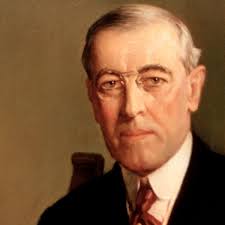
In 1919, then US President Woodrow Wilson was affected by the global pandemic Spanish flu and more than 675,000 Americans died from the contagious disease.

Even in 1918, Wilson’s personal secretary was affected by the influenza, along with his eldest daughter, while many Secret Service members also caught the virus, including sheep grazing on the White House lawn.

Woodrow Wilson was a victim of the Spanish fluin 1920 while Donald Trump is facing similar fate now in 2020

Woodrow Wilson was in France for the Paris Peace Conference negotiating with the French at the end of World War I and after flu, he reportedly “yielded to several French demands that he had previously said were nonnegotiable.”

Wilson fell ill on April 3, 1919 and according to A. Scott Berg’s 2013 biography, “Wilson,” the president excused himself from a meeting with the Council of Four and returned to his room. His doctor, Cary T. Grayson, found the president suffering from severe pains in his back and head, severe coughing spells and a temperature of 103 degrees, Berg wrote.

Wilson’s condition deteriorated so quickly that Grayson even thought the president had been poisoned. In his mail to President’s chief of staff in Washington, Grayson wrote:”I was able to control the spasms of coughing but his condition looked very serious.” However, he told reporters that the president was suffering from a cold caused by the “chilly and rainy weather” in Paris.

Though Wilson had a full recovery, he suffered a collapse on Sept. 25, 1919, in Pueblo, Colorado, while speaking on his idea of the United States joining the League of Nations. Wilson returned to the White House, where he suffered a severe stroke on Oct. 2, 1919. His wife Edith apparently steered the government until Warren G. Harding took over formally as President in 1921.

What’s Happening Now

Hundred Years after, in March 2020 When the novel coronavirus gripped the world, US President Donald Trump brushed it aside as another flu outbreak that would go away once the summer sets in. When it reached an uncontrollable pandemic proportion, his disdain for a mask prompted his staff in the White House refrain from wearing a mask despite pleas to contrary by the CDC.

As in the case of Wilson, Trump’s close aide Hope Hicks tested positive for the coronavirus after spending time in close proximity to the president in the entire week preceding the diagnosis. Soon, President Donald Trump tweeted confirming that he and first lady Melania Trump tested positive for Covid-19.

Unlike in 1920 when President Wilson was not in Presidential race due to his illness, Trump is very much in the hectic campaign finishing the first round of Presidential Debates just a week before the diagnosis on October 2, that may defer the second debate slated for October 15, 2020.

Return to Normalcy

Though many world leaders have successfully returned to duties after suffering from the bouts of Covid-19 infection, Trump’s age has pushed him into the most vulnerable age group at 74 years. According to the US Centers for Disease Control and Prevention (CDC) advisory issued on Sept. 11, 2020, “people in their 60s or 70s are, in general, at higher risk for severe illness than people in their 50s.”

In June 2020, Trump weighed 244 pounds. For his height at 6 feet 3 inches, with a body mass index of 30.5, he is technically obese and as per the CDC, obese individuals are three times more likely than others to suffer severe symptoms of Covid-19. However, Trump does not have prominently high blood pressure, nor any cancer, kidney disease, or diabetes.

If Trump returns to normal health and wins the election, he may have rewritten the history of pandemic deja vu in the history of US or else, it would be a lesson for all the future presidents to learn and make the nation prepared for any pandemic.

Glitch or Cyberattack Behind Tokyo Stock Exchange Breakdown?

Citing a hardware breakdown, the Tokyo Stock Exchange halted trading for the entire day Thursday, Oct. 1, 2020 with serious rippling effect on exchanges in Sapporo, Nagoya, and Fukuoka as well. Japan Exchange Group Inc., which operates the TSE, said it would announce any updates on resumption of trade on Friday later. All buying and selling has been frozen on the first day of the new quarter.

The impact is likely to stem the positive investor sentiment created following a buoyant U.S. stock market performance overnight and closures in other major markets in the region, including China, Hong Kong, South Korea and Taiwan.

Moreover, the shutdown of stock exchange will dent the investor confidence in the Japanese markets system.  Chief Cabinet Secretary Katsunobu Kato, the top Japanese government spokesman, said the disruption was “extremely regrettable.”

3rd Largest stock Exchange 

There were no indications that the outage was related to hacking, said the operator of the $6.15 trillion stock market that is the third-largest in the world behind the U.S. and China. Its daily turnover has averaged about $22 billion over the past year.

But glitches are common to Tokyo stock exchange since 2000. Its president resigned in mid-2000s over such computer issues and eventually the faster Arrowhead system, developed by Fujitsu was introduced in 2010. However, a glitch halted trading in 241 securities in 2012 and another a year later.

As of now, Fujitsu spokesman Takeo Tanaka made no comment on details of the present glitch though he denied that it was a cyberattack. The glitch has raised many eyebrows since a cyber attack in New Zealand spurred trading halts for over four days in August.


Ayush Ministry to conduct clinical study of Vasa and Guduchi for Covid-19 treatment

In view of the need for accelerated solutions for Covid-19, the Ministry of AYUSH has taken up a clinical study to assess the role of Vasa Ghana, Guduchi Ghana and Vasa-Guduchi Ghana in therapeutic management of symptoms in Covid-19 positive cases.

The trials will be a “randomized, open label three armed” study, and will be conducted at the All India Institute of Ayurveda (AIIA), New Delhi, in collaboration with the IGIB unit of CSIR.

The detailed proposal with methodology including outcome measures, clinical and laboratory parameters, the logistics of the research has been prepared. The study will use a unique Case Report Forum (CRF), suitable for Ayush mode research.

VASA  is an ayurvedic classical medicine. It is a herbal decoction (kashayam) with Vasa and Guduchi as its main ingredients, used to treat liver disorders. It is believed to reduce the aggravation of pitta in the body.

Study Protocol

The CRF and study protocol has also been peer reviewed by experts from different domains including modern medicine and their suggestions have been incorporated. The study will be undertaken subject to the required approvals like that of the Institutional Ethics Committee (IEC).

The project would look into the following specific considerations:

  1. The efficacy/action of mono-herbal formulations of whole extracts of Vasa and Guduchi respectively, and polyherbal formulation of Vasa-Guduchi whole extract on therapeutic management of SARS-CoV2 positive asymptomatic and/ or mild Covid-19 symptomatic cases. The impact of the said formulations on the speed of viral replication.
  2. Whether the said mono-herbal and polyherbal formulations can alter the expression profiles of key bio markers associated with Covid-19 disease.

Vasa and Guduchi are time tested herbs in Indian healthcare traditions, used in a variety of disease conditions. The outcome of this study would therefore be of considerable interest to the entire Ayush Sector.


What Has Changed on Jupiter from 2006 to Now? Hubble captures all in detail

This (above) latest image of Jupiter was captured by Hubble Space Telescope on 25 August 2020, when the planet was 653 million kilometres from Earth, giving clues on updated weather report on the monster planet’s turbulent atmosphere. A remarkable new storm is brewing, and a cousin of the Great Red Spot is changing colour again. The tiny new image is Jupiter’s icy moon Europa.

Hubble’s new snapshot appears at mid-northern latitudes as a bright, white, stretched-out storm moving at 560 kilometres per hour. This single plume erupted on 18 August 2020 and another has since appeared.

Unlike other common storms in this region, this particular disturbance appears to have more structure behind it than observed in the past storms. Trailing behind the plume are small, counterclockwise dark clumps also not seen in the past, which could mean the beginning of a longer-lasting northern hemisphere spot, perhaps to rival the legendary Great Red Spot that dominates the southern hemisphere.

Great Red Spot

Hubble shows that the Great Red Spot, rolling counterclockwise in the planet’s southern hemisphere, is ploughing into the clouds ahead of it, forming a cascade of white and beige ribbons, while its current exceptionally rich red colour, with its core and outermost band, is appearing deeper red.

Researchers say the Great Red Spot now measures about 15 800 kilometres across, big enough to swallow the Earth. The super-storm is still shrinking, as noted in telescopic observations dating back to 1930, but its rate of shrinkage appears to have slowed though the reason for its dwindling size remains a  mystery.

The NASA/ESA Hubble Space Telescope is giving astronomers their most detailed view yet of a second red spot emerging on Jupiter. For the first time in history, astronomers have witnessed the birth of a new red spot on the giant planet, which is located half a billion miles away (about 800 thousand kilometres). The storm is roughly one-half the diameter of its bigger and legendary cousin, the Great Red Spot. Researchers suggest that the new spot may be related to a possible major climate change in Jupiter’s atmosphere.
Credit: NASA, ESA, A. Simon-Miller (NASA/GSFC), and I. de Pater (University of California Berkeley)

Researchers are noticing that another feature has changed: the Oval BA, nicknamed by astronomers as Red Spot Jr., which appears just below the Great Red Spot in this image. For the past few years, Red Spot Jr. has been fading in colour to its original shade of white after appearing red in 2006. However, now the core of this storm appears to be darkening to a reddish hue. This could hint that Red Spot Jr. is on its way to reverting to a colour more similar to that of its cousin.

Hubble’s image shows that Jupiter is clearing out its higher-altitude white clouds, especially along the planet’s equator, which is enveloped in an orangish hydrocarbon smog.

Jupiter’s icy moon Europa is visible to the left of the gas giant. Europa is already thought to harbour a liquid ocean beneath its icy crust, making this moon one of the main targets in the search for habitable worlds beyond Earth.

Water vapour

In 2013 it was announced that the Hubble Space Telescope discovered water vapour erupting from the frigid surface of Europa, in one or more localised plumes near its south pole. ESA’s JUpiter ICy moons Explorer, a mission planned for launch in 2022, aims to explore both Jupiter and three of its largest moons: Ganymede, Callisto, and Europa.

Hubble also captured a new multiwavelength observation in ultraviolet/visible/near-infrared light of Jupiter on 25 August 2020, which is giving researchers an entirely new view of the giant planet. Hubble’s near infrared imaging, combined with ultraviolet views, provides a unique panchromatic look that offers insights into the altitude and distribution of the planet’s haze and particles. This complements Hubble’s visible-light picture that shows the ever-changing cloud patterns.

Sony PS5: Priced at $400, India launch on Nov 19, Pre-Order from Sept 18

Sony Interactive Entertainment (SIE) on Thursday announced November 12 as the launch date for its highly anticipated next-generation videogame system, PlayStation 5, which will be priced $399.99 or ¥39,980. SIE also revealed new updates to the PS5 game portfolio, including Final Fantasy XVI, Fortnite, Hogwarts Legacy, and a new God of War title.

On November 12, PS5 will be launched in seven key markets — the U.S., Canada, Mexico, Australia, New Zealand, Japan and South Korea. The global rollout, including India, will be on November 19, including Europe, Middle East, South America, Asia and South Africa.

The PS5 Digital Edition will be available for $399.99/¥39,980/€399.99, and PS5 with an Ultra HD Blu-ray disc drive will be available for $499.99/¥49,980/€499.99. Pre-orders will be available starting Thursday, Sept. 17 at select retailers, said Sony in a statement.

4K high-fidelity graphics 

Both PS5 models use the same custom processor with integrated CPU and GPU for high-fidelity graphics up to 4K, besides the same ultra-high speed SSD with integrated I/O that will deliver lightning-fast loading. Both PS5 models offer a deepened sense of immersion through the DualSense wireless controller and 3D audio capabilities, enabling players the same transformative gameplay experience regardless of which PS5 they choose, said Sony.

Sony launches PS5 Thursday and pre-order begins Friday, Sept 18, 2020 (SIE)

“Since we first announced our next generation console last year, we have received astounding support from developers and gaming fans all around the world, and it’s truly humbling,” said Jim Ryan, president and CEO of Sony Interactive Entertainment.

“Now we are just a couple of months away from launching PS5, which will offer a new generation of experiences that go beyond players’ expectations of how games can look, feel, sound, and play. We can’t wait for our fans to experience for themselves the incredible speed, the heightened immersion and the breathtaking games on PS5 when we launch this November.”

New Games on PS5

In addition, Sony has also unveiled several new games coming to PS5, including:

  1. Devil May Cry 5 Special Edition (Capcom)
  2. Final Fantasy XVI (Square Enix)
  3. Five Nights at Freddy’s Security Breach (Steel Wool Studios and ScottGames)
  4. Hogwarts Legacy (Warner Bros. Games)
  5. A new God of War title (Santa Monica Studio)


With titles such as Marvel’s Spider-Man: Miles Morales, Call of Duty: Black Ops Cold War, and Demon’s Souls, exclusive titles from SIE Worldwide Studios will be priced at launch from US$49.99 to US$69.99 (RRP) on PS5. However, to support the PlayStation4 community as they transition to the next generation when they’re ready, SIE will launch PS4 versions of a few exclusive titles:

Marvel’s Spider-Man: Miles Morales,
Sackboy A Big Adventure, and
Horizon Forbidden West.

While these three games were designed to take advantage of PS5 and its unique next-gen features like the ultra-high speed SSD and DualSense controller, PS4 owners will also be able to enjoy these experiences when they launch. The PS4 digital versions of launch games include a free upgrade on both PS5 consoles, while the PS4 disc versions of these games include a free upgrade on the PS5 with Ultra HD Blu-Ray disc drive.

In addition, Sony has revealed the PlayStation Plus Collection, a curated lineup of PS4 games that defined the generation, which will be available to PS Plus members to download and play on PS5. The PS Plus Collection features critically acclaimed games, including Batman Arkham Knight, Bloodborne, Fallout 4, God of War, Monster Hunter: World, Persona 5 among others.

NCB arrests Rhea after 3 days of grilling in Sushant Singh Rajput Suicide Case

After three days of grilling, the Narcotics Control Bureau (NCB) on Tuesday arrested Bollywood actress Rhea Chakraborty in connection with her alleged role in the drugs angle into the June 14 death of actor Sushant Singh Rajput.

Sushant’s girlfriend Rhea has been charged under the Narcotic Drugs and Psychotropic Substances Act and quickly whisked away for a mandatory medical test at the BrihanMumbai Municipal Corporation’s LTMG Sion Hospital. Rhea has pleaded innocence throughout, though.

She will be presented by the NCB before a court for her remand. Rhea’s lawyer Satish Maneshinde termed the arrest a “travesty” of justice. “Three central agencies hounding a single woman — just because she was in love with a drug addict, suffering from mental health issues for several years under the care of five leading psychiatrists in Mumbai, who ended up committing suicide due to consumption of illegally administered medicines and used drugs,” he said.

Earlier, Rhea filed an FIR at the late actor’s sister Priyanka Singh and Dr Tarun Kumar of RML Hospital in New Delhi among others alleging forged medical prescriptions under the Indian Penal Code and the NDPS Act, and as per the Supreme Court orders, the case has been transferred to the CBI for investigation.

Rhea’s arrest came three days after her brother Showik Chakraborty, Sushant’s home manager Samuel Miranda, and his house helper Dipesh Sawant were arrested and sent in NCB custody till September 9 (Wednesday), besides two other drug peddlers Abdel Basit Parihar and Zaid Vilatra, who are also in NCB custody.

The NCB said the arrests would help it to “uproot the drugs citadel in Bollywood and Mumbai” amidst talk of several other Bollywood personalities involved in it. Rhea was grilled several times by the Central Bureau of Investigation and the Enforcement Directorate, and even the Mumbai Police, but was finally arrested by the NCB, nearly 11 weeks after Sushant was found dead in his Bandra home.

Rhea, however, remained calm and composed as she stepped out of the NCB office post-arrest to proceed for a medical test. She did not seek any anticipatory bail either so far, said her lawyer Maneshinde, who is likely to seek bail soon in this case following the arrest.