

Declared on July 19, the ceasefire followed a harrowing wave of sectarian clashes, Israeli airstrikes and grave human rights violations.
UN Special Envoy for Syria Geir Pedersen told ambassadors in the Security Council on Monday that the recent escalation had “rocked” the country’s already precarious transition and highlighted the need for “major course corrections” on security and political fronts.
“Syrians are reeling after appalling violence in Sweida – violence that should not have happened and which also saw unacceptable foreign intervention,” Mr. Pedersen said.
Escalation and fallout
The unrest began on July 12 when mutual kidnappings escalated into armed conflict between Druze groups and Bedouin tribes, drawing in Syrian security forces.
The violence spiralled, with reports of extrajudicial executions, desecration of corpses and looting. Footage circulated widely on social media fanned sectarian tensions and disinformation.
Though fighting has largely subsided, Mr. Pedersen warned the situation “remains tense and volatile.” Civilians suffered the most, with hundreds killed and widespread accounts of abuses by both state and non-state actors.
“I condemn the appalling violations against civilians and combatants in Sweida. I also condemn Israel’s intervention,” he said, referring to airstrikes around Sweida and Damascus that reportedly caused civilian and security force casualties.
A wide view of the Security Council meeting on the situation in Syria. On screen is Geir Pedersen, Special Envoy of the Secretary-General for Syria.
Humanitarian crisis worsens
Humanitarian needs are escalating sharply. Edem Wosornu, Director of Operations at the UN Office for the Coordination of Humanitarian Affairs (OCHA), described Sweida as “teetering on the edge of collapse.”
“The recent violence in Sweida has displaced an estimated 175,000 people…a third of the population in the governorate, where two-thirds of people were already in need of assistance,” she told ambassadors.
Hospitals are overwhelmed and face severe shortages of electricity, supplies and personnel. The World Health Organization (WHO) confirmed five attacks on healthcare in Sweida, including the killing of two doctors, obstruction and targeting of ambulances
Vital infrastructure, including water systems are critically damaged, and food, fuel and medicine remain scarce. Aid access remains limited due to insecurity.
While three UN-supported aid convoys reached Sweida with food, fuel and health supplies, Ms. Wosornu stressed the need for “sustained humanitarian access” and protection for aid workers and infrastructure.
Droughts and wildfires deepen suffering
The violence coincided with devastating wildfires in Lattakia that displaced over 1,100 people and destroyed farmland.
The fires were worsened by “the worst drought-like conditions Syria has seen in 36 years,” Ms. Wosornu said, with water reservoirs falling to historic lows.
UN agencies are responding with clean water, health services and food assistance.

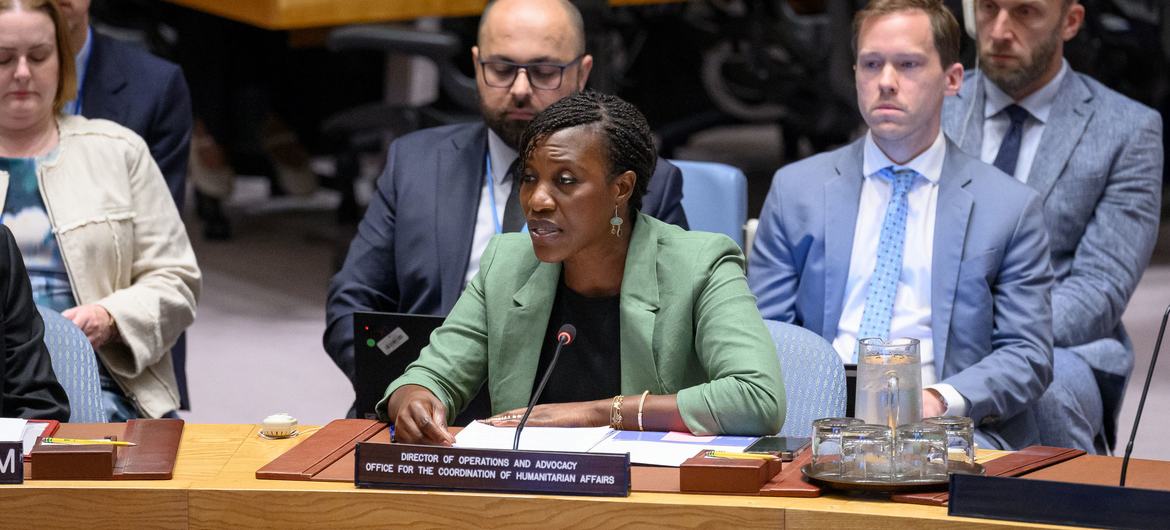
Edem Wosornu, Director of the Operations at OCHA, briefs UN Security Council members on the situation Syria.
Comprehensive political reforms
Special Envoy Pedersen emphasised that sustainable peace in Syria hinges on inclusive political reform, security sector transformation and transitional justice.
“The state has a clear duty to act professionally and with discipline, even when under attack. It must take control of its forces and ensure visible accountability,” he said.
A new People’s Assembly is expected in September, a key step in the transitional framework. Mr. Pedersen warned that unless the process is inclusive, transparent and representative, it risks deepening public mistrust.
Transition simply cannot fail
“The Syrian political transition simply cannot fail,” he said.
Ms. Wosornu echoed the call for international solidarity, urgent funding and a halt to hostilities. Only 12 per cent of the revised $3.2 billion humanitarian appeal has been met.
“Our assistance is falling far short of meeting the level of needs,” she said, “If Syria is to recover, such violence must stop.”