

In a repurposed building in Belapur, discarded clothes are no longer waste. They are inventory.
Sarees, uniforms, denim, and worn-out household linen arrive in bags, tagged, sorted, and redirected into a system that treats fabric as a resource rather than refuse. What emerges on the other side is not just recycled material, but income for women and a shift in how cities think about waste.
India generates nearly 7.8 million metric tonnes of post-consumer textile waste each year, a volume that has historically flowed into landfills with little intervention. Municipal systems have begun to acknowledge that textiles, long overlooked in solid waste management, require dedicated recovery and reuse frameworks.

Textile recovery facility in Belapur
The Textile Recovery Facility (TRF) set up in Belapur represents one of the first structured municipal attempts to address that gap.
Developed under Swachh Bharat Mission-Urban 2.0, the facility is designed as a full-cycle system that integrates collection, sorting, processing, and product development.
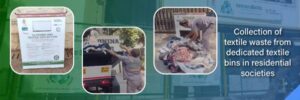
Collection begins at the neighborhood level. The city has deployed 140 textile bins across housing societies in all eight municipal wards, with plans to expand to 250. The approach is decentralized, built to encourage participation at the household level.
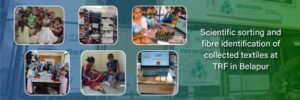
Once collected, materials are routed to the Belapur facility, where each item is weighed, tagged, and categorized into streams such as reusable, recyclable, upcyclable, downcyclable, or reject.
Technology plays a central role in this process. Handheld scanners are used to identify fiber types in real time, distinguishing between cotton, polyester, wool, and blended materials. This level of classification allows for more efficient recovery and reduces contamination in recycling streams.
A digital tracking system is also under development, intended to map each item’s journey from donation to end-use. The system is expected to improve traceability and support data-driven decisions on waste management.

Women-led workforce turns discarded fabric into income
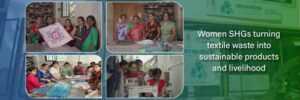
Inside the facility, the work is largely carried out by women from self-help groups.
More than 300 women have undergone structured training modules covering fiber identification, repair techniques, and upcycling methods. Over 150 are now actively engaged in the process, earning between ₹9,000 and ₹15,000 per month through sorting, stitching, and product creation.
The transformation is both economic and social. Participants move from informal or unpaid roles into structured work tied to a growing segment of the urban economy.
Recovered textiles are converted into bags, garments, accessories, and home décor items. These products are sold through exhibitions and public events, creating a market link that sustains the system.
The facility has already produced more than 400 upcycled product samples, including experimental outputs such as paper derived from textile waste.

Scale, outreach, and measurable waste reduction
The numbers offer a snapshot of the model’s reach.
The facility has collected 30 metric tonnes of textile waste so far, with 25.5 metric tonnes processed through scientific sorting systems. More than 41,000 individual items have been handled, averaging around 500 items per day.
Public engagement has been central to the initiative. Outreach efforts have reached over 114,000 families, supported by more than 75 awareness workshops and the involvement of over 350 housing society representatives.
The model relies on this participation. Without household-level segregation and donation, the system would not function at scale.
Challenges and expansion plans for textile waste management
Early implementation was not without friction.
Officials encountered resistance to placing textile bins in residential areas, along with limited awareness around fabric segregation. Sorting mixed-fiber materials also posed technical challenges.
These issues were addressed through phased rollout strategies, public engagement campaigns, and the adoption of fiber-scanning technology.
With the interim facility demonstrating viability, the next phase involves establishing a permanent, higher-capacity center in Koparkhairane near Nisarg Udyan.
The expansion signals an attempt to move from pilot to scalable infrastructure, positioning textile recovery as a formal component of urban waste systems.

Circular economy model gains policy relevance
The Navi Mumbai initiative aligns with broader policy frameworks focused on sustainability and resource efficiency.
It connects with national programs such as Swachh Bharat 2.0 and the Smart Cities Mission, while also reflecting global sustainability goals tied to responsible consumption and production.
At its core, the model reframes textile waste as an economic input. Materials once discarded are reintroduced into production cycles, generating both environmental and financial value.
In Belapur, that shift is visible in the daily flow of fabric through the facility. Each item carries a different outcome, but the system around it is consistent.
Waste enters. Work begins. Value is created.
Also Read:
‘SHE Marts’ Scheme To Support Rural Women Entrepreneurs Under NRLM Announced