
Smile please! Now improved mineralized material can restore tooth enamel

Scientists have perfected hydroxyapatite, a material for mineralizing bones and teeth. By adding a complex of amino acids to hydroxyapatite, they were able to form a dental coating that replicates the composition and microstructure of natural enamel. Improved composition of the material repeats the features of the surface of the tooth at the molecular and structural level, and in terms of strength surpasses the natural tissue. The new method of dental restoration can be used to reduce the sensitivity of teeth in case of abrasion of enamel or to restore it after erosion or improper diet. The study and experimental results are published in Results in Engineering.

“Tooth enamel has a protective function, but unfortunately, its integrity can be destroyed by, for example, abrasion, erosion or microfractures. If the surface of the tissue is not repaired in time, the enamel lesion will affect the dentin and then the pulp of the tooth. Therefore, it is necessary to restore the enamel surface to a healthy level or build up additional layers on the surface if it has become very thin. We have created a biomimetic (i.e., mimicking natural) mineralized layer whose nanocrystals replicate the ordering of apatite nanocrystals of tooth enamel. We also found out that the designed layer of hydroxyapatite has increased nanohardness that exceeds that of native enamel,” says Pavel Seredin, Leading Specialist at UrFU Center “Nanomaterials and Nanotechnologies”, Head of the Department of Solid State Physics and Nanostructures at Voronezh State University.

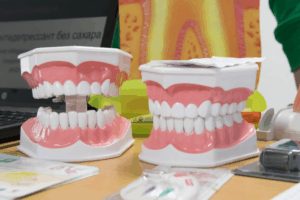
 

Scientists tested the effectiveness of the new enamel coating on real healthy teeth./Anastasia Kurshpel / UrFU

Hydroxyapatite is a compound that is a major component of human bones and teeth. Scientists selected a complex of polyfunctional organic and polar amino acids, including, for example, lysine, arginine, and histidine, which are important for the formation and repair of bone and muscle structures. The chosen amino acids made it possible to obtain hydroxyapatite, which is morphologically completely similar to apatite (the main component of tissues) of dental enamel. The researchers also described the conditions of the environment in which the processes of binding of hydroxyapatite to the dental tissue should occur. Only if these conditions are met it is possible to fully reproduce the structure of natural enamel.

“Traditionally in dentistry, composite restorative materials are used in enamel restoration. To increase the bonding efficiency of enamel and composite, the restoration technique involves acid etching of the enamel beforehand. The etching products left behind may not always have a positive effect on the bonding of enamel and synthetic materials. To reproduce the enamel layers with biomimetic techniques, we neutralized the media and removed the etching products using calcium alkali. In this way we improved the binding of the new hydroxyapatite layers,” explains Pavel Seredin.

The formation of a mineralized layer with properties resembling those of natural hard tissue was confirmed by field emission electron and atomic force microscopy as well as by chemical imaging of surface areas using Raman microspectroscopy. The study was conducted on healthy teeth to eliminate the influence of extraneous factors on the resulting layer and to be able to compare the results with healthy teeth. Next, the researchers will tackle the challenge of repairing larger defects, which can be of varying nature from the initial stages of caries to cracks and volumetric fractures.

A tougher tooth

Fewer trips to the dentist may be in your future, and you have mussels to thank.

Inspired by the mechanisms mussels use to adhere to inhospitable surfaces, UC Santa Barbara researchers have developed a new type of dental composite that provides an extra layer of durability to treated teeth. The potential payoff? Longer lasting fillings, crowns, implants and other work.

“It’s as hard as a typical dental restoration but less likely to crack,” Kollbe Ahn, a materials scientist at UCSB’s Marine Science Institute, said of the composite. The research is highlighted in the journal Advanced Materials. The paper, of which Ahn is the corresponding author, is the result of collaboration between research and industry.

On average, a dental restoration lasts five to 10 or so years before needing replacement. The time frame depends on the type of restoration and how well the patient cares for the treated tooth. However, the continual onslaught of chewing, acidic and hard foods, poor hygiene, nighttime tooth grinding, generally weak teeth and even inadequate dental work can contribute to a filling’s early demise — and another expensive and possibly less-than-pleasant experience in the dental chair.

According to Ahn, one of the primary reasons restorations fall out or crack is brittle failure of the bond with the surrounding tooth. “All dental composites have micro-particles to increase their rigidity and prevent their shrinkage during their curing process,” he explained. “But there’s a trade-off: When the composite gets harder, it gets more brittle.”

With enough pressure or wear and tear, a crack forms, which then propagates throughout the entire restoration. Or, the gap between the tooth and the restoration results in restoration failures, including marginal tooth decay.

So Ahn and his colleagues looked to nature — mussels, to be exact — to find a way not only to maintain strength and hardness but also to add durability. Having perfected the art of adhering to irregular surfaces under the variable conditions of the intertidal zone — evolving to resist pounding waves, the blazing heat of the sun and cycles of salt water immersion and windy dryness — mussels presented the ideal model for more durable dental restoration materials. The byssal threads they use to affix to surfaces allow them to resist the forces that would tear them from their moorings.

“In nature, the soft collagenous core of the mussel’s byssal threads is protected by a 5-to-10 micrometer thick, hard coating, which is also extensible and thus, tough,” Ahn said. This durability and flexibility allow the mollusks to stick to wet mineral surfaces in harsh environments that involve repeated push-and-pull stress.

Key to this mechanism is what the scientists call dynamic or sacrificial bonding — multiple reversible and weak bonds on the sub-nanoscopic molecular level that can dissipate energy without compromising the overall adhesion and mechanical properties of the load-bearing material.

“Say you have one strong bond,” Ahn explained. “It may be strong but once it breaks, it breaks. If you have several weaker bonds, you would have to break them one by one.” Breaking each weak bond, he continued, would dissipate energy, so the overall energy required to break the material would be greater than with a single strong bond.

This type of bonding occurs in many biological systems, including animal bone and tooth. The mussel’s byssus contain a high number of unique chemical functional groups called catechols, which are used to prime and promote adhesion to wet mineral surfaces. The new study shows that using a catecholic coupling agent instead of the conventional silane coupling agent provides 10 times higher adhesion and a 50 percent increase in toughness compared to current dental restorative resin composites.

While research has proven this toughening mechanism in soft materials, this study is one of the first — if not the first — to prove it with rigid and load-bearing materials.

This proof-of-concept, which also demonstrates no cytotoxicity, could mean tougher, more durable dental fillings. And that, in the long run, could mean fewer dental visits. Because each replacement filling also requires the dentist to file the surrounding tooth to prime its surface, given enough replacements a tooth might need to be crowned or extracted; and if not replaced, the tooth loss could have adverse consequences for the individual’s diet and health.

The next step, Ahn said, is to increase the material’s durability even further.

“By changing the molecular design you could have even denser coupling agents that exist on the surface, and then we can have a stronger and more durable dental composite,” he said, estimating a commercial product within a couple of years.