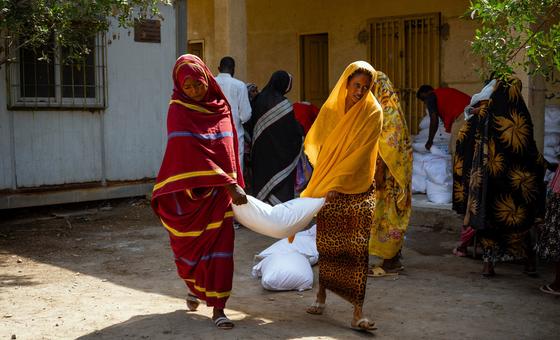
In a statement issued by his Spokesperson on Wednesday, UN Secretary-General António Guterres said he was “appalled” by the deteriorating situation in North Darfur, where the regional capital, El Fasher, is under intense and sustained attack.
The onslaught comes just two weeks after deadly assaults on the nearby Zamzam and Abu Shouk displacement camps, where hundreds of civilians, including humanitarian workers, were reportedly killed.
Mass displacement
More than 400,000 people have fled Zamzam camp alone, with the majority now seeking safety in Tawila, west of El Fasher.
There are also increasing reports of harassment, intimidation and arbitrary detention of displaced people at checkpoints, adding to the already dire humanitarian emergency.
“With the conflict now in its third year and increasingly destabilizing the broader region, the Secretary-General reiterates his call for the facilitation of safe and unhindered humanitarian access to all areas of need by all necessary routes,” UN Spokesperson Stéphane Dujarric said.
He also called for the protection of civilians, in line with the warring parties’ clear obligations under international humanitarian law.

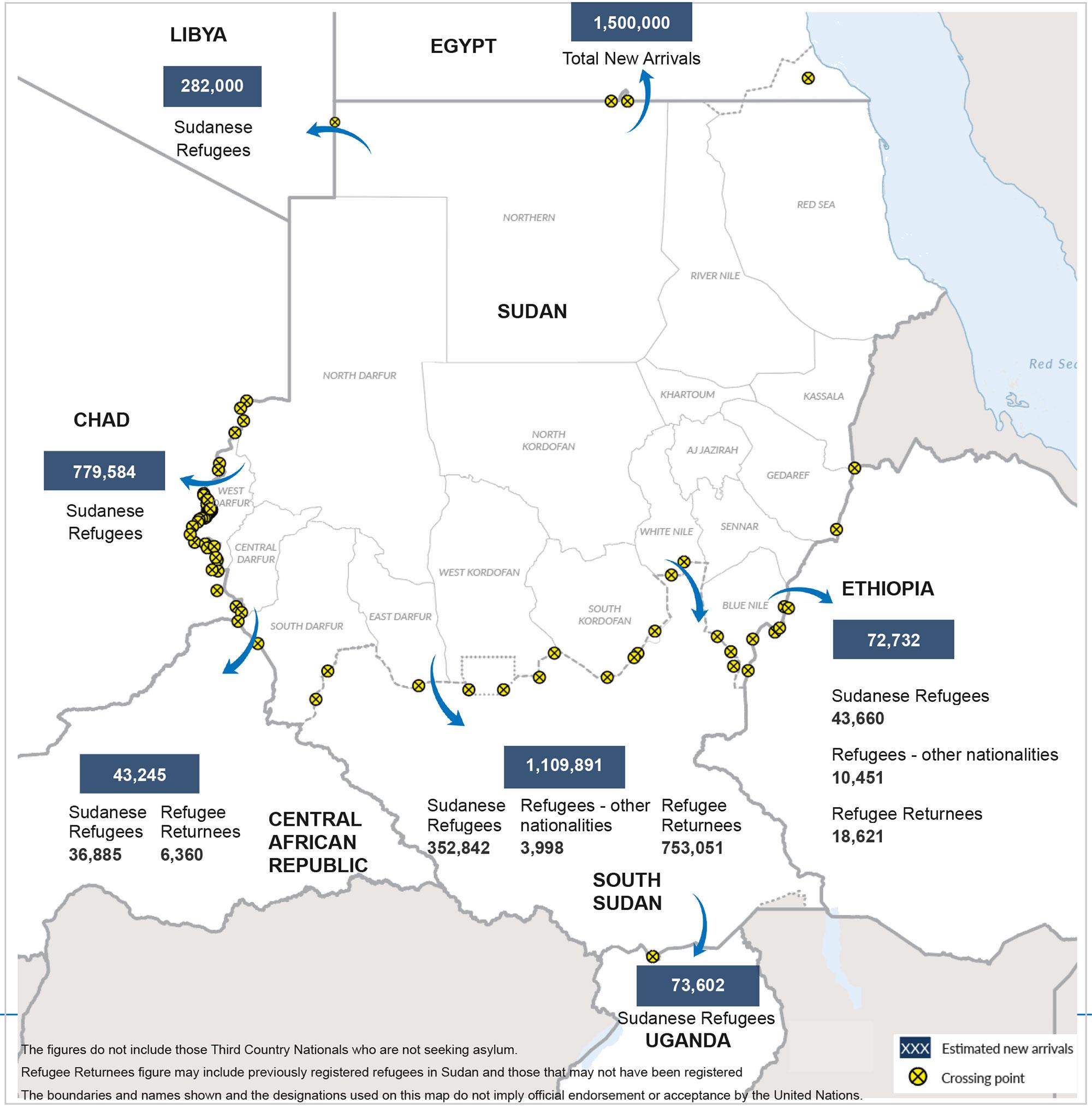
Refugee movements from Sudan.
Accountability is paramount
“Perpetrators of serious violations must be held accountable,” Mr. Dujarric stressed.
The civil war between rival militaries – the national Sudanese Armed Forces (SAF) and the paramilitary Rapid Support Forces (RSF) and allied militias – has claimed tens of thousands of lives and driven more than 12.7 million people from their homes, including nearly four million as refugees in neighbouring countries.
Violence and insecurity has also sparked a catastrophic hunger crisis, with over half the population suffering acute food insecurity and famine conditions confirmed in various regions, leaving millions at risk of starvation.
Emergency response underway in Tawila
Despite the escalating violence and dwindling funds, humanitarian agencies continue their efforts to deliver lifesaving aid.
The UN relief coordination office, OCHA, reported on Wednesday that an inter-agency convoy led by UN Deputy Humanitarian Coordinator Antoine Gérard crossed into Darfur from Chad earlier this week via the Adré border, en route to Tawila.
The convoy is transporting critical supplies including nutrition and medical items, dignity kits, and other essential goods.
Food and nutrition assistance for approximately 220,000 people has already reached Tawila, with the UN World Food Programme (WFP) confirming that distributions began this week and are already 20 per cent complete.
Additional convoys are in motion, including one expected to depart Chad on Wednesday with 19 trucks of nutrition supplies.
Aid reaches capital Khartoum
WFP has begun the first food distributions in the centre of the capital Khartoum since the conflict erupted two years ago.
Deliveries of 70 metric tonnes of food to the Burri neighbourhood are set to begin on Thursday, attempting to reach nearly 8,000 people.
Aid distributions have also started in Alazhari, one of the areas at high risk of famine, where 20,000 people are receiving assistance.
Despite these efforts, WFP warned that the impending rainy season and severe funding shortfalls could undermine recent progress.
The agency, which assists about four million people monthly, aims to expand coverage to seven million – but that still represents only a fraction of those in need.