

A new study published on April 2026 finds that Saturn has an asymmetrical magnetic field unlike Earth, based on six years of data from the Cassini–Huygens mission. Researchers led by institutions including University College London found that Saturn’s magnetic cusp shifts due to its rapid rotation and plasma from its moon Enceladus. The findings offer new insight into how magnetospheres behave on fast-spinning gas giants and could shape future missions to Saturn.
A region of space where charged particles slip into a planet’s atmosphere has revealed a key difference between Earth and Saturn.
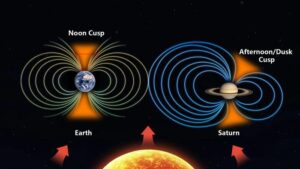
Researchers studying Saturn’s magnetic field found that its protective bubble, known as the magnetosphere, is not evenly shaped. Instead, it appears skewed to one side, a departure from the more symmetrical magnetic structure observed around Earth.
The findings come from a study published in Nature Communications, based on data gathered by the Cassini spacecraft over six years between 2004 and 2010.
Cassini Data Maps Saturn’s Shifted Magnetic Entry Point
The study focused on Saturn’s “cusp,” the region where magnetic field lines bend and allow solar wind particles to funnel into the planet’s atmosphere.
Using measurements from Cassini’s Magnetometer and Plasma Spectrometer instruments, researchers identified 67 instances where the spacecraft passed through this cusp region.
On Earth, the cusp typically aligns around noon when viewed relative to the Sun. On Saturn, the team found it most frequently appeared between 13:00 and 15:00, indicating a consistent shift to one side.
This displacement suggests that Saturn’s magnetosphere is being pulled in a particular direction rather than remaining evenly balanced.
Fast Rotation And Plasma Drive The Asymmetry
Scientists attribute this asymmetry to two main factors: Saturn’s rapid rotation and the dense plasma environment surrounding the planet.
A day on Saturn lasts about 10.7 hours, significantly faster than Earth’s 24-hour cycle. This rapid spin generates strong rotational forces that influence the planet’s magnetic field.
At the same time, Saturn is surrounded by a cloud of ionised gas, or plasma, much of which originates from its moon Enceladus. The moon releases water vapor through icy plumes, which becomes ionised and contributes to the magnetospheric environment.
Together, the fast rotation and heavy plasma appear to drag the magnetic field lines in one direction, creating the observed lopsided structure. Researchers noted that further simulations are required to confirm this mechanism.
Professor Andrew Coates of University College London’s Mullard Space Science Laboratory said the cusp plays a central role in understanding the system.
“The cusp is the place where the solar wind can slip directly into the magnetosphere. Knowing the location of Saturn’s cusp can help us better understand and map the whole magnetic bubble,” he said.

Implications For Future Missions And Search For Life
The findings come at a time when scientific interest in Saturn and its moons is growing, particularly due to Enceladus.
The icy moon contains a subsurface ocean and emits plumes that have drawn attention as a potential environment for microbial life. It is also a proposed destination for a future mission by the European Space Agency planned for the 2040s.
“A better understanding of Saturn’s environment is especially urgent now as plans for our return to Saturn and its moon Enceladus start to be developed,” Coates said.
“This time we will look for evidence of habitability and for potential signs of life.”
The study also supports a broader theory about how magnetospheres behave on large, fast-spinning planets.
Professor Zhonghua Yao of the University of Hong Kong said differences between Earth and Saturn point to a shared underlying process governing interactions with solar wind across planets.
Lead author Yan Xu of the Southern University of Science and Technology added that combining spacecraft data with simulations helped reveal how rotation and plasma shape the global magnetic structure.
A Broader Pattern Across Gas Giants
The research suggests that Saturn’s magnetosphere may resemble that of Jupiter more closely than Earth’s, despite all three planets being exposed to the same solar wind.
This indicates that internal planetary dynamics, such as rotation speed and plasma sources, can outweigh solar wind in shaping magnetic environments on gas giants.
The results provide a framework for studying other planetary systems, including exoplanets, where similar forces may be at play.
As researchers continue to analyze Cassini’s legacy data, Saturn’s magnetic field is offering a deeper view into how planetary systems function beyond Earth.
Also Read:
Indian scientists convert discarded battery waste into high-value material for cleaner fuel cells
Space Breakthrough: Astronomers confirm rogue planet candidate as a planet for the first time