

Scientists in India have developed a method to reuse graphite from discarded lithium-ion batteries to improve fuel cell efficiency, according to a recent study. The research, conducted by the International Advanced Research Centre for Powder Metallurgy and New Materials, shows that recycled graphite can enhance catalyst performance and durability in fuel cells. The findings, published in ACS Sustainable Resource Management, point to a dual solution for battery waste and clean energy challenges.
A used lithium-ion battery, often discarded after years of service, may hold more value than previously thought.
Scientists have found a way to extract graphite from spent batteries and transform it into a high-performance material that improves how fuel cells operate, offering a potential bridge between waste management and clean energy systems.
The work was carried out by researchers at the International Advanced Research Centre for Powder Metallurgy and New Materials, an autonomous institute under the Department of Science and Technology.
Recycled graphite and the challenge of fuel cell efficiency
Fuel cells, particularly those used in clean energy applications, rely on catalysts to drive chemical reactions that generate electricity. One of the most critical reactions is the oxygen reduction reaction, or ORR, which directly affects efficiency.
Platinum-based catalysts are widely used for this purpose but face two major limitations. They are expensive, and their performance can degrade over time due to poisoning by carbon monoxide and interference from methanol in certain fuel cell systems.
At the same time, the rapid rise in lithium-ion battery usage has created a growing stream of waste, with graphite being a major component of discarded batteries.
Researchers have been exploring whether this waste material could be repurposed to address bottlenecks in fuel cell technology.
How the material was developed and tested
The research team recovered graphite from end-of-life lithium-ion batteries and chemically exfoliated it, a process that increases its surface area and introduces more active sites for chemical interaction.
They then carried out detailed characterization and electrochemical testing to evaluate how the material performed in ORR conditions, including its tolerance to methanol.
Unlike earlier studies that focused mainly on alkaline environments, this work demonstrated effective performance in acidic conditions, which are relevant for many commercial fuel cell systems.
The exfoliated graphite was combined with platinum catalysts to form a conductive network that improved both electron flow and oxygen transport within the system.

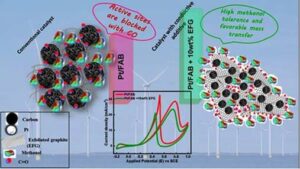
Fig: Graphical illustration of the Pt–exfoliated graphite catalyst, with exfoliated graphite forming a conductive network that suppresses methanol crossover and CO poisoning, leading to improved oxygen reduction performance and durability PIB
Performance gains and durability improvements
The study identified an optimal composition of 10 percent exfoliated graphite by weight, which delivered improved performance and stability compared with conventional setups.
The material showed an ability to selectively adsorb methanol molecules, acting as a barrier that prevents unwanted reactions. This reduces methanol oxidation and limits carbon monoxide poisoning of the platinum catalyst.
As a result, the system maintained higher efficiency over longer operating periods.
Researchers said the improvement in methanol tolerance and catalyst protection could address a key challenge in Direct Methanol Fuel Cells, a technology considered promising for portable and stationary energy applications.
Linking battery recycling with clean energy goals
The findings highlight a potential pathway to address two growing concerns: battery waste and the cost and durability of fuel cell technologies.
By converting discarded graphite into a functional material, the approach reduces reliance on expensive catalyst components while creating value from waste.
The work also supports broader efforts to build sustainable energy systems by improving the performance of fuel cells, which produce electricity with lower emissions compared with conventional combustion-based technologies.
Scientists say further research and scaling efforts will be needed to translate laboratory results into commercial applications, but the study establishes a proof of concept for integrating recycling and energy innovation.
The approach reflects a shift toward circular material use, where components from one technology lifecycle are repurposed to enhance another, reducing environmental impact while advancing clean energy solutions.