Violence roiling Nigeria extends beyond religious lines, amid a deepening humanitarian crisis

The strikes thrust Nigeria’s long-running sectarian bloodshed into the global spotlight – and revived claims that a “Christian genocide” is unfolding in Africa’s most populous country.

But in an interview, the UN’s top humanitarian official in the country has told UN News that the current crisis extends far beyond any single community or conflict. Violence, he cautioned, has spread across much of the country, leaving millions displaced and fuelling what aid agencies describe as one of Africa’s largest – and most overlooked – humanitarian emergencies.

“Security remains one of Nigeria’s major challenges,” said Mohamed Malik Fall, the UN resident and humanitarian coordinator. “You can no longer associate it with a single region. It is almost everywhere.”

A conflict that spread

The crisis began in the northeast in 2009, with an insurgency led by the jihadist group Boko Haram, later joined by splinter factions, including the Islamic State-West Africa (ISIS-WA). 

Nearly two decades in, the violence has reshaped large parts of the country.

More than two million people remain displaced in the northeast alone, many of them for years. “An entire generation has grown up in displacement camps, knowing nothing else,” Mr. Fall said.

The human toll is extensive: more than 40,000 people killed since the start of the insurgency, thousands of schools and health centres destroyed, and vast agricultural areas rendered inaccessible. But Mr. Fall said the deeper damage has been economic and social.

“People have been cut off from all economic activity,” he said. “They are deprived of the ability to live from their work and preserve their dignity.”

Children walk through the mud in a displaced persons camp in Maiduguri in northeast Nigeria.

Untargeted violence

What was once a localized insurgency has morphed into something broader and more diffuse.

In Nigeria’s northwest – in states such as Zamfara, Katsina and Sokoto – armed criminal groups have seized control of rural areas, carrying out mass kidnappings and extortion, a phenomenon authorities describe as banditry. 

Entire villages have been abandoned, and around one million people are now displaced in the region, according to United Nations estimates.

In the country’s central belt, clashes between farmers and herders over land, intensified by climate pressure and environmental degradation, have triggered further displacement. 

Elsewhere, separatist movements and attacks linked to oil production continue to destabilize communities.

The cumulative result is a country with roughly 3.5 million internally displaced people – nearly 10 percent of all displacement across Africa.

A loaded claim

Recent attacks against churches and Christian schools have revived international attention. In January, more than 160 worshippers were abducted during Sunday services in Kaduna State. 

Days earlier, villages in the northwest were attacked, killing dozens, while students near a Catholic school in Papiri were again targeted.

The violence revived memories of the 2014 abduction of 276 schoolgirls from Chibok, most of them Christian, by Boko Haram – a moment that once galvanized global outrage.

Citing the need to protect Christians from Islamist militants, the US administration ordered airstrikes on Christmas Day against jihadist positions in northern Nigeria. In Washington, some officials have since argued that a “Christian genocide” is underway.

The UN is refraining from that characterisation.

“Attributing this violence to the targeted persecution of a religious group – I would not take that step,” Mr. Fall said. “The vast majority of the more than 40,000 people killed in the insurgency are Muslims. They were attacked and killed in mosques.”

He pointed to an attack in Maiduguri, the historic centre of the insurgency, carried out on Christmas Eve in an area “between a mosque and a market,” which killed Muslim worshippers as they left prayers.

“Insecurity affects everyone, without distinction of religion or ethnicity,” he said, warning that oversimplified narratives risk deepening social fractures rather than addressing their causes.

© WFP/Arete/Siegfried Modola

Internally displaced mothers with their children attend a WFP famine assessment exercise in Borno State, northeastern Nigeria.

A crisis measured in millions

Behind the violence lies a humanitarian emergency of enormous scale. In the northeastern states alone, 7.2 million people need assistance – nearly six million of them in severe or critical condition, according to U.N. figures.

Food insecurity has become the defining threat. Aid agencies project that up to 36 million Nigerians could face varying levels of food insecurity in the coming months. Among children under five, more than 3.5 million are at risk of acute malnutrition.

“The consequences are not only immediate,” Mr. Fall said. “Malnutrition affects cognitive development, education, and continues to shape lives well into adulthood.”

Climate shocks – including droughts and floods – have compounded the crisis, alongside recurring cholera and meningitis outbreaks and a fragile health system.

Aid shrinks as needs grow

Despite the scale of the emergency, funding has collapsed.

“A few years ago, Nigeria’s humanitarian response plan raised close to $1 billion annually,” Mr. Fall said. “In 2024, it was $585 million. Last year, barely $262 million. This year, we are not even certain we will reach $200 million.”

The decline comes as donor attention has shifted to higher-profile crises elsewhere, including Ukraine and Sudan.

A test for Africa’s largest economy

Nigeria’s predicament exposes a stark paradox: one of Africa’s largest economies confronting a humanitarian crisis more often associated with far poorer states.

“Nigeria is not Sudan. It is not Somalia. It is not South Sudan,” Mr. Fall said. “This is a country with resources. The primary responsibility for responding to humanitarian needs lies with the government.”

The UN is now urging Nigerian federal and state authorities to take greater ownership of the response, even as it presses donors not to turn away.

“No one wants to live on aid,” Mr. Fall said. “People would rather be helped to access economic opportunities than remain dependent. Giving a fish is good. Teaching how to fish is better.”

Source link

The night the mountains shook: A doctor on the front lines of Afghanistan’s earthquake

At his home in Jalalabad, roughly 50 kilometres away from the epicentre, Dr. Sahak and his wife stormed out of their bedroom to find their eight children already in the hallway.

“I immediately thought about Herat,” the Afghan physician in his late forties told me, referring to the earthquakes that devastated the country’s western province in 2023. “I could tell that the impact would be huge as well.”

A native of the Jalalabad area, he knew first-hand what this new disaster would mean for the country’s northeast, where extended families all live under the same roof in remote, hard-to-reach locations.

Within seconds, their homes built of mud and loose stones would crumble. Roads would disappear under the rubble. Families would be buried alive as they slept.

The first calls

Dr. Sahak, who leads the local World Health Organization (WHO) emergency office, immediately turned to his health-cluster WhatsApp group, a thread that links hospitals, clinics and aid organisations across the region.

Reports began trickling in from Asadabad, the capital of neighboring Kunar Province, the hardest-hit area along the Pakistani border. There, the quake had been felt very strongly, the city’s main hospital informed him. Some residents would likely be injured.

By 1am, the calls grew more urgent: “We received multiple injuries from different areas and the situation is not good. If possible, provide us with support!”

Racing the monsoon

Dr. Sahak asked his WHO team to meet him at the organization’s warehouse in Jalalabad. As he and his colleagues drove through the dark, rain began to fall – the monsoon that would complicate everything, from helicopter landings to ambulance runs, in the first hours of the response.

Soon, the aid pipeline clicked into place. A truck was loaded with medical supplies at WHO’s depot, then transferred at Jalalabad’s airport, five kilometres away, before a Defence Ministry helicopter lifted pallets toward Nurgal District – the epicentre of the earthquake, midway between Asadabad and Jalalabad.

“Fortunately, we were able to quickly reach the most affected area,” Dr. Sahak said.

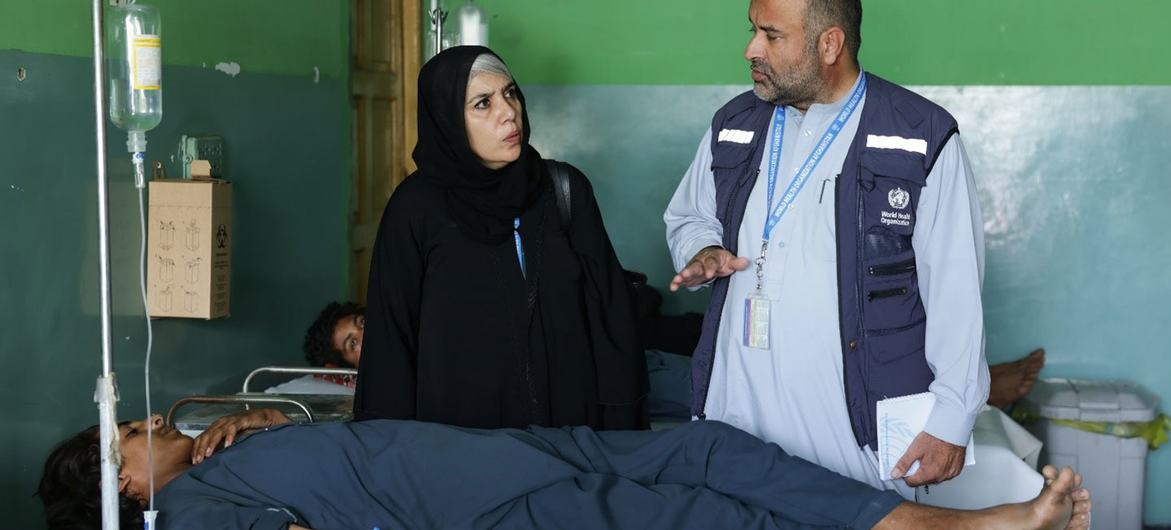
On September 2, 2025, Dr. Abdul Mateen Sahak and his WHO team visited a hospital in Kunar Province to monitor emergency healthcare services for people affected by the earthquake.

Into Nurgal District

His initial field team came down to just four people: himself, a technical adviser, an emergency focal point and a security assistant.

Within hours, they drew in Afghan partners from two local NGOs, assembling a force of 18 doctors, nurses, and pharmacists – “six of them were female doctors and midwives,” he said. That first day, WHO managed to airlift 23 metric tonnes of medicine to Nurgal District.

Meanwhile, the casualty figures kept climbing. “There was news that 500, maybe 600 people died. There were thousands of injuries and thousands of houses destroyed,” Dr. Sahak recalled.

Five days later, the official toll is far grimmer: more than 2,200 dead, 3,640 injured, and 6,700 houses damaged.

He and his team reached Nurgal District on Monday afternoon aboard an armoured vehicle. “Many roads were closed because big stones were falling from the mountains,” he said. On the lanes that remained open, crowds were slowing down traffic – thousands of civilians rushing in, most of them on foot, to help the victims.

‘Where is my baby?’

Once there, Dr. Sahak, a seasoned humanitarian worker, was unprepared for the scale of devastation. “We saw bodies in the street. They were waiting for the people to come in to bury them,” he said. Volunteer rescuers streamed in from neighbouring districts to clear rubble, carry the injured, and tend to the dead.

Among the survivors was a 60-year-old man named Mohammed, whose house had been destroyed.

I could not bear to look this man in the eyes. He was tearing up

“He had a total of 30 family members living with him…22 of them had died in the earthquake,” Dr. Sahak said. “This was shocking for me. I could not bear to look this man in the eyes. He was tearing up.”

At the local clinic, its walls cracked by the tremors, medical staff treated a rapidly growing number of patients beneath tents pitched outside.

Dr. Sahak met a woman with multiple injuries – pelvic fracture, head trauma, broken ribs. She struggled to breathe and could not stop crying. “She kept saying: ‘Where is my baby! I need my baby! Please bring me my baby!’” he recalled. Then he paused. “No, no, she lost her baby. All of her family.”
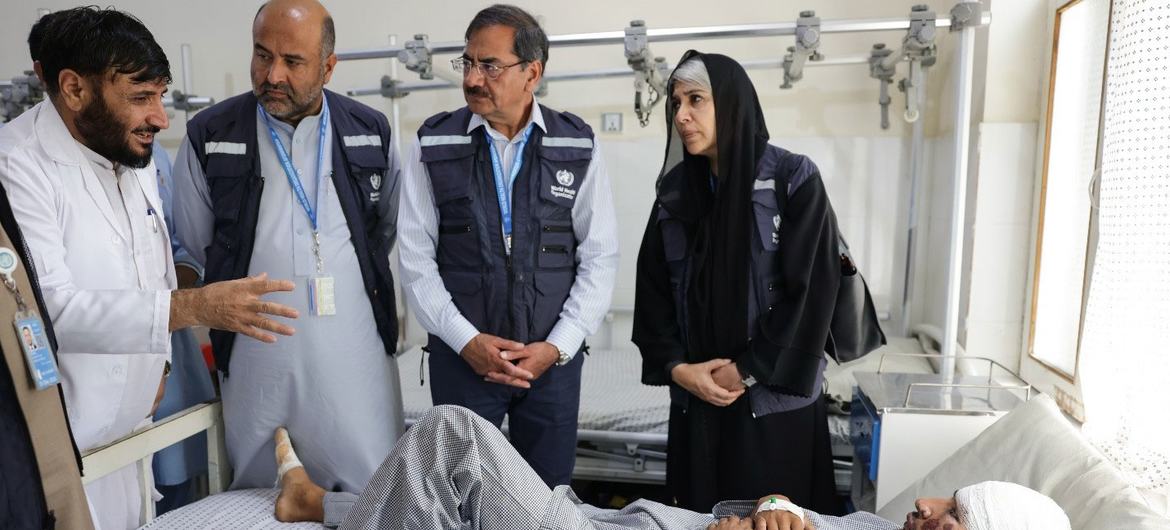
On September 2, 2025, Dr. Abdul Mateen Sahak and his WHO team visited the regional hospital of Asadabad, in Kunar Province, to monitor emergency healthcare services for people affected by the earthquake.

Women on the frontline

In a country where strict gender rules govern public life, the earthquake briefly broke down barriers.

“In the first few days, everyone – men and women – was rescuing the people,” Dr. Sahak said. Female doctors and midwives can still work in Afghanistan, but only if accompanied to hospitals by a male relative. He did not see female patients being denied care either.

In the first few days, everyone – men and women – was rescuing the people

The deeper crisis, he added, is the exodus of female professionals since the Taliban’s return in 2021. “Most of the specialist doctors, particularly the women, left the country…We have difficulty finding professional staff.”

The impact reached his own home. His eldest daughter had been in her fifth year of medical school in Kabul when the new authorities barred women from higher education.

“Now unfortunately, she is at home,” he said. “She can do nothing; there is no chance for her to complete her education.”

A family’s fear

From the outset, the WHO’s task was to keep clinics running by providing technical guidance, medical supplies, and clear instructions. It also meant offering words of encouragement to the medical staff. “We told them: ‘You are heroes!’” Dr. Sahak recalled.

As he cheered on local doctors, his family back in Jalalabad had been worried sick, following the news. He had spent a career running hospitals and leading emergency responses across Afghanistan, but this disaster struck too close to home.

That first night, when he finally returned to his wife and children, it was his 85-year-old mother who greeted him first. “She hugged me for more than 10 minutes,” he said.

She gently scolded him and tried to make him promise he would not go back to the stricken areas. But in the poor eastern districts of Nurgal, Chawkay, Dara-i-Nur and Alingar, tens of thousands of people were relying on the WHO to survive. The next morning, he was back on the trail.

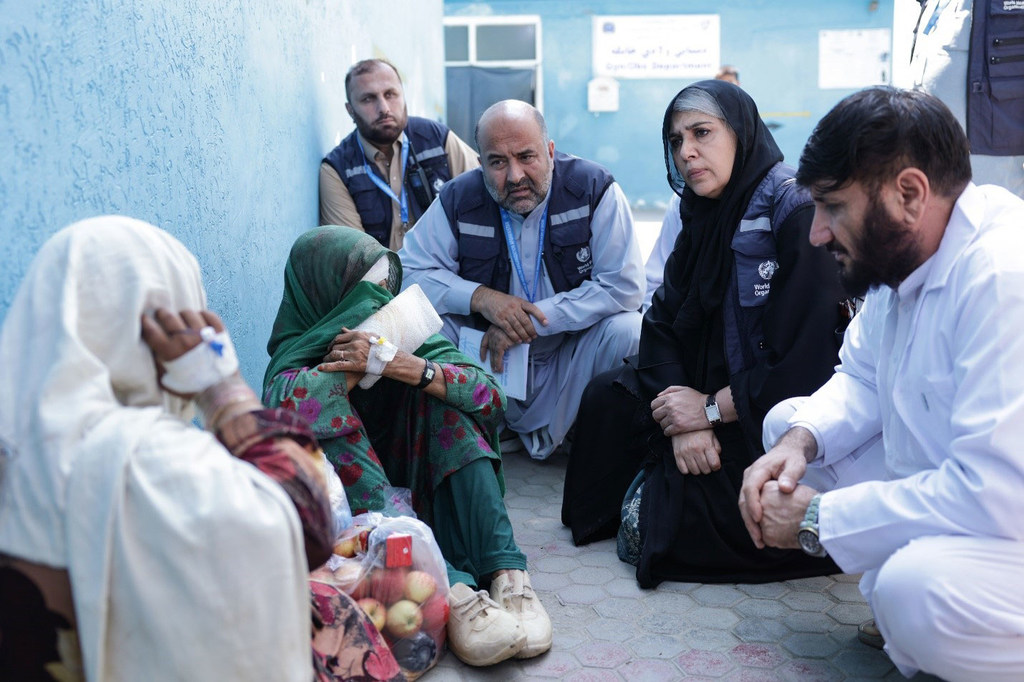
On September 2, 2025, Dr. Abdul Mateen Sahak and his WHO team met two women, at the regional hospital of Asadabad, in Kunar Province, who had lost all of their family members in earthquake, on 31 August 2025.

Ledger of life and death

By Friday afternoon, when I spoke to him, the figures in Dr. Sahak’s ledger told the story of the emergency: 46 metric tons of medical supplies delivered; more than 15,000 bottles of lactate, glucose and sodium chloride distributed – intravenous fluids for trauma and dehydration; and 17 WHO surveillance teams deployed to track the spread of disease, which the agency expects soon because of the destruction of drinking water sources and sanitation systems.

WHO has asked for $4 million to deliver lifesaving health interventions and expand mobile health services. About 800 critical patients had already been rushed to the hospital in Jalalabad. Others were taken to the regional hospital in Asadabad, which Dr. Sahak and his team visited on Tuesday.

A mother’s words

Outside the health facility, they noticed two survivors driven by the sun into a narrow strip of shade along a wall – an older woman and her daughter, both recently discharged, both alone.

They were alive, but their remaining 13 family members were dead

“They were alive, but their remaining 13 family members were dead,” Dr. Sahak said. There was no one left to collect them. The daughter, in her twenties, seemed devastated: “She was unable to speak.” Tears streamed down her face.

Moved by their plight, Dr. Sahak asked the hospital to keep them in a bed for a week or two. The director agreed. That night, back home, he recounted the scene to his family. “All of them were crying, and they were even unable to have dinner,” he said. By then, even his mother no longer begged him to stay.

“Please go there and support the people,” she told him.
Source link

Hunger lines in Gaza: ‘Food is not enough’

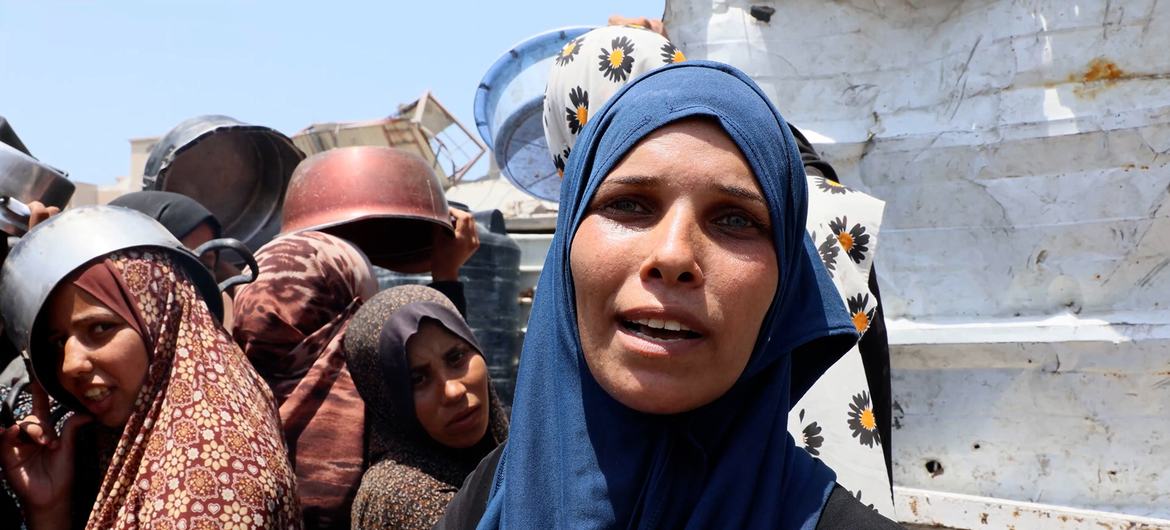
Earning a living has become a daily struggle, and hundreds of men, women and children stand in endless queues, under the scorching sun, outside the few community kitchens that serve nothing but lentil soup.

A community kitchen in western Gaza reveals a panorama of painful scenes amid displaced people suffering, their cries for help and their urgent appeals to the world, demanding an end to their tragedy and relief.

Community kitchen workers are busy preparing lentil soup while plastic bowls and empty plates are piled up behind an iron fence, waiting for a small amount that many may not be able to get a sip of.

After a bitter struggle, Ziad Al-Ghariz, an elderly displaced person from Gaza, managed to obtain a cup of lentil soup. He sat on the floor and began to take slow sips. He told UN News that he had not tasted bread for 10 consecutive days.

‘We are dying of hunger here’

“I eat the lentil soup distributed by the community kitchen,” he said. “I cannot afford flour at all. I do not have the money for it, so I try to get whatever the kitchen distributes. The people of Gaza are hungry.”

Young Mohammed Nayfeh says he spent four hours waiting for a meal for his family.

“I’ve been standing here for four hours, and I can’t get any food in the crowds and the sun,” he said. “We’re dying. We need support. We need food and drink. Where is the world? We’re dying here of hunger. Every day we eat only lentils. There’s no flour, no food, no drink. We’re dying of hunger.”

A group of displaced Palestinians gathering in front of a local community kitchen in western Gaza City.

Burn in the sun or get trampled

“Either we burn in the sun or we are trampled underfoot”

Umm Muhammad, a displaced person from the Shujaiya neighborhood, described the macabre scene around her.

“There is no water, no food, no bread,” she said. “The bitterness of the situation forces us to come here. In the end, we return with nothing. We either return burned under the sun or trampled underfoot due to overcrowding, and we return empty-handed. And no one listens.”

Hussam al-Qamari, who was also displaced from Shujaiya, said the situation is no longer acceptable.

“We are dying, and our children are starving to death,” she said. “So much is happening to the people of Gaza. Much of what is happening is unacceptable. An old man like me has been standing here since morning, carrying a bowl for his children to eat breakfast, and they still haven’t eaten.”

Um Muhammad, who fled from the Shujaiya neighbourhood in eastern Gaza City to its western areas, waits to get food.

From classrooms to queues for lentils

According to the latest findings from the United Nations Relief and Works Agency for Palestine Refugees (UNRWA), one in five children in Gaza City suffers from malnutrition, with cases increasing daily.

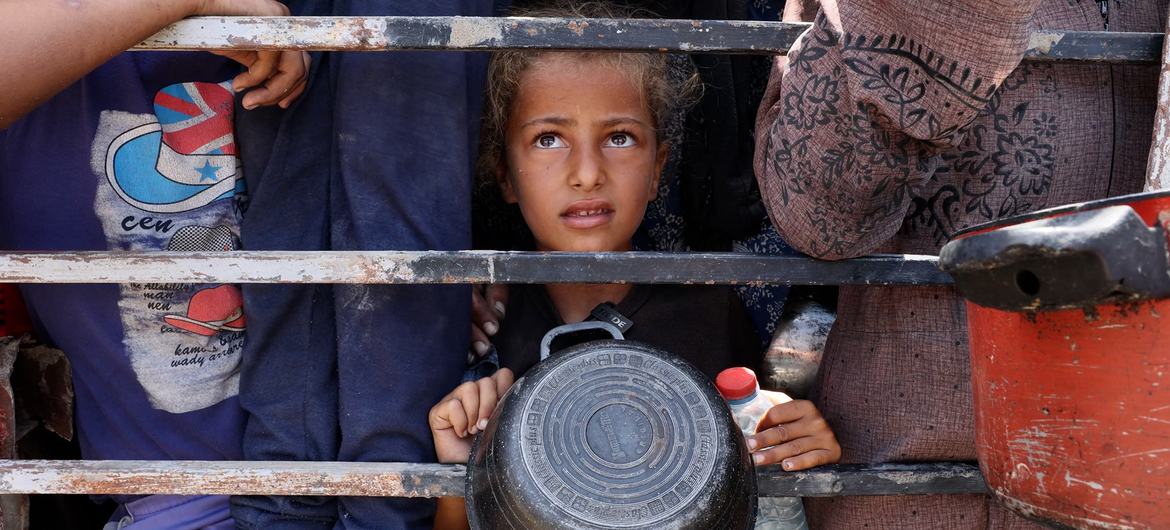
The image of this little girl standing behind an iron fence, holding her empty bowl waiting for a little lentil soup, encapsulates this horrific tragedy, for which children pay the heaviest price.

Bassam Abu Odeh, a displaced person from Beit Hanoun, made an appeal.

“We call on all the free people of the world and peace lovers to help us provide food and water until this famine imposed on us by the occupation ends. The trucks allowed into the area by the occupation are not even a drop in the ocean of needs. We have no one, but God.”

A young girl from Gaza waiting to fill her container with lentils.

‘Food is not enough’

Umm Rami, a displaced person from the Zeitoun neighborhood, said the necessities of life are lacking in Gaza, calling on the world to look at the people of the Strip with compassion.

“I came here to get a small amount of food to feed my children. “This is our reality now: we come to community kitchens for food, having once lived with dignity and respect in our own homes.”

She said food is not enough.

“We have reached a point where we stand in lines for food and water. As you can see, the lives of children now revolve around the lines for water and food. Food is not enough. We have only God. The world must look at us, and everyone must awaken their consciences.”

Undeniable risk of famine

According to a warning issued by the Integrated Food Security Phase Classification (IPC), Gaza is facing a severe risk of famine, as food consumption and nutrition indicators have reached their worst levels since the beginning of the current conflict.

The alert highlights that two of the three famine thresholds have been observed in parts of the Gaza Strip, with the World Food Programme (WFP) and the UN Children’s Fund (UNICEF) warning that time is running out to launch a comprehensive humanitarian response.

The UN Secretary-General said the alert confirms that Gaza is on the brink of famine. He said the facts are undeniable, and that Palestinians in Gaza are suffering a humanitarian catastrophe of epic proportions.

“This is not a warning, but a reality unfolding before our eyes,” he said.

He stressed the need for the aid trickle to become an “ocean”, with food, water, medicine and fuel flowing without hindrance.

“This nightmare must end,” he declared.

Death in search of food

The United Nations Office for the Coordination of Humanitarian Affairs (OCHA) said that days after the start of the tactical pauses announced by the Israeli authorities in Gaza, “we continue to witness casualties among those seeking assistance and more deaths from hunger and malnutrition.”

The UN office said that parents continue to struggle to save their starving children. Desperate and hungry people continue to unload small amounts of aid from trucks that manage to exit the crossings.

Although the UN and its partners are taking advantage of every opportunity to support those in need during unilateral tactical pauses, conditions for delivering aid and supplies are far from adequate, according to OCHA.