Speaking from the capital Kyiv which was rocked by some of the deadliest attacks of the war last week – and following a visit to the frontline region of Sumy – UN Women’s Representative in Ukraine Sabine Freizer Gunes described to UN News’s Nathalie Minard both the emotional exhaustion and the resilience she had witnessed.
The interview has been edited for clarity.
UN News: The situation for civilians in cities is drastic, with shelling and air raid sirens sounding for days and nights at a time. Could you describe your personal experience of living in a war zone?
Sabine Freizer Gunes, UN Women Representative in Ukraine: Living in a war zone like Ukraine is, on one hand, quite challenging, because as a UN official, we’re not allowed to bring our families here. So, one difficulty is living far away from one’s family.
Usually, in terms of the war situation and the attacks, they tend to happen at night. One of the clear challenges is being able to get through your week, when you’re woken up numerous times during the night. Sometimes there are attacks on Kyiv several days in a row. Sometimes it’s quiet for a week or 10 days.
Not knowing when you’re going to go to sleep, if you’re going to be able to sleep a full night, or if you’re going to have to wake up three or four times, if you’re going to have to go down to the shelter, if you’re going to have to check the news – I would say that mentally, that’s the most difficult thing. It’s not so much fear, it’s not knowing what your night is going to look like.

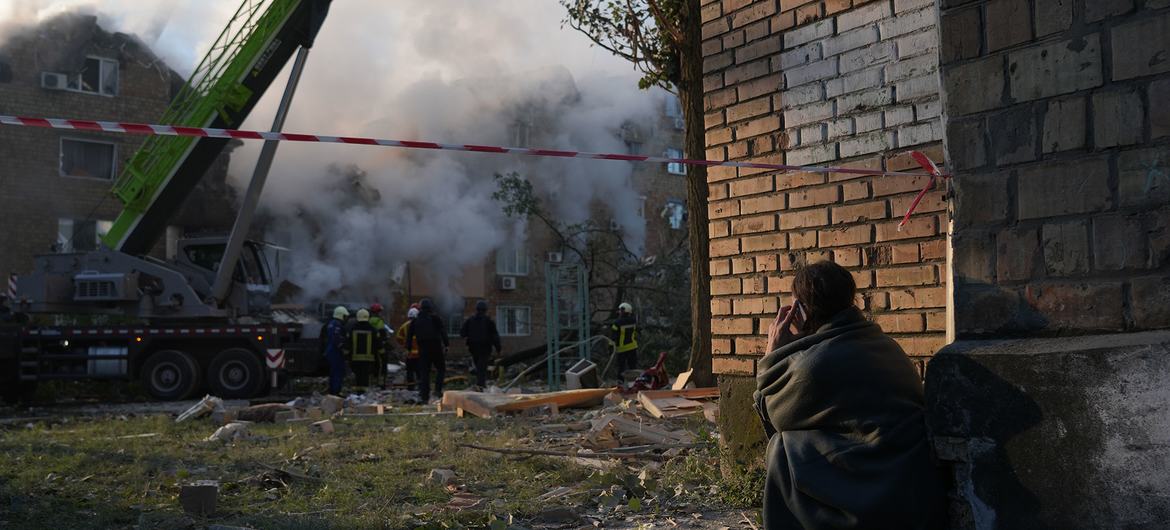
A resident near the ruins of a residential building in Kyiv, watching as emergency crews search for survivors following a missile strike in the early hours of the morning on 28 August.
UN News: You were recently in Sumy, very close to the eastern frontline. Many people have left the East for safer locations, but others have chosen to stay. How is the UN and UN Women and partners helping them?
Sabine Freizer Gunes: It is quite extraordinary that many Ukrainians are staying in their frontline communities. And some of these places have been under attack since 2014. What we do see is that people are continuing to live their lives.
I just came back from Sumy, which is 20 kilometers away from the Russian border, and the city is still completely vibrant. Businesses continue, cafes, restaurants, and shops are still open. People are still walking down the street.
This is the situation in Ukraine: from one moment to the next, tragedy can strike.
Life seems quite normal during many hours of the day, but then there’s always something kind of hidden beyond that. For example, with some of our colleagues, their husbands may be fighting on the frontline, their fathers or their brothers may have disappeared.
There’s always that element which isn’t visible but is behind the reality of the people that are working.
UN Women works very closely through local women’s rights organizations. When we have an attack, we ask them what kind of assistance we can provide.
Very often, those are going to be kits that are specifically assembled to meet the needs of women, particularly elderly women. It’s elderly women who are generally the last ones to leave their homes.
They insist on staying in their house, in their small yards, because they believe that’s a much better outcome than going to live in a collective centre.
What we try to do then is to provide them with some basic items so that they can stay in their homes.
One thing that I saw yesterday in Sumy, I saw that women’s rights organizations were doing very different kinds of activities. They’re doing cultural activities, activities to support young people, they’re providing legal advice or psychosocial advice. They are helping women get new skills to start their own businesses.
On one hand, there’s an humanitarian crisis and we need to provide life-saving support, but on the other, in the same town, we’re also discussing recovery and development.
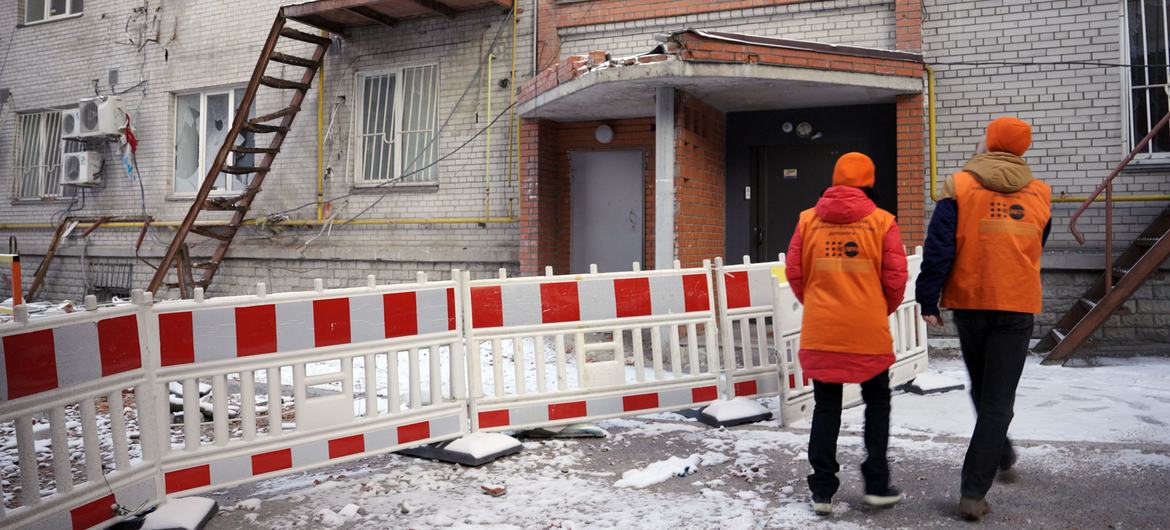
UNFPA’s mobile psychosocial support teams travel across Ukraine, including to the front lines, offering immediate emergency interventions as well as access to longer-term assistance.
UN News: Can you share the story of a woman that particularly moved you?
Sabine Freizer Gunes: One thing that really moved me recently was talking to six women who each represented a different NGO.
We were talking about our cooperation, and we asked them, “how have we helped you over the past several months?” And they said that one thing that they really benefited from was a retreat that we organized. I thought they were going to say that they benefited from material things that we gave them.
Instead, they said what they benefited from was a retreat, which was organized in western Ukraine, which is generally more peaceful. And we gave them five days to be in a quiet space where they could get to know each other, share experiences, and where they could sleep. One of them said, “this is the first time in three years that I got a decent night’s sleep”.
That was very powerful to hear, that giving space, a sense of normalcy to our partners can be incredibly powerful.
Listen to the full interview:
UN News: It’s three and a half years since Russia’s full-scale invasion of Ukraine. What are the most common impacts on women’s mental health you’ve encountered?
Sabine Freizer Gunes: Pretty much everybody who lives in Ukraine and who’s been living in Ukraine for the past three and a half years has some mental health issue. There is a clear effect of the war on everyone’s mental health. Regardless of who we’re working with at UN Women, we always include a mental health component.
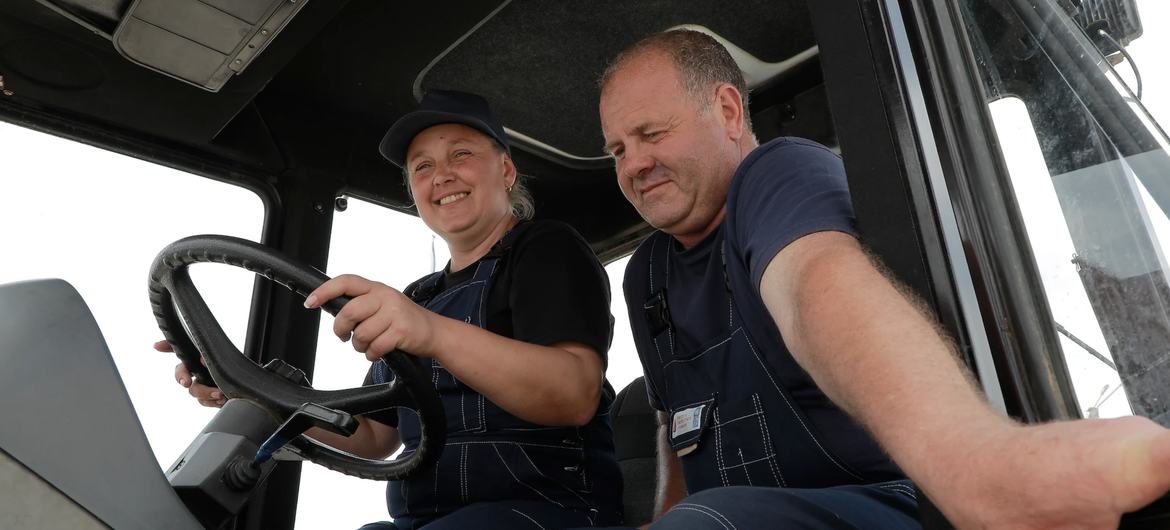
In the war-torn Ukrainian town of Snihurivka, a groundbreaking initiative is training women as tractor drivers – a role traditionally dominated by men.
For example, we are currently training women to be bus drivers, to take over positions which used to be held by men, but now with the men at the front, women are needed to take up these jobs.
UN News: Do you see a rise in gender-based violence (GBV)? What are the specific mental health challenges faced by women survivors of conflict-related sexual violence; and how do you address them?
Sabine Freizer Gunes: Conflict-related sexual violence is a real challenge in Ukraine. But very often in conflict situations, conflict-related sexual violence (CRSV) is something that’s hidden under the rug.
Here in Ukraine, the Government itself has spoken about conflict-related sexual violence and really encouraged those who are survivors to speak openly about it and to seek remedies and reparations.
In Ukraine, the Office of the High Commissioner on Human Rights has documented 484 cases.
But it is expected that’s just the tip of the iceberg, that there’s a lot of cases that are not known because they’re occurring today in occupied territories, in territories occupied by the Russian Federation, but also people do not feel ready yet to speak about it.
For CRSV in Ukraine, what’s interesting is that there are also many cases against men. So out of those 484 cases, 350 cases are men, and 119 cases are women.
That is because a vast majority of those cases are cases that occur in detention. Survivors of conflict-related sexual violence need extensive psychological support.
UN News: What urgent gaps exist in providing support to women in Ukraine today? How are funding cuts affecting your activities?
Sabine Freizer Gunes: Funding cuts are having a massive effect on the ability to provide support and services to Ukrainian women and girls. What we find to be the most disturbing is the effect of the cuts on Ukrainian women’s rights organizations.
UN women carried out a study back in March, about a month after the US declared its cuts. We did a survey of 100 different women’s rights organizations.
Seventy-three per cent reported already significant disruptions to their operations due to the cuts. Thirty-two per cent expected that they may have to suspend their operations in the next 6 months. Sixty-seven per cent were already forced to lay off staff. And 50 per cent expected that there would be further layoffs.
Most worryingly, 60 per cent of the women’s rights organizations have been forced to reduce or to suspend their gender-based violence services.
This is directly affecting women and girls’ lives. You imagine if you were a woman who was living an abusive relationship, you know that there is a shelter down the road, and suddenly you say, okay, this is too much. You go to the shelter, you knock on the door, and nobody answers anymore because there’s no more funding to keep that shelter open.