
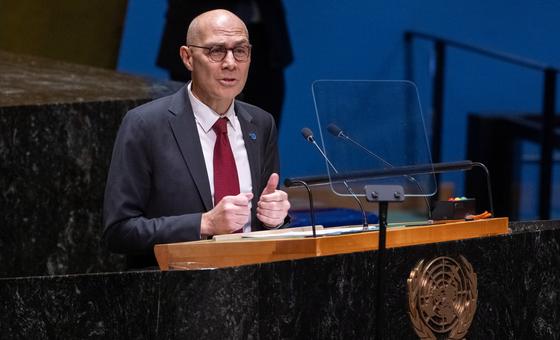
UN rights chief decries ‘relentless intensification’ of US sanctions against International Criminal Court staff

His call comes a day after four more Court personnel – two judges and two deputy prosecutors – were slapped with sanctions in connection with efforts to investigate alleged war crimes committed by the US and Israel.

This follows sanctions imposed earlier on four other judges and the ICC Prosecutor. Measures imposed could include blocking financial access to property or assets in the US, as well as travel bans.

‘Assault on the rule of law’

The relentless intensification of US reprisals against international institutions and their personnel must stop,” said Mr. Türk. 

“Sanctioning judges and prosecutors at national, regional or international levels, for fulfilling their mandate in accordance with international law standards, is an assault on the rule of law and corrodes justice.”

The sanctions stem from an executive order signed by US President Donald Trump in February in response to the UN-backed Court issuing arrest warrants for Israeli Prime Minister Benjamin Netanyahu and former defense minister Yoav Gallant for alleged war crimes and crimes against humanity in Gaza.

The ICC is also probing war crimes allegedly committed in Afghanistan by all sides during years of conflict, including the US, following the allied invasion of the country in October 2001.

Neither the US nor Israel are party to the Rome Statute, the treaty that established the ICC.

It’s time countries step up

Mr. Türk called for the withdrawal of the sanctions against the ICC personnel and those targeting the Special Rapporteur on the human rights situation in the Occupied Palestinian Territory.

The independent expert, Francesca Albanese, receives her mandate from the UN Human Rights Council in Geneva. For more details, read our story here.

“In the meantime, I call on States to take immediate steps to protect all of them, including by taking measures to encourage corporations operating within their jurisdiction not to implement the sanctions against these individuals,” Mr. Türk said.

States need to step up to defend the institutions they have created to uphold and defend human rights and the rule of law. Those working to document, investigate and prosecute serious violations of international law should not have to work in fear.”

About the International Criminal Court

The ICC investigates and tries individuals charged with genocide, war crimes, crimes against humanity and the crime of aggression. Read our explainer here.

Some of the cases include situations in Sudan, the Democratic Republic of the Congo and Libya. 

In March 2023, the Court issued an arrest warrant for Russian President Vladimir Putin in connection with alleged war crimes concerning the deportation and “illegal transfer” of children from occupied Ukraine.

The ICC was established in 2002 and is based in The Hague, in the Netherlands.  
Source link

International Criminal Court: New US sanctions ‘a flagrant attack’ on judicial independence

The sanctions target judges Kimberly Prost of Canada and Nicolas Guillou of France, as well as two deputy prosecutors: Nazhat Shameem Khan of Fiji and Mame Mandiaye Niang of Senegal.

This follows earlier measures against four other judges and the ICC prosecutor.

Affront to victims

In a press statement announcing the new round of sanctions, US Secretary of State Marco Rubio said the ICC “is a national security threat that has been an instrument for lawfare against the United States and our close ally Israel.”

The UN-backed court denounced the sanctions as “a flagrant attack against the independence of an impartial judicial institution”.  

Furthermore, “they constitute also an affront against the Court’s States Parties, the rules-based international order and, above all, millions of innocent victims across the world.”

Investigating grave crimes

The ICC investigates the gravest crimes of concern to the international community, namely genocide, war crimes, crimes against humanity and the crime of aggression. Read our explainer here.

It is based in The Hague, in the Netherlands, and was established under a 1998 treaty known as the Rome Statute which came into force four years later.  The United States and Israel are not among the 125 States that are party to the treaty.

Last November, the ICC issued arrest warrants for Israeli Prime Minister Benjamin Netanyahu and former defence minister Yoav Gallant, together with a former Hamas commander, in connection with the conflict in Gaza, citing allegations of war crimes and crimes against humanity. 

It is also probing war crimes allegedly committed in Afghanistan by all sides during years of conflict, including the US, following the allied invasion of the country in May 2003.

Strong and undeterred

The Court reiterated that it “stands firmly behind its personnel and victims of unimaginable atrocities” and “will continue fulfilling its mandates, undeterred, in strict accordance with its legal framework as adopted by the States Parties and without regard to any restriction, pressure or threat.”

The ICC called upon “States Parties and all those who share the values of humanity and the rule of law to provide firm and consistent support to the Court and its work carried out in the sole interest of victims of international crimes.”

The UN underlined the key role that the ICC has in international criminal justice and expressed concern over the imposition of further sanctions.

The decision imposes severe impediments on the functioning of the office of the prosecutor and respect for all the situations that are currently before the court,” UN Spokesman Stéphane Dujarric told journalists in New York.

“Judicial independence is a basic principle that must be respected, and these types of measures undermine the foundation of international justice.” 

Source link

International Criminal Court: Deputies take over amid Prosecutor misconduct probe

In a statement on Monday, the prosecutors’ office confirmed that deputies Nazhat Shameem Khan and Mame Mandiaye Niang are taking the lead, ensuring continuity across all cases and operations.

The transition follows Prosecutor Khan’s announcement on 16 May that he would temporarily step aside while the UN Office of Internal Oversight Services (OIOS) conducts an external inquiry into the allegations.

The investigation into widely reported allegations of sexual misconduct is being conducted by the OIOS at the request of the ICC’s governing body. Mr. Khan has denied the allegations.

Although the ICC’s Independent Oversight Mechanism typically handles such matters, the OIOS was brought in given the circumstances of the allegations and perceptions of possible and future conflicts of interest.

Duty of care

The prosecutors’ office said it would fully cooperate with the investigation, while underscoring the need to protect the privacy and rights of everyone involved – emphasising the importance of safeguarding the integrity of the OIOS investigation.

The Office is acutely aware of the duty of care it owes to all staff members and personnel, especially affected individuals,” the statement underscored.

Impartial and fair process

The Presidency of the Assembly of States Parties to the ICC – which elects the 18 judges – said on Sunday that the OIOS investigation was being carried out to ensure a full independent, impartial and fair process.

“The findings of the investigation will be handled in a transparent manner in accordance with the Rome Statute and the legal framework of the Court,” it noted.

Upholding ICC’s mandate

In assuming leadership, the Deputy Prosecutors underlined the importance of ensuring continuity of the office’s activities across all areas of work, and particularly in its mission to investigate and prosecute the most serious crimes – genocide, war crimes, crimes against humanity and the crime of aggression – with independence and impartiality.

Court in the spotlight

The Prosecutor’s leave of absence comes at a sensitive moment for the ICC, which is conducting investigations and prosecutions across multiple conflict zones, including Afghanistan, the Democratic Republic of the Congo, Libya, Sudan (Darfur) and Ukraine.

Last November, the ICC issued arrest warrants for senior Israeli officials, prompting the United States to announce punitive sanctions against the Court.

These include measures against senior personnel – including Prosecutor Khan – with threats of arrest should they travel to the US.

Relationship with the United Nations

The International Criminal Court (ICC) is an independent judicial body established under the Rome Statute, adopted in 1998 and in force since 2002. Although not part of the United Nations, the ICC works closely with it under a cooperative framework.

The UN Security Council can refer situations to the ICC, enabling the Court to investigate and prosecute most serious crimes. Notable referrals include the situations in Darfur, Sudan (2005) and Libya (2011).

In return, the ICC reports to the Security Council when needed involving referrals.

Source link