‘Yoga for Healthy Ageing’: Theme for International Day of Yoga 2026

The theme for the 12th International Day of Yoga (IDY), to be observed on June 21, 2026, has been announced as “Yoga for Healthy Ageing”, underscoring the growing global recognition of yoga as a holistic tool for enhancing physical, mental and emotional well-being.

Rooted in India’s ancient traditions and embraced worldwide, yoga has increasingly been viewed as an effective means of promoting healthy and active living. The theme highlights yoga’s role in fostering vitality, resilience and independence, while reinforcing its importance in preventive healthcare and overall wellness.

Speaking on the theme, Union Minister of State (Independent Charge) for Ayush and Minister of State for Health and Family Welfare, Shri Prataprao Jadhav, said, “The theme for this year’s IDY, ‘Yoga for Healthy Aging’, holds immense relevance today. As life expectancy continues to rise, it is vital that we learn the art of aging gracefully and healthily—a concept beautifully exemplified in India’s ancient civilization, where our sages and yogis sustained longevity and vibrant health through the power of yoga and spiritual discipline.”

Focus on Healthspan, Not Just Lifespan

The theme places emphasis on improving not only lifespan but also “healthspan”—the number of years a person lives in good health. Through physical postures, breathing exercises, meditation and mindfulness practices, yoga offers a comprehensive approach to maintaining mobility, emotional resilience and mental well-being throughout the ageing process.

The concept aligns with growing global efforts to promote healthy ageing amid rising life expectancy and changing demographic trends.

Scientific Interest Continues to Grow

The benefits of yoga in supporting healthy ageing are increasingly being backed by scientific research.

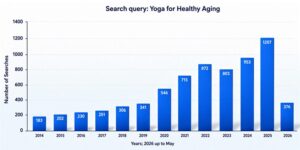
According to data available on PubMed Central, the number of scholarly publications focusing on “Yoga for Healthy Aging” has risen sharply over the past decade. Research papers on the subject increased from 183 in 2014 to 1,207 in 2025. The volume of publications crossed 500 in 2020 and has continued to expand steadily since then.

The growing body of evidence supports the long-standing view within India’s traditional knowledge systems that healthy ageing depends on maintaining a balance between physical, mental and social well-being.

Rising Opportunities in the Silver Economy

The focus on healthy ageing coincides with the rapid expansion of the global “silver economy,” which comprises products and services designed for senior citizens.

In India, the senior-focused economy—including healthcare, wellness services, rehabilitation, assisted living, digital health and elder care—is estimated at nearly ₹73,000 crore and is expected to grow significantly in the coming years.

With people in the 45-64 age group increasingly emerging as a major consumer segment worldwide, demand for preventive healthcare and wellness-oriented lifestyles is on the rise. Yoga is increasingly being viewed as an affordable and accessible solution that supports active and healthy ageing.

PIB

Ayush Ministry’s Yoga Initiatives

The Ministry of Ayush has launched several programmes to promote yoga as a year-round wellness practice and strengthen its role in preventive healthcare.

Among them is the Ministry’s evidence-based “10 Yoga Protocols for Non-Communicable Diseases (NCDs) and Target Groups,” which includes a dedicated protocol tailored for senior citizens. The programme aims to improve flexibility, balance, mobility, respiratory health and emotional well-being through age-appropriate yoga practices.

The Ministry is also advancing its “Yoga 365” initiative, which seeks to encourage daily yoga practice beyond the annual International Day of Yoga celebrations. The programme leverages technology-driven platforms and home-based practice modules to make yoga more accessible.

Another initiative, “Yoga Samavesh,” focuses on extending the benefits of yoga to vulnerable and underserved communities. Through chair yoga, low-impact exercises and community wellness sessions, the programme aims to help senior citizens maintain independence, social engagement and overall well-being.

Innovation Supporting Elder Care

The IDY 2026 theme complements broader government efforts to address the needs of India’s ageing population.

Programmes such as the Seniorcare Ageing Growth Engine (SAGE) are promoting innovation, entrepreneurship and start-up participation in the development of elderly care solutions.

The increasing awareness of yoga’s health benefits is also creating new opportunities for wellness professionals, caregivers, digital health providers and community organisations involved in senior care. Experts expect growing demand for trained personnel capable of supporting holistic and non-clinical aspects of ageing.

A Timely Message for an Ageing World

As countries around the world adapt to changing demographic realities, the theme “Yoga for Healthy Ageing” carries a timely and relevant message.

By encouraging preventive healthcare, active lifestyles and holistic wellness, yoga offers a practical pathway to improving quality of life across age groups. As the world prepares to mark International Day of Yoga 2026, the theme reaffirms India’s commitment to sharing a time-tested practice that promotes healthy, active and graceful ageing.


Also Read:

Yoga and meditation improve brain function and energy levels

India Showcases Merits of International Day of Yoga to World

VMC is biomarker of ageing for nematode; what is its role in Humans?

We all grow old and die, but we still don’t know why. Diet, exercise and stress all effect our lifespan, but the underlying processes that drive ageing remain a mystery. Often, we measure age by counting our years since birth and yet our cells know nothing of chronological time—our organs and tissues may age more rapidly or slowly regardless of what we’d expect from counting the number of orbits we tale around the sun.

For this reason, many scientists search to develop methods to measure the “biological age” of our cells -– which can be different from our chronological age.  In theory, such biomarkers of ageing could provide a measure of health that could revolutionize how we practice medicine. Individuals could use a biomarker of ageing to track their biological age over time and measure the effect of diet, exercise, and drugs and predict their effects to extend lifespan or improve quality of life. Medicines could be designed and identified based on their effect on biological age. In other words, we could start to treat ageing itself.

However, no accurate and highly predictive test for biological age has been validated to date. In part, this is because we still don’t know what causes ageing and so can’t measure it. Definitive progress in the field will require validating biomarkers throughout a patient’s lifetime, an impractical feat given human life expectancy.

To understand the irreducible components of ageing, and how these can be measured and tested, researchers turn to laboratory animals. Unlike humans, the nematode C. elegans lives for an average of two weeks, making it easier to collect behavioural and lifespan data that would otherwise require centuries.

The nematode C. elegans begin adulthood vigorously exploring their environment. Over time, they slow and stop crawling, a behavioural stage known as vigorous movement cessation (VMC). VMC is a biomarker of ageing and a proxy for nematode health. Studies of genetically identical nematodes have shown it is a powerful predictor of a worm’s lifespan, but at the same time, interventions designed to alter ageing can disproportionately affect VMC in comparison to lifespan and vice versa. Researchers at the Centre for Genomic Regulation (CRG) in Barcelona seek to understand why this happens and what this means for the ageing process in humans.

A team lead by Dr. Nicholas Stroustrup, Group Leader at the CRG’s Systems Biology research programme, has developed the ‘Lifespan Machine’, a device that can follow the life and death of tens of thousands of nematodes at once. The worms live in a petri dish under the watchful eye of a scanner that monitors their entire lives. By imaging the nematodes once per hour for months, the device gathers data at unprecedented statistical resolution and scale.

The research team found that nematodes have at least two partially independent ageing processes taking place at the same time – one that determines VMC and the other determines time of death. While both processes follow different trajectories, their rates are correlated to each other, in other words, in individuals for whom VMC occurred at an accelerated rate, so did time of death, and vice versa. In other words, the study revealed that each individual nematode has at least two distinct biological ages.

The researchers made the finding by building a genetic tool that lets them control the nematodes’ rate of ageing – effectively choosing an average lifespan for the population that can range from between two weeks and a few days. The tool works by tagging RNA polymerase II – the enzyme that makes mRNA – with a small molecule. Worms were fed different amounts of the hormone auxin, which finely controls the activity of RNA polymerase II, which in turn changes their lifespan.

Each individual C. elegans worm lives in a petri dish under the watchful eye of the Lifespan Macine’s scanner, which monitors their entire lives. By imaging the nematodes once per hour for months, the device gathers data at unprecedented statistical resolution and scale./CREDIT:Nicholas Stroustrup/CRG

Humans are larger and, in many ways, more complex than nematodes, and so are likely to have an even higher number of distinct biological ages than nematodes. Altogether, the study demonstrates how multiple, mostly independent ageing processes can work in tandem to cause different parts of the animal to age at different rates. The findings challenge the concept that animals have a single, unitary measure of biological age that can be indicative of an individual’s overall health.

The researchers also found that no matter which lifespan-altering mutations and interventions they gave the nematodes, the statistical correlation between the distinct biological ages remained constant. This suggests the existence of an invisible chain of command – or hierarchical structure – that regulates the worm’s ageing processes, the mechanisms of which are yet to be discovered. This means that, while ageing processes can be independent, it is also true that some individuals are ‘fast agers’ and others ‘slow agers’, in that many of their ageing processes move similarly faster or slower than their peers.

The study calls into question a crucial assumption of ageing biomarkers, that when interventions such as exercise or diet “rejuvenate” a biomarker, it’s a good sign that the underlying biology of ageing has similarly changed. “Our model shows that biomarkers can be trivially decoupled from outcomes because they measure an ageing process that is not directly involved in the outcome but simply correlates with it in a system of hierarchical processes,” explains Dr. Stroustrup. “In simple terms, just because two parts of an individual tend to correlate in their biological age across individuals, it doesn’t mean that one causes the other, or that they are likely to involve shared ageing mechanisms.”

The findings have implications for consumers being offered commercial products that assess their biological age. Biological age tests use panels of biomarkers that are purported as being meaningfully diverse. These can measure a thousand different parts of an individual, but those parts might all be confounded in an identical way.

According to Dr. Stroustrup, the solution lies in finding biomarkers that measure distinct, interacting ageing processes that also minimally correlate with each other. “Biomarkers used to assess biological age can be changed without actually turning a ‘fast ager’ into ‘slow ager’. Researchers should focus on measuring the effect of interventions on functional outcomes rather than assuming that changes in biomarkers will predict outcomes in a straightforward way,” he concludes.

Also Read:

Being away from excessive blue light from our gadgets slows ageing process

Depression and early old age go hand-in-hand, finds study

How Climate Change tweaked popular proverbs or made them redundant now, finds Study