The US National Institute of Allergy and Infectious Diseases (NIAID), part of the National Institutes of Health (NIH) has started working on a clinical trial to evaluate whether the malaria drug hydroxychloroquine, given together with the antibiotic azithromycin, can prevent hospitalization and death from coronavirus disease 2019 (COVID-19).
The Phase 2b trial will enroll approximately 2,000 adults across the United States who have confirmed infection with SARS-CoV-2, the virus that causes COVID-19, and experiencing fever, cough and/or shortness of breath. The investigators anticipate that many of those enrolled will be 60 years of age or older or have a comorbidity associated with developing serious complications from COVID-19, such as cardiovascular disease or diabetes.
Participants will be randomly assigned to receive short-term treatment with either hydroxychloroquine and azithromycin or matching placebos. People living with HIV and pregnant and breastfeeding women also are eligible to participate in the study. The first participant enrolled today in San Diego, California.
Fauci defends clinical trial
“We urgently need a safe and effective treatment for COVID-19. Repurposing existing drugs is an attractive option because these medications have undergone extensive testing, allowing them to move quickly into clinical trials and accelerating their potential approval for COVID-19 treatment,” said NIAID Director Anthony S. Fauci.
Currently, there are no specific therapeutics approved by the U.S. Food and Drug Administration to treat people with COVID-19. Hydroxychloroquine is FDA-approved to prevent and treat malaria, as well as to treat the autoimmune diseases rheumatoid arthritis and lupus.
FDA approval
Some preliminary reports have suggested that hydroxychloroquine, alone or in combination with the FDA-approved antibiotic azithromycin, may benefit people with COVID-19. On March 28, FDA issued an Emergency Use Authorization (EUA) to allow hydroxychloroquine and medical-grade chloroquine to be distributed from the Strategic National Stockpile and prescribed by doctors to hospitalized adolescents and adults with COVID-19, as appropriate, when a clinical trial is not available or feasible.
“This study will provide key data to aid responses to the COVID-19 pandemic,” said ACTG Chair Judith Currier of the University of California, Los Angeles. “We are pleased to be able to leverage ACTG’s existing infrastructure for HIV treatment clinical trials to quickly implement this important study.”
Treatment with antivirals such as interferons may significantly clear virus and reduce levels of inflammatory proteins in COVID-19 patients, said a new study conducted by researchers in Toronto.
Researchers conducting an exploratory study on some confirmed COVID-19 cases in Wuhan found that treatment with interferon (IFN)-α2b significantly reduced the duration of detectable virus in the upper respiratory tract and reduced blood levels of interleukin(IL)-6 and C-reactive protein (CRP), two inflammatory proteins found in the human body.
The findings, published in the journal Frontiers in Immunology show potential for the development of an effective antiviral drug COVID-19 global pandemic caused by the novel coronavirus, SARS-CoV-2, said researchers.
“Interferons are our first line of defence against any and all viruses – but viruses such as corona-viruses have co-evolved to very specifically block an interferon response”, said lead author Dr Eleanor Fish of the Toronto General Hospital Research Institute & University of Toronto’s Department of Immunology. “This informs us of the importance of interferons for the clearance of virus infections. Treatment with interferon will override the inhibitory effects of the virus,” he noted.
Earlier study on SARS helped
Fish and his team of doctors considered IFN-α therapy for COVID-19 based on their earlier findings during the 2003 SARS outbreak. “My group conducted a clinical study in Toronto to evaluate the therapeutic potential of IFN-α against SARS. Our findings were that interferon treatment sped up the resolution of lung abnormalities in patients treated with interferon compared with those not treated with interferon” said Fish.
The authors examined the course of disease in a group of 77 individuals with confirmed COVID-19 and admitted to Union Hospital, Tongii Medical College, Wuhan in China, between January 16 and February 20, 2020. The individuals were in their preliminary stage of disease and required no intensive care or oxygen supplementation or intubation.
Patients were either treated with IFN-α2b, arbidol (ARB), which is a broad-spectrum antiviral, or a combination of IFN-α2b plus ARB, and viral clearance was defined as two consecutive negative tests for virus at least 24 hours apart, from throat swab samples.
The researchers found treatment with IFN-α2b, whether alone or in combination with ARB, accelerated viral clearance when compared to ARB treatment alone. IFN treatment was able to significantly reduce circulating levels of IL-6 and CRP, whether alone or in combination with ARB. Noticeably, age and sex did not negate the effects of IFN treatment on viral clearance times or on the reduction in the inflammatory proteins IL-6 and CRP, they said.
Clinical trial next
Despite the study being a small and non-randomised cohort, the work provides new insights into COVID-19 disease, notably accelerated viral clearance from the upper respiratory tract and reduced circulating inflammatory biomarkers, hinting at functional connections between viral infection and host end organ damage by limiting the subsequent inflammatory response in the lungs of patients.
In defense of the treatment method, Fish argues, “Rather then developing a virus-specific antiviral for each new virus outbreak, I would argue that we should consider interferons as the ‘first responders’ in terms of treatment. Interferons have been approved for clinical use for many years, so the strategy would be to ‘repurpose’ them for severe acute virus infections.”
Fish says a randomized clinical trial is a crucial next step but for now, the current findings suggest therapeutic efficacy of IFN-α2b as an available antiviral intervention for COVID-19, which may also benefit public health measures by shortening the duration of viral clearance and therefore slowing the tide of the pandemic.
The largest collection of footprints from the human fossil record in Africa belonging to human life during the Late Pleistocene period (126,000 to 11,700 years ago), suggests a division of labour in ancient human communities.
Arcaeologists Kevin Hatala and his team from the Center for the Advanced Study of Human Paleobiology, George Washington University, Washington DC, unearthed 408 human footprints in Engare Sero, Tanzania after the site was discovered by members of a nearby Maasai community.
The researchers dated the footprints to between 19,100 and 5,760 years ago. Based on their size, the distances between them and their orientations, the authors estimate their speed and suggest that 17 tracks of footprints were created by a group of individuals moving in a southwesterly direction.
“Within this assemblage is a collection of 17 trackways that is estimated to include at least 14 adult females traveling in the same direction and at similar speeds,” said researchers in their paper.
Footprints / Hatala, K.G., Harcourt-Smith, W.E.H., Gordon, A.D. et al.
The group, besides 14 adult females, had two adult males and one young male. The authors speculate that the females were foraging together and were accompanied by the males, as this behaviour is observed in modern hunter-gatherers such as the Ache and Hadza. Essentially, the findings may indicate a division of labour based on sex in ancient human communities, said researchers.
In addition, six tracks of footprints oriented to the northeast, reflecting a broader range of variation in speed, may suggest that they were not a single group travelling together, but several individuals running and walking at different speeds. The findings provide clues to group behaviour of humans living in east Africa during the Late Pleistocene period, said the study.
“The Engare Sero footprint assemblage provides a tantalizing snapshot of the movements of a group of modern humans living in East Africa in the Late Pleistocene. These trace fossils offer windows into anatomy, locomotion, and group behavior, which help to supplement what is known from other forms of fossil and archaeological data,” wrote authors in their paper published in the journal Nature.
Footprints also provide evidence of body sizes from a region and area where skeletal fossil data are scarce, and they preserve direct evidence of both walking and running behaviors, said the authors. “This may represent direct fossil evidence of sexually divided foraging behaviors in Late Pleistocene humans. Such insights cannot be gleaned from most other forms of fossil data.”
Important lessons learned from the Severe Acute Respiratory Syndrome (SARS) outbreak of 2002-2003 could inform and guide vaccine design for COVID-19 according to University of Melbourne Professor Kanta Subbarao, Director of the WHO Centre for Reference.
In an article published Thursday in Cell Host and Microbe, Prof. Kanta Subbarao stressed the importance of detecting a neutralising antibody response in recovered COVID-19 patients, and of studies of COVID-19 vaccines in animal models.
Neutralising antibodies prevent infection by binding to a virus and blocking their ability to infect. After an infection, a host can produce neutralising antibodies to protect against future infection. “The speed with which SARS-CoV-2, the virus that causes COVID-19, has spread around the world and its toll in numbers of cases, severe illness, and death has been staggering,” she said.
“However, technological advances have made rapid vaccine development possible. We have to ask ourselves what the new vaccines should aim to achieve – prevent all infection or prevent severe disease and death? In which age group(s)? What effect will vaccines that address these choices have on subsequent epidemics?”
How they worked on SARS in 2003?
Professor Subbarao was the Chief of the Emerging Respiratory Viruses Section of the Laboratory of Infectious Diseases at the National Institute for Allergy and Infectious Disease at the US National Institutes of Health during the SARS outbreak in 2002-2003, and was central to an important discovery of how neutralising antibodies protect from infection.
Halden’s technique boasts high sensitivity, with the potential to detect the signature of a single infected individual among 100 to 2 million persons. To accomplish this, wastewater samples are screened for the presence of nucleic acid fragments of the SARS-CoV-2 virus. The RNA genomes are amplified through a process known as reverse-transcriptase quantitative PCR (RT qPCR) / CREDIT: Shireen Dooling
“We used mouse experiments to establish the very important principle that neutralising antibodies alone were sufficient to protect them from SARS-CoV infection,” Professor Subbarao described.
She also explained the crucial discovery that the ‘spike’ protein of the virus induced neutralising antibodies, and the importance of animal trials of several SARS vaccine candidates. Coronavirus particles have a corona (crown) of spike proteins that allow the virus to attach and enter cells.
“The ‘spike’ proteins of both SARS-CoV and SARS-CoV-2 are related and they attach to the same molecule called ACE 2 on human cells to infect people. We now also know through animal experiments with SARS-CoV-2 that neutralising antibodies protect from reinfection,” Professor Subbarao said.
“Two SARS vaccines were evaluated in humans, and a number of promising candidates were tested in pre-clinical studies, but they weren’t pursued because SARS didn’t re-emerge. “However, the work on SARS is relevant to the COVID-19 pandemic because the two viruses share several features and many of the principles and experience with SARS vaccines will apply to SARS-CoV-2.”
The Cold War era that had seen seen both super powers — the United States and the erstwhile Soviet Union — engaged in a nuclear weapons development under a mutual deterrence program, left behind immense impact in political and defense purview. A new study claims that it did leave its impact on how the test clouds changed the rain patterns on Earth.
One such leftover is traceable to radioactive period following nuclear bomb tests, which have changed rainfall patterns thousands of miles from the detonation sites. The study says that these nuclear bomb tests during the Cold War may have changed rainfall patterns thousands of miles from the detonation sites.
Scientists at the University of Reading have researched how the electric charge released by radiation from the test detonations, carried out predominantly by the US and Soviet Union in the 1950s and 1960s, affected rainclouds at the time.
The study, published in Physical Review Letters, examined historic records between 1962-64 from a research station in Scotland. Scientists compared days with high and low radioactively-generated charge, finding that clouds were visibly thicker, and there was 24% more rain on average on the days with more radioactivity.
Rain falling from a cloud. Photo taken in Gloucestershire CREDIT Prof Giles Harrison, University of Reading
Professor Giles Harrison, lead author and Professor of Atmospheric Physics at the University of Reading, said: “By studying the radioactivity released from Cold War weapons tests, scientists at the time learnt about atmospheric circulation patterns. We have now reused this data to examine the effect on rainfall.”
It has long been thought that electric charge modifies how water droplets in clouds collide and combine, potentially affecting the size of droplets and influencing rainfall, which is difficult to observe in the atmosphere. But combining the bomb test data with weather records, the scientists were able to retrospectively probe it.
The race to develop nuclear weapons was a key feature of the Cold War and detonations were carried out in remote Nevada Desert in the US, and on Pacific and Arctic islands, though radioactive pollution spread widely throughout the atmosphere. Radioactivity ionises the air, releasing electric charge. The researchers from the Universities of Reading, Bath and Bristol, studied records from Met Office research weather stations at Kew near London and Lerwick in the Shetland Isles.
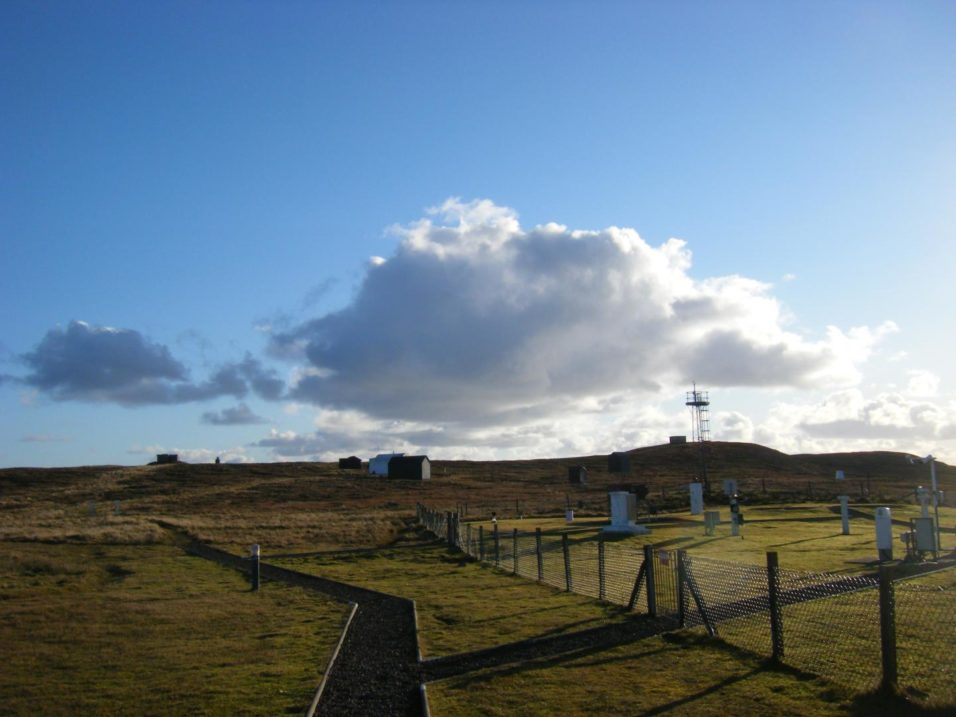
The weather observatory in Lerwick, Shetland Isles, Scotland, where the historic rainfall records were taken / CREDIT: Dr Keri Nicoll, University of Reading and University of Bath
Located 300 miles north west of Scotland, the Shetland site was relatively unaffected by other sources of anthropogenic pollution, making it suitable for a test site to observe rainfall effects which, although likely to have occurred elsewhere too, would be much more difficult to detect.
Atmospheric electricity is most easily measured on fine days, so the Kew measurements helped to identify nearly 150 days where there was high or low charge generation over the UK while it was cloudy in Lerwick. The Shetland rainfall during the same period showed differences which vanished after the major radioactivity episode was over.
The findings, which will pioneer new research in cloud-related geoengineering and to explore how electric charge could influence rain, relieve droughts or prevent floods, without the use of chemicals.
External Affairs Minister S. Jaishankar has described Finance Minister Nirmala Sitharaman’s announcement under government’s Rs 20 lakh crore stimulus package under Atma Nirbhar Bharat as “bold initiatives” and noted that freign policy begins at home, hinting at changes soon to foreign policy too.
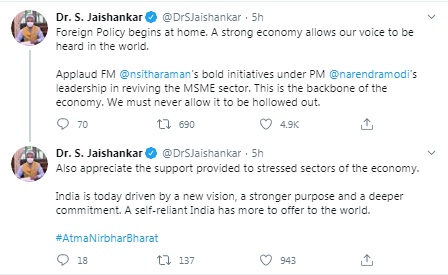
“Foreign Policy begins at home. A strong economy allows our voice to be heard in the world. Applaud FM @nsitharaman’s bold initiatives under PM @narendramodi’s leadership in reviving the MSME sector,” Jaishankar tweeted.
In a series of tweets on the stimulus plan, he followed it saying, “This is the backbone of the economy. We must never allow it to be hollowed out…Also appreciate the support provided to stressed sectors of the economy… India is today driven by a new vision, a stronger purpose and a deeper commitment. A self-reliant India has more to offer to the world.”
The finance minister’s plan included several measures for helping various economic sectors amid the coronavirus crisis such as — a Rs 5.9 lakh crore with a sharp focus on MSMEs, a liquidity scheme for NBFCs, HFCs and MFIs. It has reduced the rates of TDS and by 25%, lowering statutory deductions on EPF contributions by employees and employers.
Earlier on Wednesday, Prime Minister Narendra Modi tweeted describing the announcements by the FM “will go a long way in addressing issues faced by businesses, especially MSMEs… The steps announced will boost liquidity, empower the entrepreneurs and strengthen their competitive spirit.”
India to grow with World
Referring to Modi’s speech earlier this week, Jaishankar clarified that the call for self-reliant India doesn’t mean shutting down doors to globalization. He tweeted saying India seeks to grow with the world. “Vision of a self-reliant India that will convert the Corona challenge into opportunity. India will grow, but grow with the world. Will contribute fully to global resilience,” he tweeted.
Be Vocal about Local: PM @narendramodi’s mantra for economic recovery.
Vision of a self-reliant India that will convert the #Corona challenge into opportunity.
An Indian-origin engineer by name Shashank Rai has been charged by Texas prosecutors for fraudulent applications for $10 million loans under the COVID-19 relief program claiming to be for his firm employees. The charges include bank fraud and making false statements to a federal agency.
Paycheque Protection Programme (PPP) is an initiative of the federal government to provide emergency help to small businesses hit by the COVID—19 crisis to enable them to keep their employees availing loans under the program, which are written off after eight weeks if all the workers stay on the payroll. US Congress approved $649 billion for the program.
Shashank Rai, 30, of Beaumont, Texas, allegedly sought millions of dollars in forgivable loans in forgivable loans guaranteed by the Small Business Administration (SBA) under the Coronavirus Aid, Relief, and Economic Security (CARES) Act, from two different banks by claiming to have 250 employees earning wages when, in fact, no employees worked for his purported business. Rai is charged with violations of wire fraud, bank fraud, false statements to a financial institution, and false statements to the SBA.
“As alleged, Rai fraudulently pursued millions of dollars in loans intended for legitimate small businesses suffering the economic hardships of the COVID-19 pandemic,” said Assistant Attorney General Brian A. Benczkowski of the Justice Department’s Criminal Division. “The department and our law enforcement partners will remain vigilant in our efforts to protect critical CARES Act relief programs from fraud and abuse.”
“The behavior in this case was very brazen,” said U.S. Attorney Joseph D. Brown of the Eastern District of Texas. “Those who submit these applications for loans or other assistance need to understand that there are people checking on the representations made, and those representations are made under oath and subject to the penalties of perjury. Federal agencies are watching for fraud, and people who lie and try to cheat the system are going to be caught and prosecuted.”
Pre-meditated plan, says prosecution
“To support small and community banks, the Federal Home Loan Banks can accept Paycheck Protection Program (PPP) loans as collateral when making loans to their members,” said Richard Parker, Acting Deputy Inspector General for Investigations for the Federal Housing Finance Agency, Office of Inspector General.
“Today’s charges hold the defendant responsible for his actions to swindle money out of a federal program intended to help those in need during a pandemic crisis,” said Inspector General Jay N. Lerner of the Federal Deposit Insurance Corporation Office of Inspector General (FDIC OIG). “When an individual cheats the Paycheck Protection Program out of money, it deprives hard-working Americans and deserving small businesses.”
diaspora news
According to court documents unsealed today in U.S. District Court in Beaumont, Rai allegedly made two fraudulent claims to two different lenders for seek loans guaranteed by the SBA for COVID-19 relief through the PPP. In the application submitted to the first lender, Rai allegedly sought $10 million in PPP loan proceeds by fraudulently claiming to have 250 employees with an average monthly payroll of $4 million. In the second application, Rai allegedly sought approximately $3 million in PPP loan proceeds by fraudulently claiming to have 250 employees with an average monthly payroll of approximately $1.2 million.
According to court documents, the Texas Workforce Commission provided information to investigators of having no records of employee wages having been paid in 2020 by Rai under his business, Rai Family LLC. In addition, the Texas Comptroller’s Office of Public Accounts reported to investigators that Rai Family LLC reported no revenues for the fourth quarter of 2019 or the first quarter of 2020.
According to court documents, materials recovered from the trash outside of Rai’s residence included handwritten notes that appear to reflect an investment strategy for the $3 million, which is the amount of money that Rai allegedly sought from the second lender.
What is PPP?
The CARES Act is a federal law enacted on March 29, 2020, designed to provide emergency financial assistance to the millions of Americans who are suffering the economic effects caused by the COVID-19 pandemic. One source of relief provided by the CARES Act was the authorization of up to $349 billion in forgivable loans to small businesses for job retention of employees. In April 2020, Congress authorized over $300 billion in additional PPP funding.
The PPP allows qualifying small-businesses and other organizations to receive loans with a maturity of two years and an interest rate of 1 percent. PPP loan proceeds must be used by businesses on payroll costs, interest on mortgages, rent, and utilities. The PPP allows the interest and principal to be forgiven if businesses spend the proceeds on these expenses within eight weeks of receipt and use at least 75 percent of the forgiven amount for payroll.
Using machine learning to track surges in interest in health topics on popular online comment boards, especially Reddit, a new study conducted during the COVID-19 outbreak by researchers in the Perelman School of Medicine at the University of Pennsylvania (Penn Medicine) fund peaks of interest among the public.
Such insight could help public health officials better understand and address public concerns and priorities, and stem the spread of misinformation, said the study, published in the Journal of General Internal Medicine. The researchers vetted discussions on Reddit because it is one of the most popular sites on the internet, as well as being relatively unfiltered and up-to-date.
“Public health priorities do not always align with community priorities, and the success of public health efforts often depends on having a plan to address community concerns,” said Daniel Stokes, a research fellow with the Center for Emergency Care Policy and the Center for Digital Health at Penn Medicine. “Having a source like Reddit that is directly tied to people’s thoughts could prove invaluable in crafting plans that meet people where they are.”
Researchers said real-time monitoring of Reddit could have allowed for a nimbler response during a surge of questions around whether it was safe to go outside in mid-March when the US Centers for Disease Control and Prevention (CDC) did not issue official guidelines for safely enjoying parks and outdoor activities until early April. If there had been more monitoring of online discussion activity on just Reddit, the guidance could have been issued closer to the peak of interest, said Stokes.
As a conduit directly to the thoughts of some, Reddit is also valuable because it is the place where some of the “infodemic” –the plague of misinformation about COVID-19–has spread. Examples include one Reddit poster’s belief that a natural remedy like licorice root might prevent COVID-19 infection, or another’s thought that the virus was human engineered. Here, too, a quick, tailored response from public health officials could lead to more fact-based and productive discourse.
To identify surges of interest in the public, the study’s researchers collected nearly 95,000 posts from March 3 through March 31, 2020 on the most popular COVID-19 thread on Reddit, r/Coronavirus. It had 50 different discussion topics through a machine learning technique of natural language processing. And, 10 of those topics were determined to be most related to three areas of interest in the study:
— the response to public health measures,
— the sense of the pandemic’s severity, and
— its impact on daily life.
By tracking how the popularity of these topics varied day-by-day, the team was able to demonstrate how areas of interest ebbed and flowed, say, hand-washing was found to peak early, between March 3 and 6, while concern about personal finances was discussed roughly 50 percent more by the end of March as compared to the beginning. The analysis showed some topics popular at the start of the month remained on top, or had a comeback later in the month, such as the case for mask-wearing.
“The CDC didn’t make their recommendations on wearing masks in public until early April, so it is interesting to see that masks were being discussed a great deal prior to that recommendation,” Stokes said. “Perhaps it was a sign that many people were ready for these guidelines earlier.”
The team hopes to continue to track and analyze posts on this COVID-19-specific thread. In another effort from Penn’s Center for Digital Health, led by Raina Merchant, MD, an associate professor of Emergency Medicine, they collected similar data through Twitter across the United States.
“We are aiming to incorporate input from several digital sources that would allow us to not just track the public’s sentiment and perception of the virus, but also track, in real time, the emergence of new outbreaks,” said Merchant, author of the study published in the Journal of General Internal Medicine.
Stokes and Merchant believe that such insight will be heeded by public health officials to better combat the spread of misinformation that accompanied the COVID-19 outbreak. “Early comparisons to the flu on Reddit may have indicated a gap in public understanding of pandemic severity. Recognizing such gaps can be useful in developing targeted campaigns to close them,” Stokes said.
Earth had far more oxygen levels early in its history than previously thought, which culd have aided setting the stage for the evolution of complex life on it, said a study by scientists at the University of Alberta and the University of Tartu in Estonia.
The international team of researchers, led by UA scientists, studied a Russian drill core containing shungite — a unique carbon-rich sedimentary rock deposited 2 billion years ago and the unearthed material provided clues about oxygen concentrations on Earth’s surface at that time. Besides, the study also showed strikingly high levels of molybdenum, uranium, and rhenium, as well as elevated uranium isotope ratios during the time.
This two-billion-year-old shungite records evidence for balmy, oxygen-rich conditions on the early Earth. Photo credit: K. Paiste
“These trace metals are only thought to be common in Earth’s oceans and sediments when oxygen is abundant,” explained Kaarel Mänd, a PhD candidate in the University of Alberta’s Department of Earth and Atmospheric Sciences and lead author of the study. “These trace metal concentrations are unrivaled in early Earth’s history, suggesting elevated levels of oxygen at the time.”
Previously, it was widely accepted that the models of Earth’s carbon and oxygen cycles predict that shungite should have been deposited at a time of rapid decrease in oxygen levels. “What we found contradicts the prevailing view,” says Mänd. “This will force the Earth science community to rethink what drove the carbon and oxygen cycles on the early Earth.”
The new findings throw new insight into the evolution of complex life on Earth, which had its “middle age” representing the backdrop for the appearance of eukaryotes.
Eukaryotes are the precursors to all complex life, and require high oxygen levels in their environment to thrive and here, the new study strengthens the idea that suitable conditions for the evolution of complex life on early Earth began much earlier than previously thought.
The findings will pen wide the requirement of future research to examine the delay between the initial rise of oxygen and the appearance and spread of eukaryotes.
Bollywood actor Farhan Akhtar has donated 1,000 PPE or protective equipment for the Coronavirus frontline warriors in Mumbai, on the lines of many other donors such as Uday Shankar, Chairman of Star and Disney India. PPEs will be extremely helpful during the lockdown that has been caused by the coronavirus pandemic.
Since there was a shortage of supply of personal protection equipment (PPE) for people working in the frontline, many celebrities have come to their aid and donated lakhs of PPE kits to the frontline heroes who are fighting Covid-19 and also encouraged the people to donate as much as they can.
Farhan inspired people to donate and the actor recently expressed his gratitude towards people who helped make the donation possible. He posted a picture of PPE kits on social media with the caption:
“Thanks for your support you amazing people. Our first batch of PPE kits are on its way to Vakola Police Station from the factory. Please do contribute at http://tring.co.in/Farhan-Akhtar
Let’s protect our frontline warriors Smiling face with smiling eyes🙏🏽 Jai Hind. @MumbaiPolice @DevenBhartiIPS @TringIndia”
Thanks for your support you amazing people. Our first batch of PPE kits are on its way to Vakola Police Station from the factory.
Last week, Uday Shankar, who is President of the Walt Disney Company Asia Pacific and chairman, Star and Disney India, was among those to contribute 2 lakh PPEs in partnership with Project India. The company has donated over 200,000 PPE kits to the health workers at BMC and an additional 10,000 khakhi coloured kits for the Mumbai Police. The BMC tweeted, thanking it for the initiative.
One million years old early stone tool used by hominins (early humans) has been unearthed by archaeologists in the Nihewan Basin, China which has thrown light on how the early civilizations were able to adapt to climate change and lead a sustainable living.
These stone tools show the skills of ancient humans who modified their tool manufacturing behaviour in Eastern Asia, said Shixia Yang, who led a team that examined three well-known archaeological sites from the Nihewan Basin in North China. The study has been published in the journal National Science Review.
Ecological, biological and stone tool information from 2.2 million years ago to the present (the light red horizontal bar shows increased climate variability) (a) Global climate change. (b) Vegetation history of the North China Plain based on pollen analysis. (c) Hominin brain size estimates for Africa and Eurasia. (d1) Stone tool changes through time in the Nihewan Basin, China, showing the frequency of artefacts across different time periods (dark green bars). (¬d2) Key stone tool changes across China / Science China Press
Comparing the stone tools from the archaeological sites of Xiaochangliang, Cenjiawan and Donggutuo, the archaeologists realized that these tools indicate that technological skills increase at ca. 1.1-1.0 million years ago. The stone tools at Cenjiawan and Donggutuo show increasing levels of manufacturing procedures and some degree of planning in the tool-making process to produce desired end-products, said the team.
Stone tools adapting climate change
The ancient technological innovations at ca. 1.1-1.0 million years ago in the Nihewan Basin coincided with a major climate transition which occurred between 1.2 million years ago to 700,000 years ago (called the Mid-Pleistocene Climate Transition), effecting a series of global and regional palaeoclimatic and palaeoenvironmental changes during the period such as increase in aridity and monsoon intensity and decrease in sea surface temperature in the North Atlantic.
Hence, at 1.1 million years ago the early human inhabitants of the Nihewan Basin lived under a changing and unstable environment, experiencing aridification. The climatic change also produced ecological changes, including landscape alterations and mammalian extinctions, but adapting novel technologies may have provided benefits to those who lived in the Nihewan Basin, said the study.
The unstable environmental conditions during the onset of this period provide a good example of the adaptive skills of early hominins in China, contrasting with the notion of long-lasting conservative behaviours recorded by other archaeologists, said the research paper.
Making stone tools
Earlier studies showed that refined stone tools emerged half a million years ago. Research carried out at the University of Kent demonstrates that a technique used to produce stone tools is likely to have needed a modern human-like hand, such as the ability to perform highly forceful precision grips.
Image of stone tools half-a–million years ago — Comparison between a Handaxe and a Clovis Point CREDIT: Alastair Key and Metin Eren
The technique involves preparing a striking area on a tool to remove specific stone flakes and shape the tool into a pre-conceived design. Platform preparation is key for making many different types of advanced prehistoric stone tool, with the earliest known occurrence observed at the 500,000-year-old site of Boxgrove in West Sussex (UK).
A study, led by Dr Alastair Key, of the University’s School of Anthropology and Conservation, and funded by the British Academy, investigated how hands are used to produce such early stones.
Using sensors attached to the hand of skilled flint knappers (stone tool producers), the researchers identified platform preparation using the hand to exert significantly more pressure through the fingers when compared to all other stone tool activities studied.
Since human hand bones rarely survive in the fossil record, Dr Key said: “Hand bones from before 300,000 years ago are rare, particularly when compared to other human fossils such as teeth, so the fact we can study the manipulative capabilities of our early ancestors from the stone tools they produced is incredibly exciting.”
The research demonstrates that the Boxgrove hominins would have needed significantly stronger grips compared to earlier populations who did not perform this behaviour. It further suggests that highly modified handaxes discovered at Boxgrove and stone spear points found in later prehistory, may not have been possible to produce until humans evolved the ability to perform particularly forceful grips.
After building a high buzz around the story line and characters in their their upcoming series, the makers of Amazon Prime’s Paatal Lok recently released the trailer bringing the intensity to the series.
From the looks, the series had created a buzz with the social media raving about the characters, actors, story line and the graph of captivating content the series brings along, ever since the trailer hit the Youtube. The makers started off by releasing the teaser followed by character posters of Jaideep Ahlawat, Abhishek Banerjee and Neeraj Kabi, back to back.
The trailer gives an insight into the story line of Paatal Lok and certainly gives you shivers and walk you through the gateway of hell. The highly anticipated Amazon Original Series by Creator Sudip Sharma (writer of NH10 and Udta Punjab) is set to make viewers have a whole different experience of hell on Friday, May 15, 2020, amid the coronavirus lockdown when many people are watching Amazon Prime on their tiny phones at home.
Produced by Clean Slate Films, Bollywood actress Anushka Sharma‘s banner, the story revolves around a down and out cop who lands in the case of a lifetime when four suspects are nabbed in the assassination attempt of a prime time journalist. The case turns out to be a devious maze where nothing is what it appears and a hot pursuit of it leads them to the dark netherworld – the ‘Paatal Lok’, and many more shocking discoveries in the past of the four suspects.
Written by Sudip Sharma, the police and crime thriller series is inspired by the traditional concepts of Svarga, Dharti and Paatal (heaven, earth and the underworld) and the four estates of present government structure. Inspector Hathi Ram Chaudhary is a cynical, washed out Delhi cop who has nothing to look forward to in his ordinary career finds the case too high profile to earn him a promotion. The case turns into a dark mystery thriller that leads inspector to the dark realm of underworld or Paatal Lok.
When Hathi Ram follows his instincts to investigate into the lives of the suspects, he discovers startling truths and insights that eventually unravel his place in the larger scheme of things and the larger meaning of life itself.
Cast
Neeraj Kabi as Sanjeev Mehra
Gul Panag as Renu Chaudhary
Jaideep Ahlawat as Hathiram Chaudhary
Abhishek Banerjee as Hathoda Tyagi
Swastika Mukherjee as Dolly Mehra
Ishwak Singh as Imran Ansari
Jagjeet Sandhu
Asif Khan
Mairembam Ronaldo Singh
Niharika Lyra Dutt as Sara Matthews
Bodhisattva Sharma as Siddharth Chaudhary.
Since going to Mars, one of our closest terrestrial neighbors, is still very far away, Japanese scientists have tried something on our own planet with simulations and found that the iron-sulfur alloys thought to comprise the core of Mars to reveal details about the planet’s seismic properties for the first time.
This information will be compared to observations made by Martian space probes in the near future when Mars missions yield results. Mars is usually 55 million and 400 million kilometers away from the Earth depending on where both the planets are relative to the sun.
Keisuke Nishida, an Assistant Professor from the University of Tokyo’s (Todai) Department of Earth and Planetary Science and his team studied the seismic data and composition which revealed the present state of the red planet, including its past and the possible origin.
“The exploration of the deep interiors of Earth, Mars and other planets is one of the great frontiers of science,” said Nishida. “It’s fascinating partly because of the daunting scales involved, but also because of how we investigate them safely from the surface of the Earth.”
For a long time it has been theorized that the core of Mars probably consists of an iron-sulfur alloy but it will take decades to confirm scientifically. Hence, the Todai team focused on seismic waves, which are akin to enormously powerful sound waves, and can travel through a planet and offer a glimpse inside, albeit with some caveats.
The Missing Middle
“NASA’s Insight probe is already on Mars collecting seismic readings,” said Nishida. “However, even with the seismic data there was an important missing piece of information without which the data could not be interpreted. We needed to know the seismic properties of the iron-sulfur alloy thought to make up the core of Mars.”
Kawai-type multianvil presses installed at the SPring-8 facility (left) and KEK-PF (right)
Nishida and the team have measured the velocity for P-waves (one of two types of seismic wave, the other being S-waves) in molten iron-sulfur alloys. The study that last for more than three years to collect the ultrasonic data, however, helped to throw some light on the red planet. “A molten iron-sulfur alloy just above its melting point of 1,500 degrees Celsius and subjected to 13 gigapascals of pressure has a P-Wave velocity of 4,680 meters per second; this is over 13 times faster than the speed of sound in air, which is 343 meters per second,” explained researchers.
They used a device called a Kawai-type multianvil press to compress the sample to such pressures, besides X-ray beams from two synchrotron facilities, KEK-PF and SPring-8, to get images of the samples and then calculate the P-wave values.
“Taking our results, researchers reading Martian seismic data will now be able to tell whether the core is primarily iron-sulfur alloy or not,” said Nishida. “If it isn’t, that will tell us something of Mars’ origins. For example, if Mars’ core includes silicon and oxygen, it suggests that, like the Earth, Mars suffered a huge impact event as it formed. So, what is Mars made of and how was it formed? I think we are about to find out.”
A helium atom in which one of the two electrons has been replaced by a negative pion gives out a composite particle made of one quark and one antiquark. Exotic atoms can help physicists to make exquisitely precise measurements of the fundamental constants of nature, such as the size of the proton.
Pionic helium is the latest addition to a zoo of exotic atoms, including positronium, muonium, muonic hydrogen, muonic deuterium and antihydrogen. No dilithium crystals yet, though. Pionic helium could provide a direct measurement of the mass of a related fundamental particle, the neutrino. That has been estimated indirectly, says physicist Masaki Hori, but “it is always nice to have a direct laboratory determination”.
Exotic atoms are those in which one or more of the constituents of normal atoms have been replaced by an exotic particle, such as an antimatter particle. These atoms can then be probed to search for any tiny discrepancies in their properties from those predicted by models using techniques that underpin the world’s most accurate timekeepers, atomic clocks — and thereby opening a window on the foundations of physics.
Transition in ‘pionic’ helium atom
Reporting for the the first time about laser excitation of helium atoms in which one electron has been replaced by a subatomic particle called a pion, the scientists said they recorded a transition in a ‘pionic’ helium atom, in which one of the two electrons of a helium atom has been replaced by a subatomic particle called a pion.
Pions were discovered7 by Cecil Powell and co-workers in 1947, but their existence was first predicted in 1935 by Hideki Yukawa. They belong to the family of subatomic particles known as mesons, which are made up of a quark and an antiquark. Quarks are the particles that make up protons and neutrons.
Pions are short-lived particles that come in positively charged, negatively charged and neutral varieties and the team amanged to produce negatively charged pions with a lifetime of only 26 nanoseconds when isolated. It is thus no small feat that the experiment not only succeeded in replacing an electron in helium atoms with a pion, but also observed the resulting exotic atom undergo a quantum transition.
Hori and colleagues’ work now opens up a whole new experimental system for further exploration. If some challenges can be overcome, such exploration might enable the accuracy of the mass of the negative pion to be improved by a factor of 10–100, for instance; currently, this mass is known to only six decimal places.
By Dr. S. Naresh Kumar / Dr. Om Prakash / Jitender Kumar Gupta
The Covid-19 epidemic is spreading rapidly across the country and the number of patients infected with corona virus is increasing. India has done a great job so far in keeping these numbers low, relative to other countries. However, the indirect impact of this infection is on the farmers and crops. During March and April, crops usually get ready to be harvested in most parts of the country.
However, due to the fear of virus infection and lockdown, farmers have been facing many problems in harvesting and marketing the crop produce. A quick view of the issues faced by the farmers of Bundelkhand region (Jhansi and Niwari districts) along with their response to situation as well as Government interventions by a team of Indian Agricultural Research Institute (ICAR) led by Dr. S. Naresh Kumar and his team Dr. Om Prakash and Jitender Kumar Gupta could see the ground level impact in some villages of Bundelkhand region.
Covid-19 impact in villages
The crop harvest is delayed due to non-availability of labour as a consequence of nation-wide lockdown.
Threshing machines come to Bundelkhand region mostly from areas like Punjab, Haryana and Rajasthan during the wheat harvesting season to work on rent but, due to lockdown the threshing machine could not reach in time.
To save crop from wastage, farmers are trying to harvest and transport themselves.
After harvesting, they are also facing issues in storing the produce, transporting it to markets and selling it. During the first phase of lockdown farmers could not even get the means of transportation to take them to markets.
In such a situation, farmers are looking for options to sell the crop directly from the farm field, so that they can get some money for their produce.
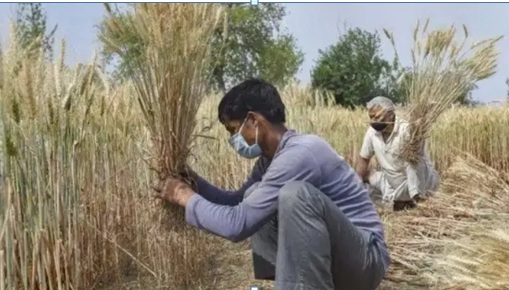
Pradhan Kaushal Nayak and wheat farmers of village Pathari in block Babina of Jhansi district say that this is the season for harvesting of crops like wheat and gram, while the harvesting of mustard crop was over before lockdown. In fact, the absence of laborers forced many farmers to harvest the crop by involving entire family members and by taking help from neighbours. But due to lack of transportation, they could not sell the crop.
In case of vegetable crops, major varieties such as cauliflower, cabbage, brinjal, okra, pumpkin are drying in the fields. Due to the closure of routes leading to vegetable markets, farmers have left the vegetables in the fields unharvested. In normal course, vegetables from Jhansi used to go to distant places such as Agra, Banda, Mahoba, Gwalior and Jabalpur. But the lockdown made it virtually impossible to transport the vegetables to distant places, while buyers too could not reach the villages. Farmers are left to face economic strides in their villages.
Decrease in sales and prices
In another village, NayaGaon, of the same block, the farmers shared their issues related to animal husbandry. Rajesh Rai and other livestock owners say that the price of animal feed such as khali (oil cake) has gone up by Rs 200 to Rs 300 per bag. For instance, a bag of oil cake which was available earlier at Rs 1,400 has now become Rs 1,600. In the same vein, the Chokar (wheat bran) which was Rs 850 is now available for Rs 1,100. On the other hand, prices of milk have decreased, causing further economic loss to farmers. Closure of sweet shops and hotels has also led to a huge reduction in the demand for milk. The milk which was earlier sold at Rs. 45 to Rs. 50 per liter, is now sold barely at Rs. 25 to Rs. 30 a litre.
Despite all these hardships, farmers have shown exemplary resilience following the coronavirus directions to keep social distance, wear masks and sanitize hands frequently. They started harvesting crops themselves. Soon, the government has exempted the agricultural related activities from lockdown restrictions.
This has greatly helped them to access the harvesting machines, labour, local transport and markets. Machines related to harvesting, such as Combined Harvester, Reaper is able to move from one state to another for meeting the harvesting demand in a short duration. Harvesting was done even during nights to maximize the machine availability.
Opening of government markets, agricultural production market committees and those mandated with agricultural products as listed by the authorities enabled farmers to access fertilizers, seed and chemical pesticide shops for maintaining their standing vegetable crops in tact and to plan for ensuing kharif season. The Government has allowed movement of people engaged in crop harvesting and those in procurement of crops at minimum support price. In addition, opening of Custom Hearing Centers helped them to prepare value added products.
Govt relief efforts
In addition to all these, under the PM Kisan Samman Yojana, registered farmers got an installment of Rs. 2,000 in the first week of April. This amount provided instant financial relief in the midst of Corona crisis. Under the Pradhan Mantri Ujjwala Yojana, the Centre has decided to provide free gas cylinders to the beneficiary women for three months. Farmers in these villages already started getting these benefits. Due to the above facilities and financial relief that is being provided by the government to farmers, despite the lockdown, they are able to carry on agricultural work with relatively less hardship.
Among other facets of village activities, education of school and college going children is largely affected as many of them do not have smartphones, the internet connectivity is limited and know-how on use of online or e-learning platforms is also limited.
The Indian Council of Agricultural Research and Indian Agricultural Research have issued advisories to farmers to use machines for harvesting and threshing. A precautionary advisory is made for the use of farm equipment, so that more people will not gather for farm operations; and if possible, engage people only familiar to the farm work to prevent any Covid-19 infection from outsiders. These guidelines along with the Covid-19 prevention measures helped farmers to carry on farm operations without much hindrance.
Guidelines to farmers
The ICAR-Indian Agricultural Research is implementing the climate resilient technologies in six villages of Jhansi (in UP) and Niwari (in MP) districts under the project entitled ‘Agricultural Productivity in Climate Change Scenarios: Impacts and Adaptation Pathways’. On-station project personnel have been providing the information to farmers of Bundelkhand region on precautions to be followed for prevention of Corona virus. The precautions advised to farmers in these villages while performing the agricultural operations such as harvesting or threshing include:
Maintain social distance (i.e. at least 2-meter distance between each other),
Do not employ more workers in the field simultaneously,
Do not drink water from the same bottle used by others,
Use your own farm implement or wash it before and after use, if borrowed from others,
All working persons / workers have to ensure that they work only by wearing home-made masks,
All must wash their hands frequently with soap for at least 22 seconds,
If crop is harvested, then store the produce in dry place,
Do not indulge in panic selling, as there may be a possibility of getting lower price,
Keep emergency numbers of your district officials (agriculture, health, etc) with you,
The most important thing is to take care of health of yourself and your family, and
Do not litter and do not defecate in the open.
Future challenges and opportunities
The recent developments also lead to the return of villagers who migrated to cities for jobs and livelihood. Currently, these are under quarantine at centers located in district headquarters. This ‘Reverse Migration’ will pose new challenges and also provide opportunities in rural areas. Over 2 million people are likely to return to their villages across the country, though it may not be a huge number in a country that has about 1.3 billion people. Many may return to their earlier jobs in cities but surely some will stay back due to the family and social pressures.
It is important to provide opportunities to start their own small business or ventures of their expertise in the village or cluster of villages. Agricultural activities such as farm mechanization, value addition, processing, grading, packing, transportation and marketing can attract these relatively skilled force. Some can also form the groups to start agricultural services such as supplying inputs (both material and knowledge) to farmers, provide market information and act as output managers. Thus a few in the village can act as the‘input-output service provider’.
In addition, the rural infrastructure needs to be given emphasis. This includes providing threshing platforms, village level storage facility, facilities for development of value added products, etc. The internet facility and some ICT facilities are needed for developing online learning facility within the village. This facility can be used by all villagers (including students) for learning and communication. For all these, the government, industries (under corporate social responsibility), NGOs and individuals can join hands to make rural India vibrant.
Time to build future vibrant rural economy
The current crisis has made us all realize that too much human perturbation has taken place in ecosystems leading to their degradation. Globally, we have been experiencing cleaner air, cleaner water and more activities of other living beings (birds, animals) due to the restrained activities of humans under Covid-19 threat. Hence, these ‘forced learnings’ must not be wasted. It’s time to rethink about designing the future development pathways that are in harmony with ecosystem sustainability so that plant earth becomes more sustainable.
All the initiatives must take ecosystems sustainability more seriously. In agriculture, for example, ecosystem based approach and solutions must be given priority. In energy sector, the renewable energy sources and developing energy use efficient technologies become important. While doing so the waste generated (eg. batteries) must not pollute the ecosystems. Similarly, in real estate sector, designing and constriction of energy efficient buildings must be given the priority. So let us think and act for a green and clean bright future of the planet earth.
(The writers are scientists from the Indian Agricultural Research Institute (ICAR), New Delhi.)
Eleven people were killed in Visakhapatnam (Vizag) styrene gas leak tragedy that shook the coastal city in Andhra Pradesh in India during the wee hours on Thursday between 02:30 to 03:00 AM. More than 1,000 people who live in villages surrounding the factory have been shifted to hospitals in the city of Vizag and a massive hunt is on for those still inside homes or died during sleep.
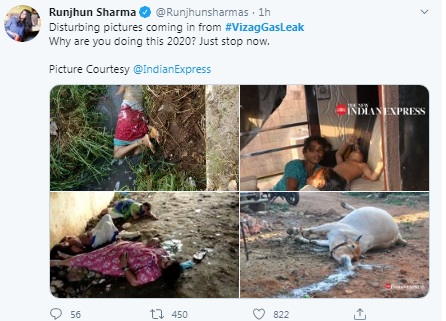
The deadly gas leaked from a closed LG polymers factory in Vepagunta village in Gopalapatnam near Vizag was identified as styrene gas, which is one of the most poisonous gases that affects lungs and nervous system initially and many vital organs over a period of two to three years. The gas leakage started at 3 pm in the night and many panic-stricken local villagers reportedly ran out of their homes towards Meghadrigedda nearby but further exposed to more gas and suffered on the roads and streets. The visuals of people falling down on roads and pavements filled the local TV screens.
While three people died after falling into a canal, five have been declared brought dead by the King George Hospital, where more than 180 people are currently being treated, said local reports. Many animals were seen already dead by morning or struggling to breathe in the open.
The leak reportedly occurred in Styrene gas chamber, that was shutdown for over a month due to the coronavirus lockdown. The doctors have warned that inhalation of this poisonous gas is dangerous with long-standing effect on lungs, liver and other vital organs of the body, besides affecting the nervous system of the human body.
Evacuation
Vizag District collector V Vinay Chand said the tragedy occurred while the plant was being recommissioned after the COVID lockdown without giving more details on how the mishap took place in the night. People from all villages around the plant have been shifted to safer places nearby and people are advised to put wet cloth on their faces covering eyes, he said.
Ambulances and RTC buses are arranged to evacuate local villages from the affected area. “Initial attempts to control the gas by spraying did not yield any result. It will take another two hours to bring the gas leak under control,” said the collector soon after the accident.
The chief minister of Andhra Pradesh, Mr Jagan Mohan Reddy announced Rs. 1 crore ($145,000) in compensation to each affected family with a death. Local leaders blamed the LG polymers, of the Korean conglomerate, which was built in 1997 at RR Venkatapuram near Gopalapatnam village in an area of 200 acres. It has a capacity of producing 400 tonnes of polystyrene daily using styrene, a highly inflammable liquid. As the area was a green zone under Covid-19 measures, the lock-down was eased earlier this week prompting the factory to resume production.
Medical doctors have advised those who are likely to have inhaled the gas up to five kilometers in radius to follow some quick precautions such as:
— Drinking more water
— Using a wet cloth mask
–Use eye-drops if there is any irritation in eyes
–Stay at home instead of going out and getting exposed to the gas, and
— Consult doctor immediately for treatment.
What is Styrene Gas?
Styrene gas was first isolated in 1839 by a German apothecary, Eduard Simon, from the resin called storax or styrax of the American sweetgum tree and named the liquid “styrol”, which eventually came to be known as styrene and in 1866 the French chemist Marcelin Berthelot stated that “metastyrol” was a polymer of styrene or polystyrene. It is used in making rubber, plastic, insulation tapes, fiberglass, pipes, automobile and boat parts, food containers and carpet backing.
Styrene is a “known carcinogen”, especially in case of eye contact, skin contact and of inhalation, as styrene oxide is considered toxic and mutagenic. Exposure to styrene causes cancer, according to some studies. The US National Toxicology Program of the U.S. Department of Health and Human Services has determined that styrene is “reasonably anticipated to be a human carcinogen.”
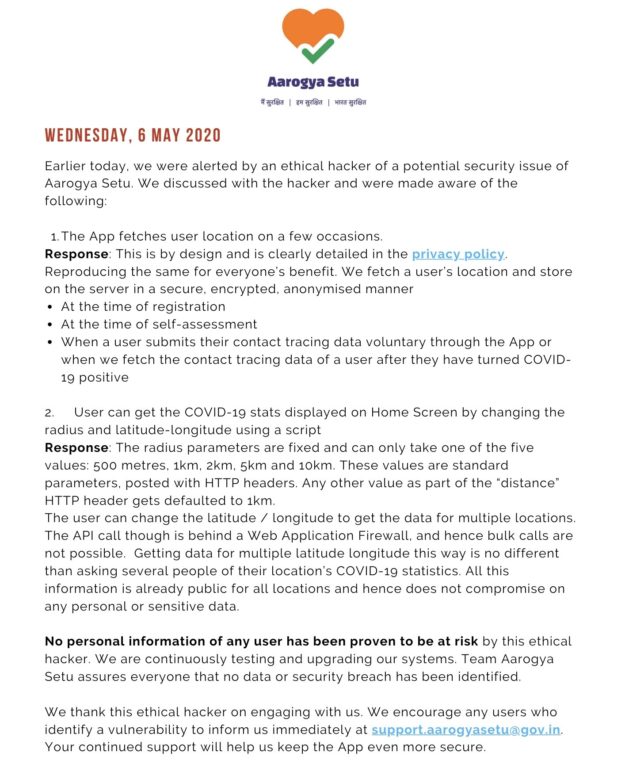
Following a tweet by ethical hacker and French cybersecurity expert under the alias “Elliot Alderson” claiming that there is a “security issue” within the Aarogya Setu app developed by the National Informatics Centre, a part of the Ministry of Electronics and Information Technology, the developers refuted the allegations over security or privacy concerns of 9 crore people who are using it amid the coronavirus pandemic in the country.
In its response posted on Wednesday, the Aarogya Setu team said, “no personal information of any users has been proven to be at risk,” though acknowledged ‘some issues’ with the app. The hacker alleged that this issue puts the data of 90 million users at risk.
The hacker, who had earlier exposed flaws in Aadhar, claimed this time that the Aarogya Setu app fetches location data and on a few occasions. The Aarogya Setu team clarified that the app stores the location data on secure servers which are encrypted. The team also denied the hacker’s claim that the “users can get the COVID-19 stats displayed on Home Screen by changing the radius and latitude-longitude using a script.”
The team said:“The radius parameters are fixed and can only take one of the few values: 500 meters, 1km, 2km, 5km, and 10km. These values are standard parameters posted with HTTP headers.”
Earlier Elliot had tweeted saying, “A security issue has been found in your app. The privacy of 90 million Indians is at stake. Can you contact me in private?” He tagged official handle of Arogya Setu and Congress leader Rahul Gandhi, who had last week raised data security concerns on the app.
Rahul Gandhi alleged that the app is a sophisticated surveillance system and it was “outsourced to a pvt operator, with no institutional oversight – raising serious data security & privacy concerns.”
Later, Elliot said that he was contacted by the Computer Emergency Response Team (CERT) and the National Informatics Centre (NIC) and he urged them to fix the flaws within a “reasonable deadline”. After the reply from Arogya Setu team, he said he would respond soon with his findings. Here’s his tweet:
My prediction was correct 😅
Thank you all for your messages, emails and sms. I’m doing my best to answer to everyone. Welcome to the new 20K people who follow since yesterday 😯
The Aarogya Setu app has come under severe scrutiny over privacy and surveillance concerns as well as the lack of audit and transparency, as it is not an open source code.
Here’s the full statement by the Aarogya Setu team on issues raised by the ethical hacker:
India is preparing the ground for what is billed as the biggest evacuation of its citizens, millions of them, stranded in several countries abroad due to the coronavirus pandemic beginning with the registration forms being opened online onTuesday, May 5, on their respective Indian embassy website.
Once the information is collected, India’s flag carrier Air India is ready to screen and repatriate all those willing to return home, including the United States, Europe and Asia. Quoting a senior official, ANI reported that the Indian missions will be asked to compile a list through this registration and repatriation will be coordinated with respective states. This registration exercise would help the Government of India to assess and plan for the return of Indian nationals wishing to return home for “compelling” reasons.
ANI further reported that the government has listed some categories, who would be given priority and who will get accommodated in special repatriation flights, followed by the students stranded in foreign countries. “The Middle East will first be the focus. We are still formulating if the citizens stranded will be airlifted by the Air India or commercial flights,” the source told ANI.
It is learnt from Kerala that more than 25 lakh Keralites are stranded in several Gulf countries and seeking to return home immediately. “On landing in India, every citizen will be screened to figure out if the person should be sent to quarantine centres or straight to the hospital,” the official added.
On those who are stranded in the US, the official told ANI, “The exact number of Indians stranded in the United States is still to be gathered, but the New York jurisdiction of the Indian mission alone has more than a million Indians, who have shown a willingness to return to their homes.”
However, there is no official confirmation of any evacuation flight from the US to India so far though many NRI organisations are coordinating with the authorities on evacuation plans, mainly for stranded students and visitors. ANI reported that the main purpose of this information sheet is to collect actionable data on Indian nationals willing to travel to India urgently. The registration is likely to be finished by Thursday and further plans will be announced by the government.
So far, a total of 42,533 confirmed coronavirus cases have been reported in India, an increase of 2,553 has been noted in the last 24 hours, while the number of recovery stood at 11,706. The current rate of recovery rate is 27.52%, said the Union Ministry of Health and Family Welfare.
Dr. Harsh Vardhan, Union Minister of Health and Family Welfare held a meeting today with Narottam Mishra, Health Minister of Madhya Pradesh in presence of Ashwini Kumar Choubey, Minister of State of Health and Family Welfare along with the senior officials from both Centre and State to review containment and management on COVID-19 in the State.
Various issues regarding contact tracing, surveillance, strengthening house-to-house active case finding, awareness generation among the people regarding seeking treatment for non-COVID disease management etc., were deliberated and discussed, said the ministry.
Outcome ratio of Recovered vs. Death for all closed cases “indicates the clinical management status in the hospitals was analysed since 17th April, and it is observed that there is an improvement in the country compared to that prior to 17th April, 2020 (Outcome ratio was 80:20) while as of today it is 90:10,” said the ministry in a statement.
So far, a total of 11,706 people have been cured. This takes our total recovery to 27.52%. The total number of confirmed cases is now 42,533. Since yesterday, an increase of 2,553 has been noted in the number of COVID-19 confirmed cases in India.
“It is again reiterated that States / UTs must ensure that rigorous containment measures are taken, so that the caseload remains low. They must also ensure effective case clinical management while parallely focusing on infection prevention & control.
It is important that as lockdown eases, we should follow protocol and guidelines related to physical distancing, follow preventive measures like hand hygiene and environmental hygiene and deal with COVID-19 by being careful, aware and alert. Always wear face covers / masks in public spaces. Even outside containment zones, follow all guidelines issued by the government on preventive measures. Avoid overcrowding while buying essential items or meeting in common areas,” said the ministry.
India’s Defence Research and Development Organisation (DRDO) has developed an Ultra Violet (UV) Disinfection Tower for rapid and chemical free disinfection of high infection prone areas as coronavirus is continuing its spread in the country with more than 42,000 affected already.
The equipment named UV blaster is a UV based area sanitiser designed and developed by Laser Science & Technology Centre (LASTEC) in Delhi, a premier laboratory of DRDO, with the help of New Age Instruments and Materials Private Limited, Gurugram.
The UV Blaster is useful for high tech surfaces like electronic equipment, computers and other gadgets in laboratories and offices that are not suitable for disinfection with chemical methods. The product is also effective for areas with large flow of people such as airports, shopping malls, metros, hotels, factories, and offices.
UVDisinfectionTower / DRDO
The UV based area sanitiser may be used by remote operation through laptop or mobile phone using any wi-fi link. The equipment has six lamps, each with 43 watts of UV-C power at 254 nm wavelength for 360 degree illumination. “For a room of about 12 x 12-ft dimension, the disinfection time is about 10 minutes and 30 minutes for 400 square feet area by positioning the equipment at different places within the room,” said the DRDO in a statement.
This sanitiser switches off on accidental opening of room or human intervention and another salient safety feature of the product is the key to arm operation, said DRDO in a statement.