
Global warming behind the rise of reptiles 250 million years ago: Study

Sixty million years of climate change triggered the meteoric rise of reptiles around 250 million years ago, not a mass extinction of mammals as previously thought,said a new study.

Just over 250 million years ago, during the end of the Permian period, and start of the Triassic, reptiles’ rates of evolution and diversity started exploding, leading to a dizzying variety of abilities, body plans, and traits.

For the longest time, this flourish was explained by their competition being wiped out by two of the biggest mass extinction events (around 261 and 252 million years ago) in the history of the planet.

Harvard University palaeontologist Stephanie Pierce’s research shows that the evolution and diversification, seen in early reptiles, not only started years before these mass extinction events, but instead were directly driven by what caused them in the first place, rising global temperatures due to climate change.

“Climate change actually directly triggered the adaptive response of reptiles to help build this vast array of new body plans and the explosion of groups that we see in the Triassic,” said Tiago R. Simoes, a postdoctoral fellow in the Pierce lab and lead author on the study.

In the paper, published in the journal Science Advances, the researchers provided a close look at how a large group of organisms evolve because of climate change, which is especially pertinent today as temperatures continually rise.

In fact, the rate of carbon dioxide released into the atmosphere today is about nine times what they were during the timeframe that culminated in the biggest climate change-driven mass extinction of all time, 252 million years ago: the Permian-Triassic mass extinction.

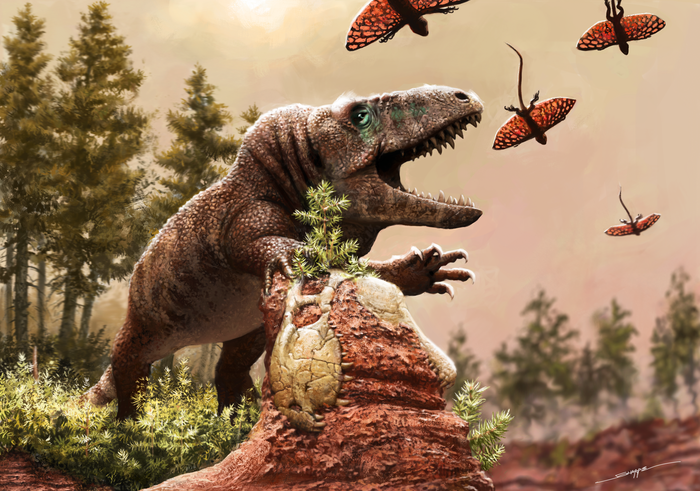
Artistic reconstruction of the reptile adaptive radiation in a terrestrial ecosystem during the warmest period in Earth’s history. Image depicts a massive, big-headed, carnivorous erythrosuchid (close relative to crocodiles and dinosaurs) and a tiny gliding reptile at about 240 million years ago. The erythrosuchid is chasing the gliding reptile and it is propelling itself using a fossilized skull of the extinct Dimetrodon (early mammalian ancestor) in a hot and dry river valley / Henry Sharpe

“Major shifts in global temperature can have dramatic and varying impacts on biodiversity,” said Stephanie E. Pierce, curator of vertebrate palaeontology in the Museum of Comparative Zoology.

The study involved close to eight years of data collection as Simees travelled to over 20 countries and more than 50 different museums to take scans and snapshots of more than 1,000 reptilian fossils.

Smaller reptiles, which gave rise to the first lizards and tuataras, went on a different path than their larger reptile brethren, said researchers. Their evolutionary rates slowed down and stabilised in response to the rising temperatures.

It was because the small-bodied reptiles were already better adapted to the rising heat since they can more easily release heat from their bodies compared to larger reptiles when temperatures got hot very quickly all-around Earth.

Aardvarks’ fate points to worrying consequences for wildlife, due to climate change

The aardvark, a highlight for anyone on a game-viewing African safari, will become increasingly rare as the world warms and dries, and the consequences go well beyond a decline in aardvark safari encounters.

According to researchers studying this elusive mammal, sometimes classed as one of the “Shy 5”, in South Africa’s Kalahari Desert, aardvarks prove to be highly susceptible to the warmer and drier climates that are predicted for the western parts of southern Africa, in the future. During the study of a number of aardvarks by researchers of the Brain Function Research Group at the University of the Witwatersrand, all but one of the study animals – as well as other aardvarks in the area – died because of a severe drought, with air temperatures much higher than normal and very dry soil in the area.

“While unusual now, those are the conditions that climate change is likely to bring as the new normal,” says Professor Andrea Fuller, the Research Group’s director.

Dr Benjamin Rey studied the aardvarks as part of his postdoctoral studies. Along with his colleagues, he used the new technology of “biologgers” (miniature sensors attached to computer chips and implanted into the aardvarks by wildlife veterinarians), to study the activity patterns and body temperatures of aardvarks living in the Kalahari. The researchers were not to know that during the year of their study there would be a severe drought, which led to the death of the study animals.

“It is not because the aardvark’s body can’t take the heat, but that the termites and ants that they rely on – not just for food but also for water – can’t take the heat and aridity of changing climates,” says Rey.

Aardvarks usually sleep during the day in burrows that they have dug, and emerge at night, to feed on ant and termites, using their long, sticky tongues to sweep up thousands of insects. However, during the drought, the termites and ants, on which the aardvark depends for body energy, were not available.

“As a result, the aardvarks’ body temperatures fell precipitously at night. The aardvarks tried to compensate by shifting their search for ants and termites from the colder night to the warmer day, so that they would not have to use energy to keep warm, but that was not enough to save their energy stores,” says Dr Robyn Hetem, a co-worker on the study. “We believe the aardvarks starved to death.”

The aardvark progressively became skinnier and bonier. They even tried sun-basking to save energy, but many ultimately died. Their body temperatures dropped to as low as 25°C just before they died.

Rey says that this curious-looking creature – described as having the snout of a pig, the ears of a rabbit and the tail of a kangaroo – is much more than just a curiosity to be checked off a bucket list.

“Many species of African birds, mammals and reptiles use the burrows dug by aardvarks to escape cold and heat, to reproduce, and to avoid predators. They can’t dig these burrows themselves. Without aardvarks, they would have no refuge. Worryingly, they could face the same fate as the aardvark.”

Climate change in southern Africa affects animals through the direct effects of increasing air temperatures and aridity. Wild dogs, for example, reduce hunting activity as temperature increases. But the indirect consequences of heat and aridity may be more pervasive. Disappearance of aardvarks, and with them the burrows that they dig, will have knock-on effects for many other animals.