US-Houthi ceasefire ‘a welcome opportunity’ to advance peace efforts in Yemen

Ambassadors were briefed by the UN Special Envoy for Yemen, Hans Grundberg, who commended Oman for its efforts to achieve the agreement which came into effect on 6 May.

He said the cessation of hostilities represented an important and necessary de-escalation in the Red Sea following the resumption of deadly US airstrikes on Houthi-controlled areas in Yemen.

Resolve the conflict

However, recent events show that the country is still ensnared in wider regional tensions, he said, pointing to Houthi attacks on Ben Gurion Airport in Israel and Israel’s subsequent strikes on Hudaydah Port, Sana’a Airport, and other locations.

“Nevertheless, the announcement of 6 May provides a welcome opportunity on which we must collectively build to refocus on resolving Yemen’s conflict and advancing a Yemeni-owned peace process,” he said.

The Houthis, also known as Ansar Allah, and Yemeni Government forces, backed by a Saudi-led coalition, have been battling for control of the country for more than a decade.

‘Yemenis want to move forward’ 

“The challenges facing Yemen are immense: from the deep and significant levels of mistrust between the parties, with some still reportedly preparing for war, to near economic collapse,” Mr. Grundberg told the Council

He said the UN will continue to work to bring the sides to the table to identify and agree on solutions that are acceptable to all.

“Yemenis want to move forward – the status quo is untenable,” he insisted.  “And while the frontlines may currently appear relatively stable, what Yemen has now is not peace.”

He stressed the need for continued engagement by the international community to help the Yemeni people realize their desire to build a stable, prosperous and safe country.

Release detained staff

Mr. Grundberg used the briefing to again highlight the plight of personnel from the UN, international and national NGOs, civil society and diplomatic missions, who continue to be arbitrarily detained by the Houthis.

“Not only is their detention in violation of international law, but it has also caused a significant chilling effect throughout the international community, which only has one outcome: undermining support to Yemen, which will sadly impact the Yemenis most in need,” he said.

He welcomed the recent release of staff members from the Dutch Embassy and international organization, saying “this demonstrates what is possible, but these releases are woefully insufficient.”

Message to the people

The Special Envoy concluded his remarks by stating that Yemenis have endured over 10 years of instability, uncertainty and economic collapse.

Speaking directly to the population, he reiterated that “I see you. I hear you. You have not been forgotten – and I won’t relent in my efforts to pursue peace and stability in Yemen.”

He urged the warring parties “to be courageous and choose dialogue,” emphasizing that “the United Nations will not waiver in its commitment to support you in finding a negotiated settlement to this conflict.”

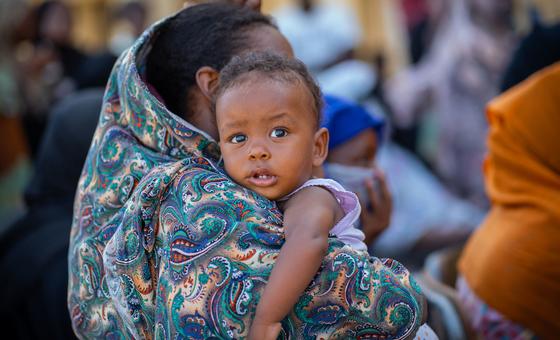
A mother holds her 10-month-old girl who is suffering from stunting and malnutrition in Abyan, Yemen.

Humanitarians ‘running out of time’: Fletcher

UN Emergency Relief Coordinator Tom Fletcher, who also briefed the Council, shared the Special Envoy’s relief at the cessation of hostilities in Yemen.

He stressed, however, that “Yemen is not out of the woods” as the humanitarian situation is deteriorating, with children most affected. 

“Half of Yemen’s children – or 2.3 million – are malnourished. 600,000 of them severely so,” he said.

Childhood killers on the rise

Moreover, “malnutrition is not just about hunger,” he added, as it attacks immunity, leaving children vulnerable to deadly infections like pneumonia and diarrhoea – both leading causes of child mortality in Yemen. 

The country also has one of the worst immunisation rates in the world as only 69 per cent of children under a year old are fully immunized and 20 per cent have received no vaccinations at all.

As a result, diseases such as cholera and measles are rising.  In 2024, Yemen accounted for over a third of global cholera cases and 18 per cent of related deaths, in addition to having one of the highest measles burdens globally.

“Children are not alone in being disproportionately impacted,” said Mr. Fletcher, as malnutrition also affects 1.4 million pregnant and breastfeeding women in Yemen, placing mothers and newborns at grave risk. 

Overall, some 9.6 million women and girls are in severe need of life-saving humanitarian support, he said.

Appeal to the Council

He warned, however, that humanitarians “are running out of time and resources” as their 2025 response plan for Yemen is barely nine per cent funded.

“These shortfalls have very real consequences,” he said. “Nearly 400 health facilities – including 64 hospitals – will stop operating, impacting nearly seven million people.” 

Meanwhile, funding for 700 midwives is quickly running out and 20 therapeutic feeding centres and more than 2,000 therapeutic feeding programmes have already been forced to close down. 

Mr. Fletcher made three requests to the Council, calling first for action to ensure respect for international humanitarian law, including protection of civilians as well as access to all those in need.

He urged ambassadors to also provide scaled-up, flexible funding to sustain critical aid operations.

“Third, and as the Special Envoy has underlined, back efforts towards lasting peace,” he concluded. 

Port Sudan: No let-up in drone attacks as UN chief urges peace

The UN chief warned that any further escalation of the conflict could result in massive civilian casualties and worsen the already catastrophic humanitarian situation across the country.

The expansion of the conflict into an area that has served as a place of refuge for a large number of displaced people is alarming,” he said in a statement issued by his Spokesperson’s office.

Mr. Guterres’s appeal follows days of drone strikes on key infrastructure in Port Sudan that have opened a new front in the fighting between forces of the military government and heavily armed paramilitaries.

The city is a main entry point for relief supplies, hosting airports and direct access to the Red Sea. It is also a shelter for hundreds of thousands of displaced people and the seat of government after generals lost control of the capital Khartoum to the Rapid Support Forces (RSF).

Aid flights suspended

In response to the drone attacks, flights of the UN Humanitarian Air Service (UNHAS) to and from Port Sudan have been suspended since 4 May.

The UN World Food Programme (WFP) which manages the airline said that operations will resume as soon as conditions allow. For the moment, amid reported gun and weapons fire overnight, the insecurity has impacted the movement of aid workers into Sudan and across the country.

A country in flux

Drone strikes have also been reported elsewhere in Sudan, including the states of Kassala and River Nile. In Kassala, strikes near the airport displaced about 2,900 people and led to the temporary suspension or relocation of some aid activities, according to the UN aid coordination office, OCHA.

As of Wednesday evening, River Nile State was still without power following a drone strike on the transformer station in Atbara on 25 April. The outage has contributed to growing fuel and bread shortages and long queues at petrol stations and bakeries.

The situation remains dire across Sudan, the UN chief continued, citing intense attacks on critical infrastructure since January that have hampered people’s access to essential services and left them without food, clean water, healthcare and electricity.

“All parties to the conflict must comply with their obligations under international humanitarian law,” Mr. Guterres insisted. “They must not direct attacks against civilians and civilian objects; must take all feasible precautions to avoid, and in any event to minimize, incidental civilian casualties; and must allow and facilitate rapid and unimpeded passage of humanitarian relief for civilians in need.”

Sudan’s war stems from the breakdown in the transition to civilian rule following the overthrow in April 2019 of Omar al-Bashir, who had been president for 30 years.

Mr. Guterres decried a “lack of political will” by the warring parties to engage in constructive dialogue as they pursued their military goals.

“Dialogue is the only way to achieve the peace that the people of Sudan demand,” the Secretary-General insisted.

A hunger catastrophe

The turmoil caused by relentless heavy fighting across Sudan has reportedly killed more than 18,800 civilians and injured tens of thousands more. UN aid agencies say that the country’s people are in the grip of the largest hunger catastrophe on the planet.

Today, more than half of Sudan’s population – 30.4 million people – need humanitarian assistance, including more than 15 million children. They lack access to food, water, shelter, electricity, education and healthcare, aid veterans have warned repeatedly.

“Across Sudan, 25 million people face acute hunger,” WFP spokesperson Leni Kinzli told UN News. “And people are displaced across the country, nearly 13 million people forced from their homes. We are seeing waves of displacement in North Darfur, where around 450,000 people have fled horrific levels of violence.

Reaching those in need

Despite the dangers, UN agencies and partners are doing everything they can to reach the most vulnerable uprooted by intensifying attacks on government-controlled El Fasher town and Zamzam displacement camp.

“We’ve distributed assistance food assistance and emergency food packages to 335,000 people who recently fled that violence in and around El Fasher,” Ms. Kinzli explained. “We are also ramping up assistance in Khartoum, aiming to support one million people across the coming month.”

Distributions are ongoing in Jabalia, in the South of Khartoum, which is one of the risk of famine areas, as well as the central Khartoum neighbourhood of Burri, “where we finally reached the centre of the city…just last week”, the WFP officer noted.

To reach 21 million people in desperate need this year the UN needs $4.2 billion which is only seven per cent funded.

And over the next six months, WFP requires around $700 million to ramp up assistance and expand assistance to seven million people per month. 

Source link

Ukraine: Ceasefire a critical first step on the road to durable peace

Under-Secretary-General Rosemary DiCarlo addressed ambassadors alongside UN deputy relief chief, Joyce Msuya, who updated on the dire humanitarian situation in the country amid ongoing Russian attacks.

Ms. DiCarlo said the meeting was taking place at a potential inflection point in the three-year war, as the past few weeks have seen intensified shuttle diplomacy towards a possible peace deal. 

‘Glimmer of hope’

These initiatives offer a glimmer of hope for progress towards a ceasefire and an eventual peaceful settlement,” she said.

“At the same time, we continue to witness relentless attacks on Ukrainian cities and towns.”

Russian forces have carried out recent deadly strikes, such as the massive, combined missile and drone attack last week on several regions, including the capital Kyiv.  

Multiple residential buildings in the city were hit. At least 12 people were reported killed and more than 70 others injured, including children, making it the deadliest attack on the capital in nine months. 

This followed several other deadly strikes, including one in Sumy city on Palm Sunday that reportedly killed 35 people.  Another in Kryvyi Rih killed 18, including nine children – the deadliest single strike against children since the start of the full-scale Russian invasion.

The UN human rights office, OHCHR, verified that as of 24 April, 151 civilians have been killed, and 697, injured so far this month in Ukraine. 

Verification is ongoing, but numbers are expected to surpass the March figures, which were already 50 per cent higher than in February.

She also noted recent media reports quoting local Russian authorities that indicate civilian casualties in the Kursk, Bryansk and Belgorod regions in Russia, including alleged Ukrainian strikes on 23 and 24 April that reportedly killed three people in the Belgorod region.

“We condemn all attacks against civilians and civilian infrastructure, wherever they occur,” she said.

Diplomatic efforts encouraged

Ms. DiCarlo noted that the UN Secretary-General has repeatedly called for de-escalation and a durable ceasefire in Ukraine.

“In this regard, we are encouraged by the diplomatic efforts underway,” she said.

“We take note of yesterday’s announcement by the Russian Federation of a 72-hour truce planned for the period from 8 to 10 May.”

It follows a similar Russian announcement on 19 April of a 30-hour Easter truce, “and Ukrainian authorities reportedly agreed to mirror any such steps, reiterating their earlier support for a 30-day ceasefire proposed by the United States,” she said.

“Regrettably, hostilities continued during Holy Week, with both sides accusing each other of violations.”

She recalled that a month earlier, the Secretary-General welcomed separate announcements by the US, Russia and Ukraine regarding a 30-day moratorium on strikes against energy infrastructure and the resumption of negotiations on the safety of navigation in the Black Sea.

Despite these commitments, however, attacks against energy infrastructure persisted,” she said. 

Political will valuable

Ms. DiCarlo said the continued exchange of prisoner of war by both sides – including the largest to date, when 500 people were swapped on 20 April – “shows that with political will, diplomacy can yield tangible results even in the most difficult circumstances.”

She concluded her remarks by pointing to the forthcoming 80th anniversary of the Second World War, which serves as a reminder “with even greater urgency” of the centrality of the UN Charter and international law in safeguarding peace and security.

“The Russian Federation’s full-scale invasion of Ukraine stands as an egregious challenge to these fundamental principles, jeopardizing stability in Europe and threatening the broader international order,” she said.

“What is needed now is a full, immediate and unconditional ceasefire as a critical first step towards ending the violence and creating the conditions for a just, comprehensive and sustainable peace.”

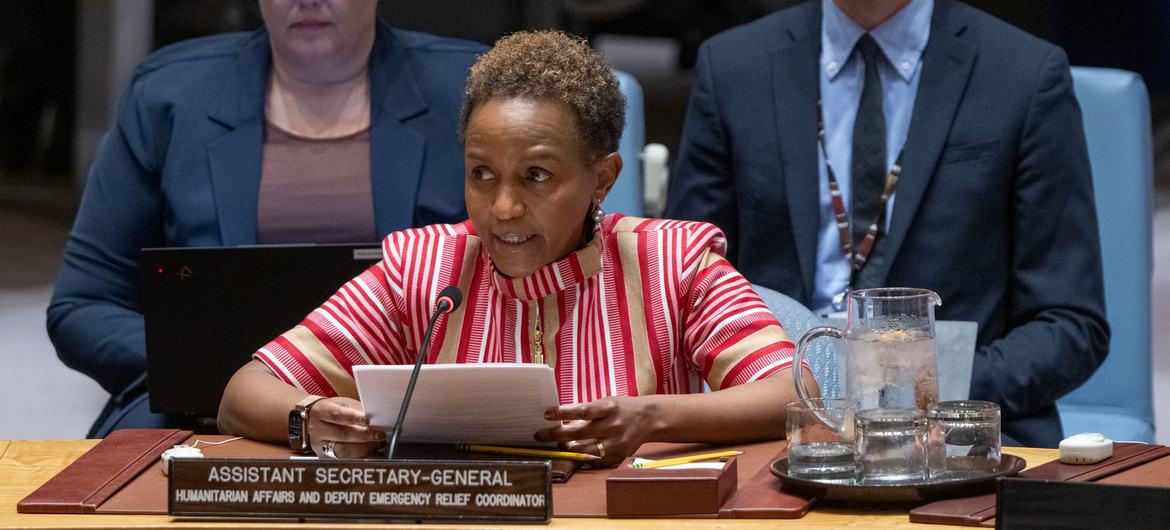
Joyce Msuya, UN Deputy Emergency Relief Coordinator, briefs the Security Council meeting on maintenance of peace and security of Ukraine.

Millions in need

Ms. Msuya reported that the humanitarian situation in Ukraine has worsened despite ceasefire opportunities. Overall, nearly 13 million people need assistance.

“So far this year, not a single day has passed without civilians being killed or injured in attacks,” she said. 

The operating environment also remains highly dangerous for humanitarians. 

Aid workers under attack

“From 1 January to 23 April, there were 38 verified security incidents impacting humanitarian staff within 20 kilometers of the frontline. This has left three aid workers dead and 21 injured while delivering life-saving assistance,” she said.

Ms. Msuya reiterated earlier calls for the Council to take urgent, collective action on Ukraine in three areas.

She urged ambassadors to ensure the protection of civilians – including humanitarian and health workers – and critical infrastructure. 

Her second point stressed the need to increase financial support for humanitarian operations as underfunding is forcing critical programmes to scale down. 

Finally, she called for a just peace: “Every effort, whether aimed at a temporary pause or a lasting agreement, must prioritize the protection and needs of civilians.” 

Source link

Hiroshima Day 2017: How World Leaders Reacted Then?

Residents in Hiroshima observed a minute of silence marking the 72nd anniversary of the first atom bomb usage on August 6, 1945 by the US to end World War Two, bringing peace to the world but the death toll has climbed up to 164,621 so far.

The event at Hiroshima’s memorial park was witnessed by people who released thousands of lanterns the adjoining Motoyasu river that saved all those who jumped into it to save the radiation and heat on that fateful day.

The second bombing on Nagasaki on August 9 will be held three days later.

A US B-29 bomber dropped the Enola Gay (uranium bomb) on Hiroshima some 600m (1,800ft) above the city, at 08:10 on 6 August 1945. While 70,000 immediately died, 70,000 more died gradually by the end of the year while others died with symptoms of radiation over a period.

About 30,000 people attended the ceremony at the Hiroshima Memorial Park near Hiroshima’s epicentre or ground zero where the bomb was dropped. The Hiroshima bombing has left behind Japan, startled and shaken, while survivors vouch for a ban on nuclear arms.

Hiroshima Mayor Kazumi Matusi called on the Japanese government to sign the treaty banning nuclear weapons. Prime Minister Shinzo Abe said: “For us to truly realize a ‘world without nuclear weapons,’ the participation of both nuclear weapon states and non-nuclear weapon states is necessary.”

The adherence to non-nuclear world remained strong across the nations ever since and here are some quotes from famous world personalities on Hiroshima Day:

1) If I had foreseen Hiroshima and Nagasaki, i would have torn up my formula in 1905.
— Albert Einstein

2) “We must strive towards the goal of abolition of nuclear devices and disarmament and through mutual trust in each other, we must realise One World.”
 Jawaharlal Nehru

3) Dropping those atomic bombs on Hiroshima and Nagasaki was a war crime.
 George Wald

4) I find wholly baffling the widespread belief today that the dropping of the Hiroshima and Nagasaki bombs was an immortal act, even possibly a war crime to rank with Nazi genocide.
— J.G. Ballard

5)    “If the radiance of a thousand suns,
         Were to burst at once into the sky,
         That would be like the splendour of the Mighty One…
         I am become Death,
         The shatterer of worlds.
[Quoted from the Bhagavad Gita after the bombing of Hiroshima and Nagasaki.]”
 J. Robert Oppenheimer

6) “So, let us be alert in a twofold sense: Since Auschwitz we know what man is capable of. And since Hiroshima we know what is at stake.”
                                                                                                                                                   — Viktor E. Frankl

7) “Hiroshima and Nagasaki were atomized at a time when the Japanese were suing desperately for peace. ”
— David T. Dellinger, Revolutionary Nonviolence: Essays

8) “What the diary does not reveal, for it stops too soon, is the appalling fact that from late 1945 until 1952 Japanese medical researchers were prohibited by U.S. occupation authorities from publishing scientific articles on the effects of the atomic bombs.”
— John W. Dower, Hiroshima Diary: The Journal of a Japanese Physician

9) The use of the atomic bomb, with its indiscriminate killing of women and children, revolts my soul.                                                                                                                                                         — Herbert Hoover

10) “Oh my God! Tell that to the people in Hiroshima… Good. Good. When you declare war, you declare war. They started it. We now don’t count who’s dead. You’re dead, you deserve to be dead.
                                                                                  — Joan Rivers, TV personality and Jewish comedian