

Indian Railways has approved projects worth ₹1,364.45 crore to strengthen safety, signalling and communication systems across multiple zones. The works include Kavach deployment on locomotives, optical fibre expansion and signalling upgrades. The approvals, part of the 2024–25 works programme, aim to improve operational safety and network efficiency.
What is Kavach
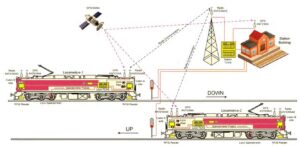
Kavach is an indigenous automatic train protection (ATP) system developed by Indian Railways to prevent train collisions and improve safety on the rail network. It is like an automatic braking and warning system that takes control if something goes wrong.
How Kavach works:
Kavach acts like a real-time safety shield for trains.
- It uses radio communication and GPS to continuously track trains
- It connects locomotives, tracks, and control centers
- It constantly compares train speed and position with safe limits
If a driver makes a mistake, Kavach automatically applies brakes to avoid accidents.
Where It Is Installed
Kavach works through a combination of systems:
- Onboard equipment in locomotives
- Trackside devices along railway lines
- Station systems integrated with signalling
- Central control systems monitoring operations
India’s national rail network is moving deeper into a technology-led safety upgrade, with a fresh round of approvals targeting both trains and trackside systems.
Indian Railways has sanctioned projects worth ₹1,364.45 crore covering locomotive safety equipment, communication backbone expansion and signalling modernisation across several key zones. The approvals are part of a broader capital programme focused on reducing risk, improving reliability and preparing the network for higher traffic density.
Kavach deployment on locomotives in Southern Railway
A key component of the package is the rollout of Kavach, the indigenous train collision avoidance system, across locomotives in Southern Railway.
The transporter has approved ₹208.81 crore for installing onboard Kavach equipment on 232 locomotives. The work falls under a larger umbrella programme titled “Provision of Kavach with communication backbone of Long-Term Evolution (LTE) on balance routes of Indian Railways (Umbrella Work 2024–25),” which carries an overall outlay of ₹27,693 crore.
Within this, Southern Railway has been allocated ₹2,950 crore. The current phase focuses on equipping locomotives with Kavach Version 4.0, which integrates real-time signalling inputs and automatic braking systems to prevent collisions.
Kavach has been positioned as a central pillar of railway safety strategy, especially on high-density routes where traffic frequency increases the risk of human error.
Optical fibre expansion strengthens communication backbone
Parallel investments are being made to upgrade the communication systems that support modern signalling and safety technologies.
In Northern Railway, three projects worth ₹400.86 crore have been approved to expand the optical fibre cable network. These works fall under a separate umbrella programme for strengthening and replacing communication backbone infrastructure, with a total approved cost of ₹4,871 crore.
A sub-allocation of ₹871 crore has been earmarked for the zone.
The approved works include installation of 2×48 fibre cables across 926.05 route kilometres in Ambala Division, 1,204 route kilometres in Delhi Division along with station-level OFC rooms, and 1,074 route kilometres in Lucknow Division.
The upgrades are designed to improve bandwidth, reliability and redundancy in communication systems, which are critical for both signalling operations and Kavach deployment.
OFC network expansion in North Central Railway
Further expansion of the fibre network is planned in North Central Railway, where ₹176.77 crore has been approved for laying 2×48 fibre OFC cables across 2,196 route kilometres.
The work is split across major divisions, including 1,016 kilometres in Prayagraj, 709 kilometres in Jhansi and 471 kilometres in Agra.
This project is part of the same communication backbone programme and is supported by a ₹200 crore sub-allocation for the zone.
Officials say the expansion will support high-density routes where real-time communication between trains and control systems is essential for safe operations.
Electronic interlocking upgrades in South Central Railway
Signalling systems are also being upgraded through a shift from older panel interlocking systems to electronic interlocking.
In South Central Railway, projects worth ₹578.02 crore have been approved to replace panel interlocking at 49 stations.
The works include upgrades at 35 stations in Guntakal Division and 14 stations in Nanded Division, both located on high-density and highly utilised routes.
These projects fall under an umbrella programme for electronic interlocking, which has an overall cost of ₹15,164 crore.
Electronic interlocking systems reduce manual intervention and improve the precision and reliability of train routing decisions. They are also better suited for integration with automated safety systems such as Kavach.

Network-wide push toward safer, more efficient operations
The latest approvals reflect a layered approach to railway modernisation, combining onboard safety systems, trackside communication upgrades and signalling improvements.
Each component supports the others. Kavach relies on robust communication networks, while modern signalling systems ensure accurate data flow and control.
Indian Railways has been scaling up these technologies as part of its long-term strategy to handle increasing passenger and freight demand without compromising safety.
The ₹1,364 crore package represents a targeted investment across zones, but it also fits into a much larger national effort to upgrade infrastructure, reduce accidents and improve operational efficiency.
As these systems are deployed, the network is expected to move closer to a model where technology plays a central role in preventing errors and managing traffic at scale.
Also Read:
Almost every Indian village now has a banking outlet within 5 km radius. What changed?
Government slashes excise duty on Petrol, Diesel despite surge in global oil prices