
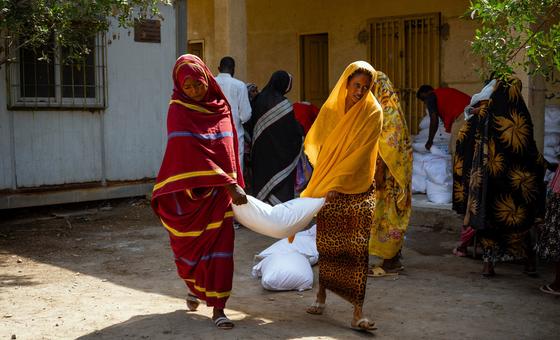
Sudan situation ‘absolutely devastating’ as UN ramps up food aid

Speaking in Port Sudan after a visit to Khartoum, Samantha Chattaraj, Emergency Coordinator for the UN’s World Food Programme (WFP) in Sudan, said that “vast parts of the city are destroyed. Levels of hunger and desperation are extremely high,” but she added “people remain hopeful.”

Sudan is currently the only country in the world where famine has been officially confirmed.

Half of its population is facing extreme hunger, and nearly five million children and breastfeeding mothers are severely malnourished.

Ms. Chattaraj said that in March, WFP was able to reach four million people across Sudan, the highest number since the conflict broke out over two years ago.

“This marked an important step in getting food to people who have been cut off from aid for a long time,” she added.

However, she added that “the need is far greater. With 27 areas either in famine or at high risk, the recent progress still covers only a small part of what’s required to stop the crisis.”

Destruction and hunger

In Darfur, in the west of Sudan, nearly 450,00 people who were already facing famine and horrific levels of violence have been forced to flee from El Fasher and Zamzam camps in the last few weeks, amidst an increase in fighting.

Reports from the ground are shocking,” said Mrs Chattaraj, explaining that WFP is currently mobilising assistance to reach populations wherever they have fled to – across various parts of Darfur and Northern State.

Planning for returnees

Many people are expected to return to Khartoum in the coming months and WFP is working to strengthen its presence in the city and ensure it can deliver food regularly to those coming back.

Together with local authorities, the UN aims to provide emergency food aid to one million people in the greater Khartoum area next month.

Racing against the rain

Ahead of the rainy season set to begin in June, which will leave many routes across Darfur impracticable, WFP only has a few weeks to pre-stock food close to populations in need, Ms. Chattaraj said.

In preparation WFP is setting up mobile warehouses across Darfur to safely store food supplies and keep operations running even during the rains.

Meanwhile, around 100,000 people remain trapped in the besieged city of El Fasher.

WFP is urgently calling for more funding and safe access to areas in need so it can continue its work in what is now the world’s largest humanitarian crisis.

Source link

Gaza: Aid ban pushes civilians to the brink

UN Spokesperson Stéphane Dujarric told reporters at a news briefing at UN Headquarters on Thursday that the humanitarian situation continues to deteriorate rapidly.

Children are going hungry, patients remain untreated, and people are dying,” he said.

“It is time to lift those restrictions immediately.”

According to latest reports, the disruption in the flow of goods has led to dramatic price hikes – up to 1,400 per cent above pre-ceasefire levels – with  basic items such as dairy, eggs, fruits and meat now absent from local markets.

In April alone, prices have risen by 50 per cent compared to March, according to the UN aid coordination office, OCHA. Shortages of cash and plummeting purchasing power have forced many families deeper into hunger.

Conditions on the ground

On Wednesday, UN’s acting Humanitarian Coordinator for the occupied Palestinian territory, Suzanna Tkalec, visited Deir al Balah and Khan Younis to assess conditions on the ground.

In Khan Younis, the team inspected the main desalination plant for southern Gaza, which has been operating at only 15 per cent capacity since early March due to electricity cuts imposed by Israel. As a result, access to clean water remains extremely limited.

They also visited two overcrowded displacement sites to evaluate living conditions.

In Deir al Balah, the UN team observed operations at a community kitchen run by the Atfaluna Society for Deaf Children, which offers meals and training for youth, women and people with disabilities.

Severe shortages

Meanwhile, humanitarian partners are reporting severe shortages of tents, tarpaulins and other critical materials, Mr. Dujarric said.

Warehouses are almost depleted, which is limiting shelter assistance to just a fraction of what is needed to survive.

UN agencies continue to provide relief as best they can. UN reproductive health agency, UNFPA, this week supplied 10 reproductive health kits – enough to support over 6,900 people – to six health partners, and emergency supplies to key hospitals.

More than 900 women and girls were reached with dignity kits and agency workers held around 240 sessions addressing gender-based violence, with 200 new case files opened.

Call for accountability over killing of UN staffer

Responding to a question on the deadly 19 March strike that killed a UN staff member and severely injured at least five others in Gaza, Mr. Dujarric said that Israeli authorities had reported the outcome of their internal investigation to the UN.

“There has been more cooperation and transparency on their side that we have had in these types of incidents, since the beginning of this conflict,” he said, underscoring the need to ensure accountability and transparency – for this case as well as all others.

“We have seen UN colleagues killed in Gaza or UN infrastructure attacked. And again, we call on all parties to fully comply with international humanitarian law, including the protection of civilians but also the protection of UN and humanitarian staff.”

World Bank Provides Aid for cleaning of Ganga River

World Bank has sanctioned a loan of US $ 1 billion for funding Institutional Development and for construction of priority infrastructure projects for municipal waste water treatment and solid waste treatment on the main stem of Ganga in the five Ganga basin states of Uttarakhand, Uttar Pradesh, Jharkhand, Bihar and West Bengal.

Government of India has withdrawn a cumulative amount of US $ 91.26 million (Rs. 550.48 crore) under this loan till date.

Cleaning of river is a continuous process. Namami Gange Programme has been launched as a holistic approach covering all existing ongoing projects and new initiative. Under Namami Gange project total number of 173 projects for various activities such as sewage infrastructure, river front development, ghat and crematoria, ghat cleaning, river surface cleaning, afforestation and biodiversity conservation and rural sanitation etc. have been sanctioned. Out of 173 projects 41 numbers of projects have been completed so far.

This information was given by Union Minister of State for Water Resources, River Development and Ganga Rejuvenation Dr. Sanjeev Kumar Balyan in a written reply in Lok Sabha today.