As part of its special programming for International Women’s Day on the 8th of March, France 24’s culture team heads to India to explore the world’s largest democracy and see how women, and women’s rights, are making their mark on the country’s vibrant arts scene. Olivia Salazar-Winspear presents two special editions of the daily culture showEncore!
Wednesday 8th March
Paromhita Vohra and Ram Devineni present the comic-book project that is looking to change mentalities when it comes to women’s place in society. “Priya’s Shakti” and “Priya’s Mirror” take real-life stories as their inspiration.
The culture teams also catches up with filmmaker Leena Yadav, whose film “Parched” explores gender politics in the patriarchal setting of an isolated village, and discuss the challenges of pushing a feminist message in mainstream cinema.
Thursday 9th March
For the second part of this special edition, Encore! goes to Mumbai to meet with stand-up comedian Radhika Vaz. She highlights the cultural shift that’s redressing the gender balance slowly but surely in India, and how being “Unladylike” is a form of political resistance.
Encore! also meets with the “Why Loiter” group, who stage cultural interventions in public spaces which can feel hostile for women. One of “Why Loiter’s” members, Priyanka, demonstrates how a simple “Antakshari” -or singing game- in the Mumbai metro brings men and women together in a friendly sing-off.
It is not the tallest flag in the world but certainly one of the tallest at attari-Wagah border in India but the sight of tricolour even from Lahore has irked Pakistan, who woke up on Sunday seeing India’s national flag.
The 360-ft tall tricolour, hoisted on a 110-meter high mast, measures 120-foot long and 80-foot wide and the weight of the flag pole is 55 tonnes built at Rs.3.5 crore.
Pakistan Rangers had raised the issue with their counterparts the Border Security Force (BSF) but the Indian state of Punjab insists that the flag was well within its own border. “It is our national flag and nobody can stop us from hoisting it on our soil,” said Anil Joshi, a minister of Punjab state government, who had laid the foundation stone last april and hoisted the flag on Sunday, March 5, 2017.
The flag was erected by the Amritsar Improvement Trust but the world’s tallest is located in the United States at a height of 400-foot high flying an American flag measuring 60 feet high by 120 feet long, built by insurer Acuity on the Interstate 43 corridor.
The Union Minister of State for Finance and Corporate Affairs, Mr. Arjun Ram Meghwal will represent the India in the 4th Annual Devolution Conference to be held from 6th to 9th March, 2017 at Nakuru County of Kenya.
He is expected to share the experience of devolution system and its progress in India and specifically highlight the 73rd-74th Constitutional Amendments and provisions their under for strengthening the local governance in India.
During his visit to Kenya, Mr. Meghwal will address the Devolution Conference and will brief the Conference on the revenue sharing between the Centre and the States as well as showcase the smooth devolution on the recommendations of 14th Finance Commission from the earlier 32% share in 13thFinance Commission to 42% of Union’s net tax receipts, to the States, said a statement.
To share the successful experience of the Urban and Rural Local Bodies, Mr. Meghwal will inaugurate the Conference with the objective of sharing of good experience of devolution system and through the platform of Devolution Conference and how it can be used to increase Good Governance and Public Accountability for the Social and Economic Development internationally.
About 10,000 delegates are expected to participate from different regions including African Nations and China in the conference, including Members of Parliament, Leaders of Opposition from several States, professionals, representatives of various civil societies, religious and social organizations from Kenya among others.
The Pilgrimage to the Cave of Shri Amarnathji, known as Amarnath Yatra, involves trekking at altitudes as high as 14,000 feet and pilgrims are likely to develop High Altitude Sickness, said an advisory issued today.
The symptoms of high altitude sickness include loss of appetite, nausea, vomiting, fatigue, weakness, dizziness, lightheadedness and difficulty in sleeping, visual impairment, bladder dysfunction, bowl dysfunction, loss of coordination of movements, paralysis on one side of the body, gradual loss of consciousness and mental status changes, drowsiness, chest tightness, fullness, congestion, fast breathing and increased heart rate.
If high altitude sickness is not treated timely, it may be lethal in a matter of hours, said the Shri Amarnathji Shrine Board in an advisory for the pilgrims. Here is a list of Do’s and Don’ts for pilgrims:
Do’ s for prevention of High Altitude Sickness.
1.Do prepare for the Yatra by achieving Physical Fitness – it is advisable to start a preparatory Morning/ Evening walk, about 4-5 km per day, at least a month prior to the Yatra.
2.Start deep breathing exercise and Yoga, particularly pranayam for improving oxygen efficiency of the body.
3.Do check with your physician prior to travelling to higher elevations, if you have any existing pre-existing medical conditions.
4.Do walk slowly while ascending and take time to acclimatize-, relax for a short while on steep inclines.
5.Do avoid exerting beyond your normal capacity.
6.Do take compulsory rest at various locations and ensure time logging and take ideal walking time mentioned on the display boards while moving towards next location.
7.Do check with your physician prior to taking any medications.
8.Do drink lots of water to combat dehydration and headaches – about 5 liters of fluid per day.
9.Do follow the prescribed food menu – available at Shrine Board’s website, Shriamarnathjishrine.com – when having food in the Yatra area.
10.Do consume plenty of carbohydrates to reduce fatigue and prevent low blood sugar levels.
11.Do bring portable oxygen with you as it is helpful in case you have difficulty in breathing.
12.Do descend immediately to a lower elevation, if you start having altitude illness symptoms.
13.In case there is any change in the status of your health after having obtained Compulsory Health Certificate some weeks earlier, do consult your doctor before embarking on the pilgrimage.
14.In case of any signs of high altitude sickness or any other discomfort, immediately contact the nearest medical facility located at every 2 kms.
Don’ts for prevention of High Altitude illness:
1.Don’t ignore the symptoms of high altitude illness.
2.Don’t drink alcohol, caffeinated drink, or smoke.
3.Don’t ascend any further if you have altitude illness. Instead, descend immediately to an elevation where you can acclimatize.
4.Don’t accept everything a sick Yatri says since his/ her judgment is impaired.
The Trump administration has halted the H1 Visa Premium Processing for at least 6 months and it should not come as a bolt from the blue but an inevitable course of events from a battered economy like the United States, which had allowed streams of workers and goods from abroad, which no other country had ever done, argue US immigration experts.
Now that the visa process for any foreign worker will take 3 to 6 months instead of 15 days at a payment of meagre one thousand dollars more, the primary target will be India as the beneficiaries of the H1 visa are mostly the techies from India. In fiscal year 2014, 69.7% of these visas went to Indian techies, they said. This is just the tip of an iceberg and the time has come to resolve the bigger problem, that is immigration, says Steven Riznyk, an immigration lawyer.
“It will never be resolved as long as all of the special interests only advocate their own positions, which is natural, but again, does not resolve the bigger problem,” he stated on the hot issue plaguing the IT industry of India.
He has put forth the arguments as below:
Although many tech firms may argue that it costs them dearly, it may force them to look to American labor a bit harder. Many of the tech imports from India and China are not bringing skills the U.S. doesn’t have. This would be in line with President Trump’s initiatives to help America. A good outcome if possible.
On the flip side, tech companies may argue they can’t get people fast enough in the U.S. The question to be answered is: do we have that great a shortage of tech persons in the U.S.?
On another note, with premium processing of cases being halted, if the CIS receives, say, 50,000 of the 85,000 applications with a premium processing check in addition to the high filing fees, this would mean a loss of revenue to the CIS of about $61,250,000. Steven Riznyk, CEO of San Diego Biz Law, states he is unable to ascertain the exact number of H1 visa cases that are premium processing cases, but the losses are in the millions. All of the H1 visa cases his firm processes, he states, are Premium Processing cases.
One of the controversial subjects in the U.S. lately has been that of the outsourcing of labor. Although we are not taking a position on that issue, we will address some points to consider. If a company outsources their technology to India, China, Russia, Romania, or the Ukraine in order to remain competitive and save money, that is one thing. Even then, people of course complain because they state that jobs are lost in America. True enough.
Regardless of what one thinks of the issue, one can appreciate that it makes business sense. On the other hand, if a tech company imports the foreign labor (and most of the positions are 6-figure positions), then not only are we outsourcing, but we are outsourcing at a very high cost. It is one thing to hire someone from India for $25,000 a year. In India, that is a substantial wage. To pay that person $100,000 now, does not make sense. It is outsourcing at an American wage.
If the tech sector feels that it makes sense to hire a foreign worker at a premium wage (as they are often hired by consulting firms that make money by marking up their hourly rate), which would be even more than the six figures these people are paid, then what is the problem with the American supply of tech workers?
The common argument is that American workers are not available because they won’t work at the wages that foreign workers will. Well, maybe the wages must be adjusted across the board. Perhaps the tech sector is overpaid. As in any field, there will be some people who rise above it, and they deserve a higher wage.
However, an entire industry cannot be paid at a rate that makes it more feasible to outsource them. It would seem that tech workers would prefer to be paid a fair rate than be unemployed because they are asking too much. After all, there is no point to an education if after that one is stuck with student loans and no job.
A tech visa is way overdue, states Steven Riznyk. Either a subcategory of the H1 visa should be dedicated to technology or tech should have its own visa (preferred). If the tech sector has its own visa, regulations could be implemented that are tailored to the visa and to the needs of American business.
The needs of the tech sector are very different to those in other areas of business and really should have its own considerations implemented after consulting with the tech sector that hires these people. Additionally, this would allow a control over the number of persons hired in the tech sector.
As the H1 visa stands now, it is out of control and is destroying the validity of the H1b visa in that it is preventing people from other industries from entering the U.S. This has to be placed in perspective. If persons from third world countries are getting trained in technology in a country where the average daily wage for a doctor is $30.00, it would only make sense they have nothing to lose by applying to work in the U.S. where they can make more than that per hour. It makes sense they would apply, but does it mean we have to hire them?
Doctors. Our underserved areas in America require high-level doctors. It is not fair to a person who lives in a remote area not to have access to rapid and effective medical care. A wonderful program we have in place is the J1 program wherein foreign doctors can study in the U.S. (in medical school or a residency program) but have to leave the country for two years before re-entering to work here. They can, however, under certain circumstances have the two-year bar waived if they offer to work for three years in certain underserved areas (this is also called the Conrad 30 Waiver Program).
A lot of lives depend on the J1 program for doctors. If doctors cannot obtain the H1 visa, a lot of people will die or suffer due to a lack of high-level medical care, states Mr Riznyk. The people cannot afford to go elsewhere or do not have enough time to travel and obtain assistance.
This is one of the reasons the tech sector has to be split off from the H1 visa as it stands, he states (additionally, the J1 section dealing with doctors needs to be severed from the other J1 categories, such as au pairs, camp counselors, and people learning to fly airplanes; it is too complex to be thrown into this general category and requires special care).
There are always at least two sides to an argument and the other side to this one, states Mr Riznyk, is that the J1 visa provides foreigners the opportunity to take career opportunities from U.S. citizens and residents and is therefore unfair; if that is the case, then a compromise must be reached that works for everyone.
Last but not least, the H1 Visa visa is overrun by tech applicants. The H1 was meant for all industries, not one. The problem with it right now, between the lottery system and the randomness of obtaining a valid H1 visa, persons from other industries that are badly needed do not have a chance of working here and helping other industries such as medicine, for example.
This cannot go on, because this is the weakest link in the chain, states Mr Riznyk. It is here that we have a real need for persons in other industries and day after day when I explain the H1 visa system to people in other industries, states Steven Riznyk, they simply tell me they will apply to Canada or elsewhere.
The H1 visa is overdue for a fix, but there are many issues to be addressed. These issues require brainstorming with the business sector so that once again the visa, presently abused in many ways, can restore its integrity and serve the purpose it is meant to serve and help the United States become the leader it has been and will continue being, stated Rizvik. “It will require a delicate balance when it comes to satisfying its many facets,” he concludes.
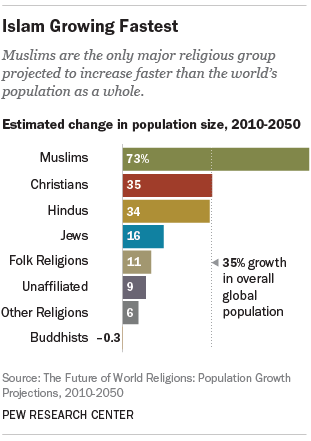
Global research outfit Pew Research Center has predicted that India will replace Indonesia, with currently the world’s largest Muslim population of 311 millions or 11% of global total, while Hindus will be about 1.3 billion (130 crore).
However, Muslims are expected to grow faster than Hindus as they have the youngest median age and the highest fertility rates. In 2010, the median age of Indian Muslims was 22 and Hindus was 26 and for Christians 28. An average Muslim woman has an average of 3.2 children, compared with 2.5 for Hindus and 2.3 for Christians, the report said.
Indian Muslims may grow faster than Hindus, from 14.4% in 2010 to 18.4% in 2050 but Hindus will still be more than 3-in-4 Indians (76.7%) and they account for the five largest Muslim populated countries – India, Pakistan, Indonesia, Nigeria and Bangladesh put together.
In 2010, Christians constituted approximately 2.5% and they may make up 2.2% by 2050. The report also mentioned the religious strife in India since its Independence in 1947 and the death of Mahatma Gandhi and late PM Indira Gandhi on similar grounds.
Another recent Pew Research Center report said religious restrictions found in India will be of the highest levels with social hostilities in the world. It referred to Prime Minister Narendra Modi, who it said has been dogged by allegations of religious intolerance, stemming from anti-Muslim violence in the state of Gujarat as then state Chief Minister in 2002, that left 2,000 people killed.
At the global level, the Pew Research center’s report said from 1.6 billion in 2010 constituting 23%, Muslims will exceed the number of Christians by the end of the century, if current demographic trends continue. , the number of Muslims is expected to exceed the number of Christians by the end of this century.
US President Donald Trump’s nominee for National Intelligence, Dan Coats, told the Senate Hearing Committee that he was “shocked” to learn India’s space agency successfully launched more than 100 satellites in one go, saying that the US cannot afford to be laggard.
“I was shocked the other day to read that India, on one rocket launch, deposited more than 100 satellites in space,” said Coats during his confirmation hearing for the position of Director of National Intelligence on Tuesday.
“They may be small in size with different functions but one rocket can send up, I think it was 104 platforms,” said Mr Coats, who will be supervising even the CIA.
In fact, out of 104, 96 satellites were for the US companies and most of them were launched for Planet Labs Inc, a San Francisco-based Earth-imaging company.
The successful launch of 104 has relegated even the US which had created a record in 2014 launching 37 satellites in a single go. All 104 satellites were lofted off by India’s PSLV rocket in a precisely timed method and all the 104 were put in their respective orbits in a span of 18 minutes, each travelling at 27,000 kmph.