Teachers are the ‘guardians of our future’, says UN deputy chief

Their work, said UN Deputy Secretary-General Amina Mohammed, is “the beating heart of education, the cornerstone of sustainable development, and the guardians of our future.”

Speaking Thursday at the opening of the UNESCO World Summit on Teachers in Santiago, Chile, Ms. Mohammed called for urgent global action to address the deepening teacher crisis.

“Let us honour their influence with the policies and the respect that teachers need, and future generations deserve,” she urged, laying out a five-point plan to support educators and strengthen education systems worldwide.

A crisis with global consequences

The deputy UN chief warned that the world is facing a “deepening teacher crisis” that threatens progress across the Sustainable Development Goals.

“We are failing our teachers,” she said, pointing to a global shortfall of 44 million educators needed to meet universal education targets by 2030.

She described the crisis as “a slow-burning emergency” that is undermining learning outcomes, widening inequalities, and weakening the social fabric of communities. “We must respond to those truths,” she said.

No single actor can fix this alone

UNESCO Director-General Audrey Azoulay also addressed the Summit, emphasizing the complexity of the challenge. “No single actor will be able to bridge the gaps we see, and that is what brings us together here in Santiago,” she said.

Ms. Azoulay highlighted the multiple causes behind the crisis: low and often delayed salaries, an aging teacher workforce, surging school enrolments without matching resources, and persistent gender inequalities – especially in STEM fields. Tackling these issues, she said, requires “level heads and clear thinking.”

The numbers are stark

To meet global education goals by 2030, the world must recruit 44 million teachers – more than double the population of Chile. Yet, instead of progress, gains are being reversed.

“Too many young teachers are leaving within their first years,” Ms. Mohammed said, citing low pay, heavy workloads, and lack of professional development. “Ultimately, we are asking the impossible of teachers: to build the future without the tools, trust and conditions they need.”

Financing the future

The cost of recruiting the teachers needed by 2030 is estimated at $120 billion annually. But education financing is falling short.

“More than 40 per cent of the world’s population lives in countries where governments spend more on debt interest payments than on education or health,” she warned.

Aid to education is projected to drop by 25 per cent between 2023 and 2027, with a 12 per cent fall already recorded last year.

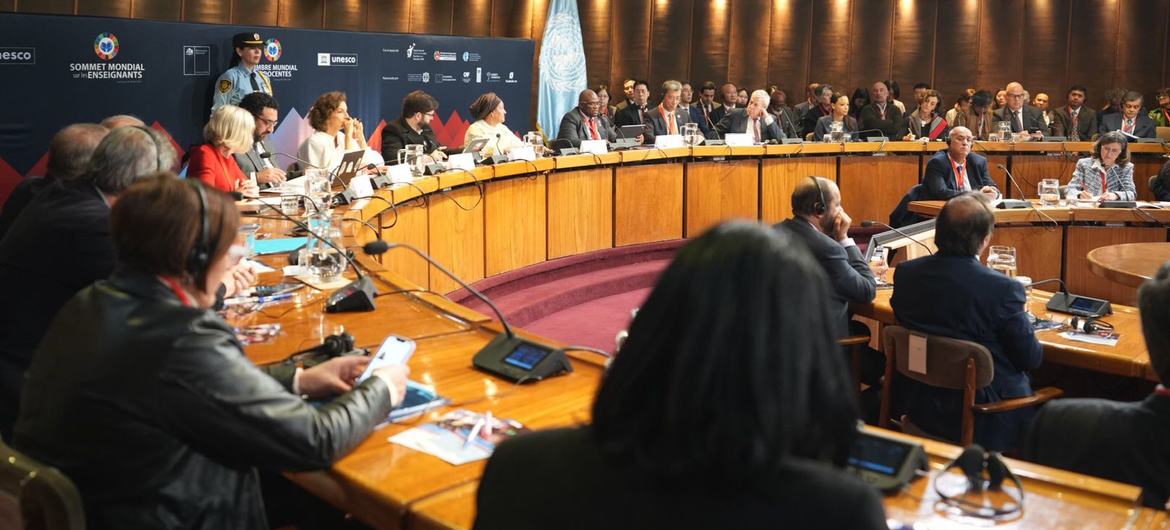
Deputy Secretary General Amina Mohammed delivers remarks to the World Summit on Teachers in Santiago, Chile.

Five areas for urgent action

Ms. Mohammed laid out a five-point plan to tackle the global teacher crisis:

  1. Elevate the profession: Implement the High-Level Panel’s recommendations — fair pay, stable contracts, safe workplaces, manageable class sizes, investment in upskilling, and clear career pathways.
  2. Finance education: Make education a top budget priority. Expand domestic funding, pursue debt relief, and consider a Global Fund for Teachers in Emergencies.
  3. Advance gender equality: Recognize and elevate women’s leadership in a profession dominated by women but often lacking female decision-makers.
  4. Support digital transformation: Train teachers to lead inclusive digital learning, especially as AI reshapes the job market. Equip classrooms and prioritize human agency.
  5. Protect teachers in crisis zones: From Gaza to Sudan and Ukraine, educators are risking their lives. “We owe them more than admiration – we owe them protection, resources, and unwavering support.”

From Summit to action

Ms. Mohammed urged leaders to turn the summit’s outcomes into concrete commitments ahead of the World Social Summit in Doha this November.

She proposed:

  • National teacher compacts with time-bound targets on recruitment, retention, and pay.
  • A financing track that links aid and debt swaps to teacher investments.
  • A teacher-led digital pact to set standards for AI and ed-tech, with funded training.

“Quality education is the foundation of everything we hope to achieve with the Sustainable Development Goals,” she concluded. “Without teachers, none of it is possible.”

Source link

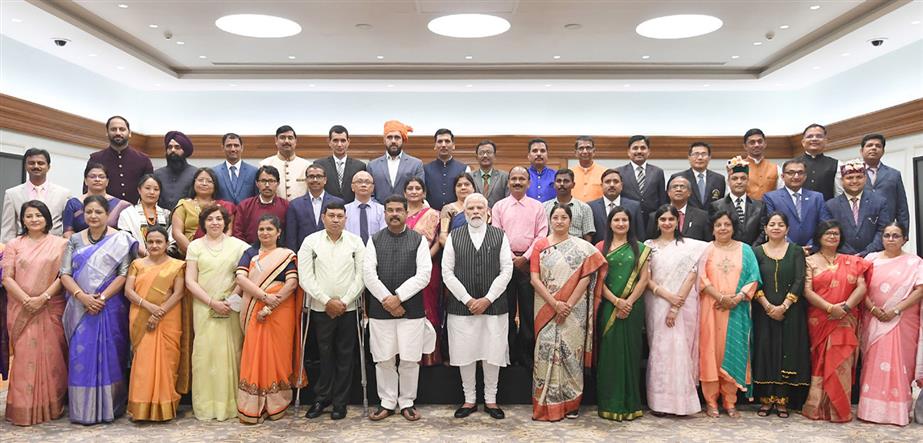
PM Narendra Modi to interact with winners of National Awards to Teachers on 5th Sep 2022

On the occasion of Teacher’s day, Prime Minister Shri Narendra Modi will interact with the winners of  National Awards to Teachers, 2022 at 7 Lok Kalyan Marg on 5th September, 2022 at 4:30 PM.

The purpose of National Awards to Teachers is to celebrate and honour the unique contribution of some of the finest teachers in the country who through their commitment and hard work have not only improved the quality of school education but also enriched the lives  of their students.

Teacher’s day

The National Awards to Teachers accords public recognition to meritorious teachers working in elementary and secondary schools. For the award this year, 45 teachers from across the country have been selected through a rigorous and transparent online three stage process.


PM with the winners of National Awards to Teachers on the occasion of Teacher’s Day/Photo:PIB

National Award to Teachers 2016

Mediocre teacher tells, good teacher explains, superior teacher demonstrates and a great teacher inspires – Vice President, Shri M. Venkaiah Naidu

Society which respects the dignity of the teacher is a progressive society – Prakash Javadekar

The Vice President, Shri M. Venkaiah Naidu presented the National Award to Teachers – 2016 on the occasion of Teachers’ Day, in New Delhi today. Shri Venkaiah Naidu also launched DIKSHA portal, a national digital infrastructure for teachers. DIKSHA will enable, accelerate and amplify solutions in the realm of teacher education.

Speaking on the occasion, Shri M. Venkaiah Naidu remembered Dr. Sarvepalli Radhakrishnan, an educationist and scholar par excellence. He congratulated the winners of the awards for the invaluable services rendered by them. He said this felicitation to teachers is inspiration to others to perform in the future. He emphasized on the importance of mother tongue and we must respect it. He also said that mediocre teacher tells, good teacher explains, superior teacher demonstrates and a great teacher inspires. A teacher should have an ideal behavior which can leave direct impression on their students as values are caught and they cannot be taught.

On the occasion Shri Prakash Javadekar greeted one crore teachers of the country. He said that the society which respects the dignity of the teacher is a progressive society, the one which is ours. And our teachers should perform efficiently so that society can value them as they were valued in our ancient teaching system. He told that the ministry is continuously making efforts in the direction of quality education for all i.e “Sabko Shiksha aur Acchi Shiksha”. He also reiterated the message of Prime Minister Shri Narendra Modi to teachers –“teach to transform, educate to empower and learn to lead”.

Minister of State for Human Resource Development, Shri Upendra Kushwaha congratulated the winners of National Award to Teachers – 2016. He said to overcome the challenge to provide quality education to each and every child of our country, the Government of India and teachers should work collectively to achieve it.

Addressing on the occasion Minister of State for Human Resource Development, Dr. Satya Pal Singh said whatever we are today is because of our teachers. Teachers have that capacity to make a New India by inculcating knowledge, values, wisdom in the students who are the future of this country.

Shri Anil Swarup, Secretary, Department of School Education and Literacy gave vote of thanks on the occasion.

The award carries a Silver Medal, Certificate and Rs.50, 000/- as award money.


Recruitment of Teachers

The University Grants Commission (UGC) has notified the Regulations on Minimum Qualifications for Appointment of Teachers and Other Academic Staff in Universities and Colleges and Measure for the Maintenance of Standards in Higher Education, 2010. These principal regulations along with their subsequent four amendments notified up to 2016 lay down principles and guidelines for recruitment and promotion of faculties at the cadre of Assistant Professor, Associate Professor and Professor.

In these Regulations, Master’s degree with UGC specified score along with NET/SET/SLET or Ph.D. earned in conformity with UGC Regulations has been made mandatory eligibility condition for appointment to various academic positions. However, para 4.1.0 of UGC Regulations, 2010 prescribes an alternative criterion for the post of Professor. As per this criterion, an outstanding professional with established reputations in the relevant field who has made significant contributions to the knowledge in the concerned/allied/relevant discipline could be recruited as a Professor.

The Universities are autonomous bodies created either under the Central Act or State Acts and the onus of filling up the vacant posts lies with them. However, to make the teaching profession more attractive and to draw in good talent at the entry level, the UGC Regulations, 2010 has prescribed norms for improvement in service conditions for the new entrant, in terms of better working and leave conditions, career advancement prospects, retirement benefits etc.

Further, the UGC has, inter alia, undertaken the following initiatives for improving the teachers and Teacher education so as to make the profession more attractive:

§ The UGC supports ‘operation faculty recharge’ through strengthening high quality research in science related disciplines and promoting innovative teaching in the universities through induction of fresh talent at the level of Professors, Associate Professors, and Assistant Professors. Many universities require the support of professionals and experts beyond those available to the university in its regular faculty especially in strengthening high quality research in science-related disciplines, at internationally competitive level and in promoting innovating teaching in universities. Besides, it has provided positions of Adjunct Faculty and Scholars-in-Residence to enrich the teaching and research programmes of the university system at M.Phil and Ph.D levels.
§ UGC implements a Travel Grant Scheme that provides financial assistance to permanent teachers and librarians of colleges and vice-chancellors of state universities, deemed to be universities and central universities, recognized under section 2 (f) and 12 (B) of the UGC Act, to present research papers at international conferences abroad.
§ UGC provides financial assistance to teachers teaching in universities and colleges to promote excellence in teaching and research. Research project may be undertaken by an individual teacher or a group of teachers. The ceiling of assistance under the scheme is Rs.20 lakhs for sciences including Engineering & Technology, Medical, Pharmacy and Agriculture etc. while for humanities, Social Science, Languages, Literature, Arts, Law and allied disciplines, the assistance is Rs.15.00 lakhs.
§ In order to encourage research and development in the country, UGC has laid out a number of schemes, awards, fellowships, chairs and programmes under which financial assistance is provided to institutions of higher education as well as faculty members working therein to undertake quality research in almost all areas of knowledge across disciplines including revival & promotion of indigenous languages.

This information was given by the Minister of State (HRD), Dr. Mahendra Nath Pandey today in a written reply to a Lok Sabha question.