
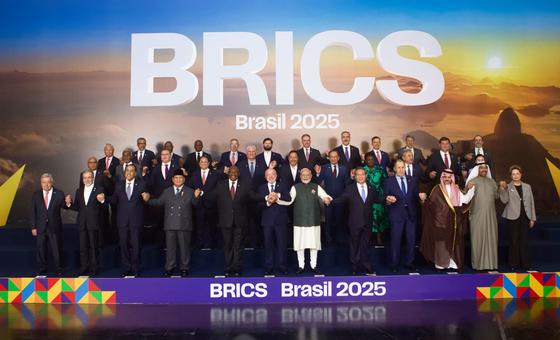
‘Cooperation is humanity’s greatest innovation,’ UN chief declares at BRICS summit

Speaking at the 17th BRICS summit in Rio de Janeiro, Brazil, he emphasised the human impact of environmental devastation and climate change.  And as environmental disasters increase, the sustainable development goals are also being left behind.  

Across the world, lives and livelihoods are being ripped apart, and sustainable development gains left in tatters as disasters accelerate,” Mr. Guterres said. 

The impact on human health is atrocious…the vulnerable and the poorer pay the highest price.” 

BRICS was founded by Brazil, Russia, India and China in 2006. South Africa joined in 2011 and Egypt, Ethiopia, Indonesia, Iran, Saudi Arabia and the United Arab Emirates joined the group since. Collectively, these eleven States represent over half of the world’s population and approximately one-third of the world’s GDP.  

Artificial intelligence must benefit all

On Sunday, Mr. Guterres addressed a session on strengthening multilateralism, economic-financial affairs and artificial intelligence, where he called for efforts to “minimize the risks and maximize the potential” of the breakthrough technology.

Artificial intelligence is reshaping economies and societies. The fundamental test is how wisely we will guide this transformation, how we minimize the risks and maximize the potential for good,” he said.  

To maximize the potential, the Secretary-General argued that AI cannot be “a club of the few but must benefit all,” calling for the “real voice” of developing countries to be included in global AI governance.

He also said that human rights and equity must be the guiding principles which shape any international governance structure for AI.  

“We cannot govern AI effectively – and fairly – without confronting deeper, structural imbalances in our global system,” he said.  

Collaboration is key

UN Secretary-General António Guterres stressed the need for peace amid conflicts in Gaza, Ukraine, Sudan and Myanmar.

He called for urgent reform of global institutions, noting that bodies like the Security Council and international financial systems were “designed for a bygone age, a bygone world, with a bygone system of power relations.”

“The reform of the Security Council is crucial,” he said, highlighting also calls from the recent financing for development conference in Sevilla.

Priorities include greater voice for developing countries in global governance, effective debt restructuring, and tripling multilateral bank lending – especially in concessional and local-currency terms.

Call for reform

Mr. Guterres concluded his remarks highlighting the power of cooperation and trust.

At a time when multilateralism is being undermined, let us remind the world that cooperation is humanity’s greatest innovation,” he said.

Let us rise to this moment – and reform and modernize multilateralism, including the UN and all the systems and institutions to make it work for everyone, everywhere.” 

Source link

Innovation Level

The Department of Science & Technology has launched a new programme ‘National Initiative for Developing & Harnessing Innovations (NIDHI)’ last year which covers the entire value chain of innovations starting from idea to commercialization.

To promote innovation focused start-ups some of the key initiatives taken by the government are:

1. National Institution for Transforming India (NITI) Aayog is implementing Atal Innovation Mission (AIM) for promoting Incubators and Tinkering Labs.

2. Ministry of Human Resource Development (MHRD) and Department of Science and Technology (DST) have joined hands to promote Research Parks in the country.

3. Department of Industrial Policy and Promotion (DIPP) in association with Small Industries Development Bank of India (SIDBI) has set up a Rs.10,000 crore Fund to invest in Venture Capital Funds to promote innovations and start-ups.

4. Ministry of Micro Small and Medium Industries has a programme to setup incubators in the Agriculture sector, under the ASPIRE (‘A Scheme For Promoting Innovation, Rural Industry & Entrepreneurship’) programme.

5. Department of Bio-Technology has a programme to promote incubators in the Bio-tech sector under the Biotechnology Industry Research Assistance Council (BIRAC) programme.

6. MHRD has also launched a Smart India Hackathon for involving Engineering students to provide solutions to problems faced by Government Departments.

In short there is a concerted effort by the government to promote innovation for addressing the problems and challenges faced by the country.

This information was given by Minister of State for Ministry of Science & Technology and Ministry of Earth Sciences Shri Y.S.Chowdary in a written reply to a question in Lok Sabha today.

Indian Cabinet Approves MOUs with United Arab Emirates

The Union Cabinet on Wednesday approved the Memorandum of Understanding between India and United Arab Emirates for cooperation in the field of Small and Medium Enterprises and Innovation. The MoU will benefit Indian SMEs and lead to equitables and inclusive development, said a statement.

The exposure to best practices in SME sector abroad would provide an opportunity to Indian SMEs to improve upon them and innovate further. It would also provide to Indian SME sector an opportunity to have a mutually beneficial relation with SME sector of the United Arab Emirates and to explore their markets.

The Cabinet also approved an MoU with UAE on Institutional Cooperation in Maritime Transport that will pave way for facilitation and promotion of maritime transport, simplification of customs and other formalities, wherever possible, observed in Ports and facilitation of the use of existing installations for the disposal of waste.

The MoU entails Shipping Companies in both countries to enter into bilateral and multi-lateral arrangements for trade. In addition, a pact on bilateral Cooperation in the Road Transport and Highways Sector to be signed between the Ministry of Road Transport and Highways, India and the Federal Transport Authority – Land and Maritime, U.A.E. was also approved.

The proposed MoU envisages increased cooperation, exchange and collaboration between India and the UAE, and will contribute to increased investment in infrastructure development and enhance logistics efficiency. This will help in promoting safe, economical, efficient and environmentally sound road transport in the country and will further help both the countries in creating an institutional mechanism for cooperation in the field.