
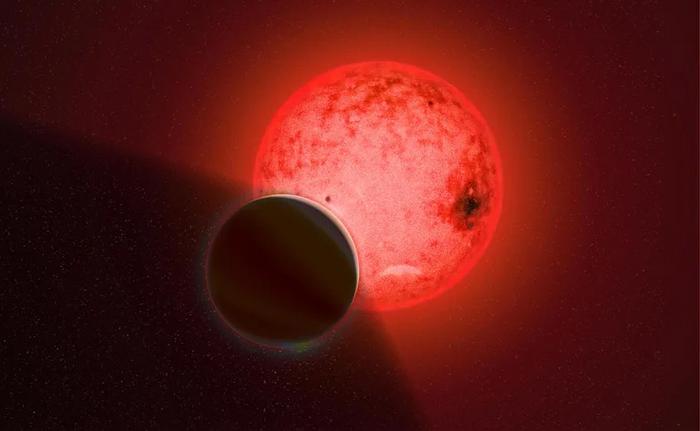
Astronomers studying the exoplanet TOI-5205 b have found unexpected atmospheric properties that challenge existing models of planet formation. Using the James Webb Space Telescope, researchers observed the Jupiter-sized planet orbiting a small red dwarf star and detected unusually low heavy-element content. The findings, published this week, suggest new mechanisms may shape how giant planets form around smaller stars.
A giant planet circles a small, dim star, and astronomers are still working out how it got there.
The exoplanet TOI-5205 b, roughly the size of Jupiter, orbits a red dwarf star that is far smaller than the Sun. Systems like this are often described as unusual because standard models of planet formation struggle to explain how such a large planet could emerge from a relatively small disk of material.
Now, new observations using the James Webb Space Telescope (JWST) have added another layer to the puzzle. Researchers report that the planet’s atmosphere contains fewer heavy elements than expected, even when compared to its own host star.
The findings were published in The Astronomical Journal and led by scientists at NASA Goddard Space Flight Center, with contributions from Carnegie Institution for Science and other international partners.
JWST transit data reveals unexpected atmospheric composition
TOI-5205 b orbits its host star closely enough that it regularly passes in front of it, an event known as a transit. During these transits, the planet blocks about six percent of the star’s light, allowing astronomers to analyze its atmosphere.
Using spectrographs aboard JWST, researchers split the starlight filtering through the planet’s atmosphere into different wavelengths. This technique reveals the chemical composition of the gases surrounding the planet.
The results showed the presence of methane and hydrogen sulfide, both commonly found in gas giant atmospheres. But what stood out was the relative lack of heavier elements, often referred to as metallicity in astronomy.
The planet’s atmosphere appears less enriched in heavy elements than Jupiter, and even less than its own host star. That runs counter to expectations. In most known systems, giant planets tend to have atmospheres richer in heavy elements than their stars.
“Forbidden” planet raises questions about how worlds form
TOI-5205 b belongs to a class sometimes called giant exoplanets around M dwarf stars, or GEMS. These systems are rare because smaller stars are thought to have less material available in their protoplanetary disks, making it harder to form large planets.
The existence of TOI-5205 b already challenged that assumption when it was confirmed in 2023 using data from the Transiting Exoplanet Survey Satellite (TESS). The new atmospheric findings deepen the mystery.
Researchers expected that if such a planet formed, it would show clear signs of heavy-element enrichment. Instead, the data suggests the opposite.
To interpret the results, scientists used models of planetary interiors developed at the University of Zurich. These models indicate that while the planet as a whole may be rich in heavier elements, those materials could be concentrated deep inside.
That separation between interior and atmosphere points to a process where heavy elements migrate inward during formation, leaving the outer layers relatively depleted.

Credit-Katherine Cain, Carnegie Science.
New clues about early planetary evolution
The findings suggest that TOI-5205 b may have experienced a more complex formation process than previously thought. One possibility is that the planet formed quickly, capturing large amounts of hydrogen and helium before heavier elements could mix evenly throughout its structure.
Another possibility involves limited mixing between the planet’s interior and its atmosphere, preventing heavier elements from rising to observable levels.
The study also points to a carbon-rich, oxygen-poor atmosphere, which could influence how clouds form and how heat moves through the planet’s outer layers.
Astronomers plan to expand their observations through a broader program focused on similar systems. By studying more giant planets around small stars, researchers hope to determine whether TOI-5205 b is an outlier or part of a larger pattern.
For now, the planet stands as a case that does not fit neatly into existing models. A massive world orbiting a modest star, with an atmosphere that defies expectations.
Also Read:
Astronomers Spot “Sneezing” Baby Stars Creating Massive Rings In Space
Space Breakthrough: Astronomers confirm rogue planet candidate as a planet for the first time
Astronomers, dim star, exoplanet, exoplanet atmosphere, Giant Planet, Moon, planet formation, Planets, Red Dwarf, Space, space news, stars, Sun, TOI-5205 b Exoplanet

TOI-5205 b Exoplanet Around Red Dwarf Reveals Unusual Atmosphere: JWST Study added by Sridhar P on
View all posts by Sridhar P →