
Scientists from the Raman Research Institute have identified a possible cause behind irregular X-ray bursts from a distant space object, based on observations spanning 2001 to 2021. The study focuses on ULX M74 X-1, an ultraluminous X-ray source in the spiral galaxy M74, using data from NASA and European space telescopes. Researchers suggest that a wobbling accretion disk may explain the unusual and unpredictable flaring pattern observed over time.
A distant object in space has been flashing bursts of energy in a pattern that refuses to settle into rhythm. Indian scientists now think they know why.
Researchers at the Raman Research Institute in Bengaluru have analyzed years of observational data to explain the unusual behavior of a powerful X-ray source known as ULX M74 X-1. Their findings point to a wobbling disk of matter spiraling into a compact object, possibly a black hole or neutron star.
ULX M74 X-1 and the mystery of irregular X-ray flares
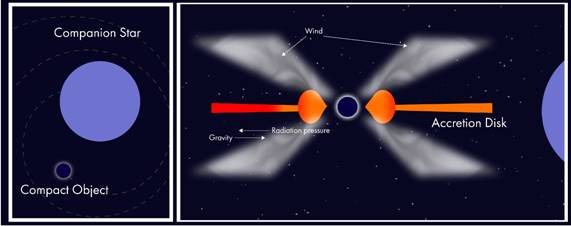
Ultraluminous X-ray sources, or ULXs, are among the brightest objects in the universe. They consist of a compact object such as a black hole or neutron star pulling in material from a companion star in what astronomers call an accreting binary system.
These systems can exceed the so-called Eddington limit, the theoretical cap on how bright an object can shine based on its mass. In some cases, ULXs surpass this limit by more than 100 times, making them key targets for astrophysical research.
The specific source studied, ULX M74 X-1, lies in the spiral galaxy M74 and first drew attention in the mid-2000s when scientists detected rapid bursts of energy, known as flares. These flares showed a repeating pattern, but not at consistent intervals, creating a puzzle that remained unresolved for years.
To investigate, the RRI team led by researcher Aman Upadhyay used archival data from Chandra X-ray Observatory and XMM-Newton, covering two decades of observations.

Spectral clues reveal shifting perspectives
The team analyzed both flaring and non-flaring states of the source by studying its spectrum, which maps the intensity of radiation across energy levels.
During flares, the data showed a distinct feature around one kilo-electronvolt, a unit used to measure X-ray energy. This feature suggests the presence of strong winds blowing off the accretion disk due to intense radiation pressure.
In such scenarios, the structure of the system creates a funnel-like region around its axis. When observed through this funnel, the system appears at a low inclination angle. When viewed through the surrounding wind, it appears edge-on, or at a higher inclination angle.
However, the non-flaring data told a different story. High-energy photons dominated the spectrum, indicating a direct view of the inner, brightest region of the disk without interference from wind.
This contrast suggested that the observer’s line of sight was not fixed, but changing over time.
Wobbling accretion disk explains irregular bursts
To reconcile the conflicting observations, researchers proposed that the accretion disk itself is wobbling, similar to a spinning top.
As the disk tilts and shifts, the wind surrounding it moves in and out of the telescope’s line of sight. This leads to periodic changes in brightness, producing flares that repeat but not at regular intervals.
Co-author Prof. Vikram Rana said the wobble could explain why the same object appears differently depending on when it is observed, offering a unified explanation for both flaring and non-flaring states.
The mechanism provides a physical model for understanding irregular variability in ULXs, which has been a long-standing question in high-energy astrophysics.
Black hole or neutron star: the central debate
The nature of the compact object at the center of ULX M74 X-1 remains uncertain.
Earlier studies suggested the presence of an intermediate-mass black hole, based on lower temperature readings of the accretion disk. However, the RRI team applied updated spectral models that describe the disk as having multiple temperature zones.
Using this approach, they estimated the object’s mass to be about seven times that of the Sun, placing it in the category of stellar-mass black holes.
At the same time, the observed characteristics also resemble those of neutron star ULXs, leaving open the possibility that the object could be a neutron star instead.
Researchers say future work will focus on detecting pulsations, which would confirm the presence of a neutron star.
Expanding understanding of extreme cosmic systems
The findings contribute to a broader effort to understand how matter behaves under extreme gravitational and radiation conditions.
By linking irregular flaring patterns to geometric changes in the accretion disk, the study offers a framework that could be applied to other ULXs showing similar behavior.
The research, published in The Astrophysical Journal, highlights how long-term observational data can reveal subtle dynamics in distant cosmic systems that are otherwise impossible to detect directly.
For scientists studying the most energetic objects in the universe, the work adds a new piece to a complex puzzle that continues to evolve with each observation.
Also Read:
Are we alone in the universe? JPL’s OWLS, other tools to help search for life in deep space
Boosting Space Startups: India’s Bold Rs 1,000 Cr Fund Redefines Skies For Private Players
accretion disk wobble, Chandra telescope findings Long-tail variants: what causes ULX flares space, Indian researchers, irregular X-ray bursts explanation, isro, NASA, Raman Research Institute astronomy, RRI, RRI black hole neutron star research, Space, space news, space research, ultraluminous X-ray sources, ULX M74 X-1 study, X- ray bursts, X-ray flares explanation

RRI scientists trace mysterious X-ray bursts to wobbling disk in distant galaxy added by Sridhar P on
View all posts by Sridhar P →