
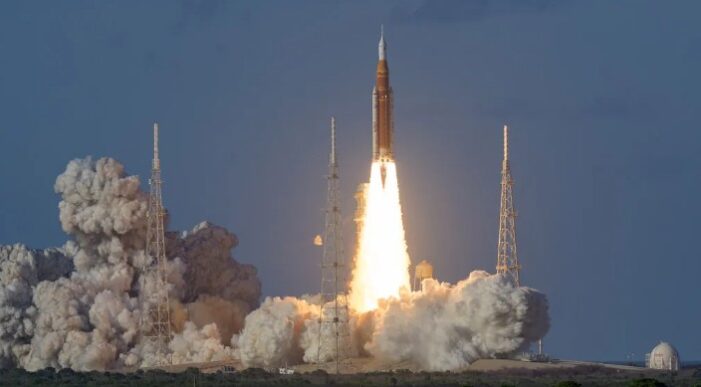
NASA confirmed the Artemis II crew completed a perigee raise maneuver on April 2, refining Orion’s orbit around Earth. A brief communications loss occurred shortly after the burn but was quickly resolved with no reported impact on crew safety. The agency will hold a press conference from Kennedy Space Center as the mission prepares for its next orbital milestone.
A routine engine burn sharpened Artemis II’s orbit. Minutes later, mission control lost contact. Then the signal came back.
The National Aeronautics and Space Administration said the Orion spacecraft successfully completed its perigee raise maneuver, one of the key early steps in shaping its path around Earth. The burn used the interim cryogenic propulsion stage’s RL10 engine to lift the spacecraft’s lowest orbital point, refining its trajectory for later mission phases.
The maneuver followed earlier orbital adjustments and forms part of a sequence designed to prepare Orion for operations beyond low Earth orbit. NASA officials said the burn occurred as planned, with precise timing required to achieve the desired orbital change.
Artemis II perigee raise burn and orbital adjustments
The perigee raise maneuver increases the spacecraft’s minimum altitude during its orbit. Along with a separate apogee raise burn, which affects the highest orbital point, these adjustments create a stable and elongated orbit suitable for further testing.
NASA said these burns are critical in preparing Orion for a planned high Earth orbit phase lasting about 23.5 hours. During that period, astronauts and ground teams will conduct system checkouts before committing to the next stage of the mission.
The work is coordinated through mission control at Johnson Space Center, where engineers track propulsion performance, navigation data, and onboard systems in real time.
Brief communication dropout under review
Shortly after completing the burn, ground teams experienced a temporary loss of communications with the spacecraft. NASA said controllers were unable to receive data from Orion or the crew for a brief period.
The interruption resolved quickly. Astronauts reported that they continued to hear communications from the ground throughout the event, indicating that onboard systems remained functional.
NASA said engineers are reviewing telemetry to determine the cause of the dropout. The agency has not indicated any impact on mission safety or trajectory.
Such communication gaps, while uncommon, are treated as high-priority review items during test missions. Artemis II, as a crewed test flight, is designed to expose and evaluate system behavior under real operating conditions.
NASA press conference and mission leadership
NASA will hold a post-launch press conference at 8 p.m. EDT from the Kennedy Space Center to provide further updates.
Scheduled participants include NASA Administrator Jared Isaacman, Associate Administrator Amit Kshatriya, Lori Glaze, who serves as acting associate administrator for the Exploration Systems Development Mission Directorate, and Norm Knight, director of the Flight Operations Directorate.
The briefing is expected to address the completed maneuver, the communication anomaly, and upcoming mission steps.
Public attention remains fixed on the mission’s progress. “Even a small signal loss gets people nervous, but that’s why they test,” wrote Reddit user SpaceTrackLive in a post that drew more than 900 upvotes, reflecting cautious optimism among spaceflight observers.
Next milestone: apogee raise burn and system checks
The next major step for Artemis II is the apogee raise maneuver. This burn will increase the highest point of Orion’s orbit, complementing the earlier perigee adjustment.
Together, these orbital changes define the spacecraft’s path before it transitions into high Earth orbit operations. NASA said this phase will allow for extended system verification and crew activity in preparation for the mission’s later trajectory toward the Moon.
Engineers view these incremental milestones as essential. Each burn, test, and anomaly review contributes to a broader goal: confirming that Orion can safely carry astronauts through deep space and back.
For now, Artemis II continues to move step by step. One maneuver completed, one anomaly under review, and another burn on the horizon.
Also Read:
Artemis II Mission Launch: NASA Sends Crew on First Moon Flyby in 50 Years
NASA’s Artemis II Rocket Reaches Launch Pad 39B, Final Countdown Begins
Artemis II mission, Artemis II perigee burn, Artemis mission, Artemis program, communication loss spaceflight, Earth, Moon, Moon Mission, NASA, NASA mission status, orbital maneuver, Orion spacecraft update, Planets, Space, space news, Sun

Artemis II Update-2 : Perigee Raise Burn Completed with brief Communications Loss, NASA Probes added by Sridhar P on
View all posts by Sridhar P →