
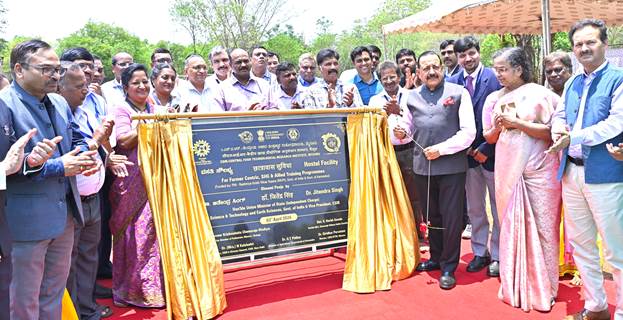
India on April 3 advanced its millet strategy with a new training facility at the Central Food Technology Research Institute in Mysuru and growing global adoption of millet-based foods. Union Minister Jitendra Singh said innovations developed at the institute are already being used by international food chains such as McDonald’s. The move links research, skill development, and market access as part of a broader push for sustainable nutrition and rural livelihoods.
A millet-based dish developed in an Indian lab now finds its way onto global fast-food menus. In Mysuru, that journey from grain to global product is being scaled up.
On April 3, Union Minister for Science and Technology Dr. Jitendra Singh laid the foundation for a 30-room single-occupancy hostel at the Central Food Technology Research Institute (CFTRI), a premier food research body under India’s Council of Scientific and Industrial Research. The facility is designed to support trainees, farmers, and entrepreneurs working in millet-based food processing.
The announcement came alongside a broader push to expand India’s millet ecosystem, with the minister highlighting that millet recipes developed using Indian technology are already being served by global chains, including McDonald’s.
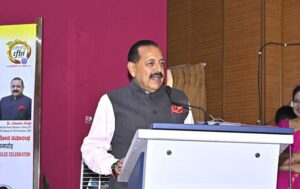
CFTRI Mysuru millet centre and hostel project details
The new hostel facility, funded under the Rashtriya Krishi Vikas Yojana (RKVY), will accommodate around 50 participants and include kitchen and dining infrastructure. Officials expect it to be completed within a year.
The residential setup is intended to support immersive training programs for Farmer Producer Organisations, self-help groups, and startups. By enabling participants from across the country to stay on campus, the institute aims to expand access to hands-on training in food processing, entrepreneurship, and value addition.
Officials said demand for such structured programs has grown steadily, with CFTRI already conducting dozens of training sessions annually. The residential model is expected to improve participation and learning outcomes, particularly for those who cannot afford independent accommodation.
During his visit, Singh reviewed the institute’s Centre of Excellence on Millets, which he described as one of the first globally dedicated platforms for millet innovation.
The facility includes seven processing lines and a laboratory capable of handling end-to-end processing of major millet varieties. Technologies at the centre allow cleaning, dehulling, polishing, and sorting, along with production of value-added products such as flakes, extruded foods, baked goods, and semolina.
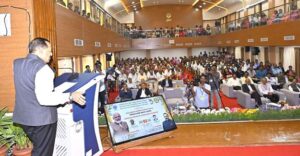
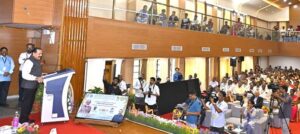
India millet strategy links research, industry and rural livelihoods
The millet centre, supported by ₹20 crore under RKVY, is designed for industrial-scale efficiency. It can process between 300 kg and 1,000 kg per hour and handle all nine major millet varieties within a single integrated system.
Its infrastructure includes cleaning capacities of up to 70 tonnes per day and milling capacities of up to 15 tonnes per day, producing flour, bran, and semolina while preserving nutritional content.
One of the key technological advances highlighted during the visit is the extension of millet flour shelf life from about one month to nearly ten months. That improvement is seen as critical for commercial viability, especially for packaged and export-ready products.
Singh also pointed to efforts to expand innovation beyond millets, including work on sustainable food products derived from “Kalari,” a traditional cheese from Jammu and Kashmir.
The minister emphasized that the next phase of growth lies in strengthening the commercial ecosystem around such technologies. That includes greater engagement with startups, micro, small, and medium enterprises, and digital outreach to expand market access.
India’s focus on millets has gained international visibility in recent years, particularly after the United Nations declared an International Year of Millets, a move led by India to promote climate-resilient crops and sustainable diets.
The CFTRI model reflects a broader policy shift that links scientific research with grassroots capacity building. The millet centre provides the technological base, while the new hostel aims to expand the pool of trained individuals who can apply these innovations in real-world settings.
Public sentiment around millets has also evolved as awareness grows. In a Reddit discussion on sustainable diets, user “EcoFoodIndia,” writing on Reddit (1,600 upvotes), said, “Millets went from being seen as poor man’s food to something global brands now want.”
As global demand rises for climate-resilient and nutrient-rich foods, policymakers are positioning millets as a strategic component of India’s food economy.
The developments in Mysuru suggest a coordinated approach that brings together research institutions, industry adoption, and training infrastructure. The outcome will depend on how effectively these elements translate into scalable production and wider market access.
Also Read:
Food Ministry canteens to have millets on menu in view of its health benefits
Central Food Technology Research Institute (CFTRI), CFTRI hostel, Food, food processing, McDonald, millet mission India, millets, Union Minister Jitendra Singh

From McDonald’s Menus To Rural Training: Inside India’s Millet Strategy added by Sridhar P on
View all posts by Sridhar P →