
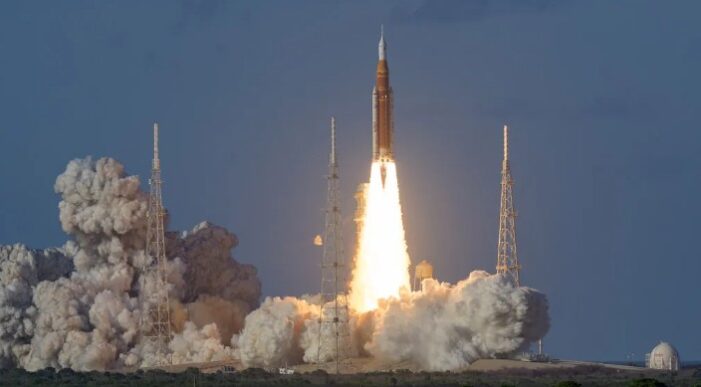
NASA confirmed the Artemis II crew resolved a toilet system fault aboard the Orion spacecraft on April 2 while in Earth orbit. The issue, first detected as a blinking fault light on April 1, was addressed through coordinated troubleshooting with mission control in Houston. The fix comes ahead of a scheduled perigee raise burn, a maneuver that will adjust Orion’s orbit for future deep space operations.
A minor but essential system aboard NASA’s Artemis II spacecraft briefly drew attention this week. It was not propulsion or navigation. It was the toilet.
Astronauts aboard Orion, the capsule named Integrity, reported a blinking fault light tied to the waste management system on April 1. Within hours, engineers on the ground and the crew in orbit worked through the problem together. By the next mission update, the system was back to normal operation.
The episode highlights how even routine spacecraft functions demand precision during crewed missions led by the National Aeronautics and Space Administration.
Orion spacecraft toilet issue and in-flight troubleshooting
The issue first surfaced ahead of a planned apogee raise burn, when the crew noticed a blinking fault indicator linked to Orion’s toilet system. Such warning signals are designed to flag irregularities early, even when the system continues functioning.
NASA’s mission control team at the Johnson Space Center in Houston began reviewing telemetry immediately. Engineers assessed system data while communicating directly with the astronauts to isolate the cause.
The troubleshooting process involved both software diagnostics and procedural checks inside the spacecraft. The agency did not report any hardware damage or safety risk tied to the issue.
By April 2, NASA confirmed that normal functionality had been restored. The resolution ensured that one of the spacecraft’s life-support subsystems remained fully operational as the mission continued.
Waste management systems in microgravity rely on airflow, pressure control, and precise mechanical components. Even minor anomalies require immediate attention, as they can affect crew comfort and long-duration mission readiness.
NASA
Perigee raise burn timing and mission trajectory planning
With the issue resolved, the Artemis II crew is preparing for the next major step in the mission timeline. The perigee raise burn is scheduled after a planned rest period.
Perigee refers to the lowest point of a spacecraft’s orbit around Earth. Raising it changes the orbital shape, making it more stable and better suited for future maneuvers.
This burn follows an earlier apogee raise maneuver, which increased Orion’s highest orbital point. Together, the two burns define the spacecraft’s initial orbit and test its propulsion system under operational conditions.
NASA scheduled a four-hour rest period for the crew before the maneuver. Astronauts are set to wake at 7 a.m. Eastern Time on April 2 to begin preparations. After completing post-burn procedures, they will return to a second sleep cycle later in the morning.
The sequence reflects the structured rhythm of human spaceflight, where operational tasks alternate with carefully timed rest to maintain performance.
The Artemis II mission continues to build toward its broader objective: validating systems for future missions that will carry astronauts beyond Earth orbit and toward the Moon.
Also Read:
Artemis II Mission Launch: NASA Sends Crew on First Moon Flyby in 50 Years
Artemis II Update-1: Orion Completes Proximity Operations, Perigee Burn Next
Artemis II update, Artemis update, Earth, Moon, Moon Mission, NASA, NASA Artemis crew operations, nasa update, Orion spacecraft toilet issue, Orion systems check, perigee raise burn, Space, space mission troubleshooting, space news, Sun

Artemis II Crew and Ground Teams Successfully Troubleshoot Orion’s Toilet Glitch added by Sridhar P on
View all posts by Sridhar P →