
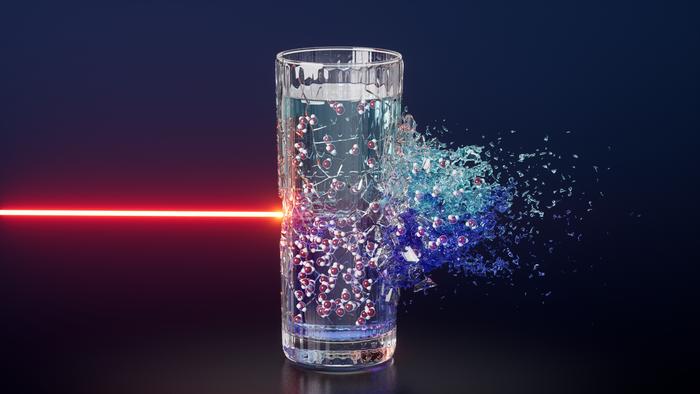
Researchers at Stockholm University have identified a long-theorized critical point in supercooled water at about minus 63 degrees Celsius and 1,000 atmospheres, using advanced X-ray laser experiments. The discovery, published in Science, helps explain why water behaves differently from other liquids, including why ice floats and why water expands as it cools. Scientists say the finding could reshape understanding of water’s role in climate, biology and planetary systems.
Water, a substance so familiar it fills glasses and oceans alike, has long defied basic rules that govern other liquids. Now, scientists say they have pinpointed a hidden state that may explain why.
Researchers at Stockholm University report experimental evidence of a “critical point” in supercooled water, a condition reached at roughly minus 63 degrees Celsius and pressures about 1,000 times higher than Earth’s atmosphere. The findings appear in the journal Science
The work offers a physical explanation for water’s well-known anomalies, from the way ice floats to the unusual way liquid water expands when cooled below 4 degrees Celsius.
Supercooled water critical point discovery and X-ray laser method
The team used ultrafast X-ray pulses generated at facilities in South Korea to observe water before it froze, capturing changes that occur in fractions of a second [2].
“What was special was that we were able to X-ray unimaginably fast before the ice froze and could observe how the liquid-liquid transition vanishes and a new critical state emerges,” said Anders Nilsson, a professor of chemical physics at Stockholm University
Scientists have debated the existence of such a critical point for decades. Earlier theories proposed that water could exist in two distinct liquid forms under extreme conditions, but direct experimental confirmation remained elusive.
The new observations show that at low temperatures and high pressures, water can indeed shift between two liquid phases with different molecular structures. At a specific threshold, that distinction disappears entirely. This marks the critical point.
Why water behaves differently from other liquids
Most liquids become denser as they cool. Water does the opposite below 4 degrees Celsius, expanding as temperatures drop further.
That anomaly explains why ice floats. Solid ice is less dense than liquid water, allowing it to sit on the surface rather than sink. This property plays a crucial role in sustaining aquatic life during winter.
The study suggests that these unusual behaviors stem from fluctuations between two competing liquid structures. Near the critical point, water rapidly shifts between these states, creating instability across a wide range of temperatures and pressures.
“It is these fluctuations that give water its unusual properties,” the researchers noted
In practical terms, the influence of this critical point extends far beyond extreme laboratory conditions. According to the study, even ordinary water at room temperature carries signatures of this underlying instability.
Liquid-liquid transition and implications for science
Water’s ability to exist in two liquid phases sets it apart from most substances. At low temperatures and high pressures, molecules arrange themselves in different bonding networks, forming distinct liquid states.
As temperature rises and pressure drops, these differences vanish, leaving a single uniform phase. This transition zone creates a region of instability that affects measurable properties such as compressibility and heat capacity.
Researchers also observed that molecular motion slows dramatically near the critical point.
“It looks almost that you cannot escape the critical point if you entered it, almost like a Black Hole,” said Robin Tyburski, a member of the research team
The analogy reflects how systems behave near critical transitions, where fluctuations become large and persistent.
Longstanding scientific debate over water’s anomalies
The origins of water’s unusual behavior have been debated for more than a century, dating back to early studies by Wilhelm Röntgen, who first explored water’s structural peculiarities in the late 19th century [3].
Over time, multiple theories emerged. Some suggested that hydrogen bonding networks alone explained the anomalies. Others proposed more complex phase behavior, including the existence of a hidden critical point.
The new findings provide experimental support for the latter view, potentially settling a longstanding scientific question.
Broader impact on climate, biology and planetary science
Scientists say the implications extend beyond physics.
Water’s behavior influences everything from ocean circulation to protein folding in living organisms. Understanding its fundamental properties could refine climate models and improve predictions about how water behaves under extreme conditions, such as deep within planets.
“It’s amazing how amorphous ices, such an extensively studied state of water, happened to become our entrance to the critical region,” said Aigerim Karina
The ability to study water without it freezing was key to the breakthrough. Advances in X-ray laser technology allowed researchers to probe fleeting states that were previously inaccessible.
“It was a dream come true to be able to measure water under such low temperature condition without freezing,” said Iason Andronis
Questions about water and life remain open
The discovery also raises broader questions about the relationship between water and life.
Water at everyday conditions exists in a state influenced by this critical behavior. Scientists note that no known life can exist without water, and water itself exists in a supercritical-like regime shaped by these fluctuations.
“I find it very exciting that water is the only supercritical liquid at ambient conditions where life exists,” said Fivos Perakis ,
Researchers caution that further work is needed to understand the full implications.
Future studies will focus on how this critical point affects chemical reactions, biological systems and large-scale environmental processes.
Also Read:
Wired for water: How electrification is transforming desalination
Newer ground water is linked with increased risk of Parkinson disease
critical point in supercooled water explained, how x-ray lasers study water phases, supercooled water, water boiling point, water density anomaly, x-ray lasers

Scientists Find Hidden Critical Point in Water That Explains Strange Behavior added by Sridhar P on
View all posts by Sridhar P →