
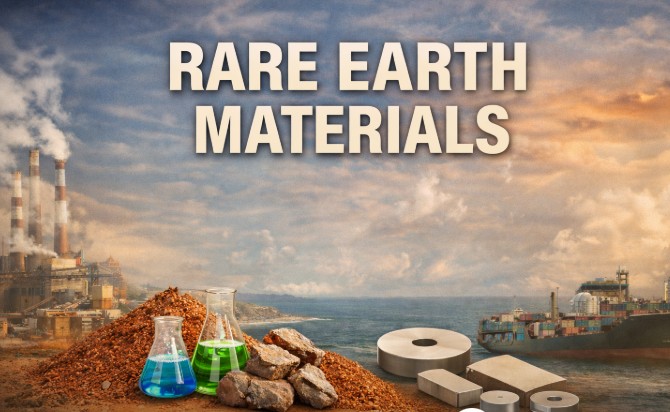
India has identified over 8.5 million tonnes of rare earth oxide resources across coastal and inland regions, the government said on April 2, 2026, in Parliament. While the country holds domestic reserves, it remains dependent on imports for rare earth magnets due to processing and industrial gaps. A ₹7,280 crore incentive scheme aims to build local magnet manufacturing capacity and reduce reliance on foreign supply chains.
A mineral buried in coastal sands and inland deposits has quietly become central to India’s industrial ambitions. Rare earth elements, essential for everything from electric vehicles to defence systems, are now at the center of a policy push to turn geological potential into manufacturing strength.
The Atomic Minerals Directorate for Exploration and Research (AMD), a unit under the Department of Atomic Energy (DAE), has identified significant rare earth reserves across the country, according to a statement presented in the Rajya Sabha on April 2, 2026.
India holds approximately 7.23 million tonnes of in-situ total rare earth oxide equivalent embedded in 13.15 million tonnes of monazite, a mineral rich in thorium and rare earths. These deposits are spread across coastal “teri” sands, beach sands, and inland alluvial regions in states including Andhra Pradesh, Odisha, Tamil Nadu, Kerala, and West Bengal, among others.
In addition, about 1.29 million tonnes of rare earth oxide resources have been identified in hard rock terrains in parts of Gujarat and Rajasthan.
Why India Still Imports Rare Earth Magnets
Despite these reserves, the government acknowledged a critical gap. India is not dependent on other countries for rare earth minerals themselves, but it continues to rely on imports for rare earth magnets and related high-value products.
The reasons are structural and technical.
The ore grade of Indian deposits is relatively low, ranging between 0.056% and 0.058%, which makes extraction economically challenging. The presence of radioactive elements further complicates processing, requiring stricter handling protocols and increasing costs.
Environmental and regulatory constraints also limit mining. Coastal Regulation Zone (CRZ) rules, mangrove protections, forest cover, and habitation patterns have restricted large-scale extraction, effectively capping production volumes.
Equally significant is the absence of a strong midstream industry. India has limited capacity to convert refined rare earth oxides into metals, alloys, and finished magnets. This lack of downstream demand has historically dampened incentives to scale up extraction.
₹7,280 Crore Scheme Targets Full Supply Chain
To address these gaps, the Union Cabinet approved a scheme in November 2025 to promote the domestic manufacturing of sintered rare earth permanent magnets. The policy was formally notified in December 2025.
The scheme aims to establish 6,000 metric tonnes per annum of rare earth permanent magnet production capacity in India.
The total financial outlay stands at ₹7,280 crore. This includes ₹6,450 crore in sales-linked incentives over five years and ₹730 crore as capital subsidy to support the creation of manufacturing facilities.
Rare earth permanent magnets are among the strongest magnets available and are critical components in electric mobility, renewable energy systems such as wind turbines, advanced electronics, aerospace applications, and defence technologies.
The government’s objective is to build an end-to-end ecosystem. This includes processing rare earth oxides, producing metals and alloys, and manufacturing finished magnets within the country.
Strategic Push Includes Corridors and Pilot Plants
Alongside the incentive scheme, the government has initiated supporting infrastructure and pilot manufacturing efforts.
The Department of Atomic Energy has established a rare earth permanent magnet plant in Visakhapatnam, Andhra Pradesh. The facility produces about three tonnes of Samarium Cobalt magnets annually, a category of high-performance magnets used in strategic sectors such as defence and atomic energy.
The Union Budget for 2026–27 has also proposed dedicated Rare Earth Corridors in Odisha, Kerala, Andhra Pradesh, and Tamil Nadu. These corridors are expected to cluster mining, processing, and manufacturing activities to improve efficiency and attract investment.
The policy direction signals a shift from resource identification to industrial scaling.
Global Context and Domestic Stakes
Rare earth magnets sit at the heart of global supply chains for clean energy and advanced manufacturing. Countries with control over processing and magnet production hold significant leverage in sectors such as electric vehicles and defence systems.
India’s approach, as outlined in Parliament, reflects an attempt to bridge the gap between resource availability and industrial capability.
The statement was delivered by Jitendra Singh, Union Minister of State (Independent Charge) for Earth Sciences and Science and Technology, in the Rajya Sabha.
As the government moves to operationalize incentives and infrastructure, the focus now shifts to execution, industry participation, and the pace at which domestic manufacturing capacity can be built.
Atomic Minerals, critcal minerals, Rare Earth Magnets, rare earth minerals, thorium

India Maps Rare Earth Reserves, Pushes Magnet Manufacturing With ₹7,280 Cr Plan added by Sridhar P on
View all posts by Sridhar P →