
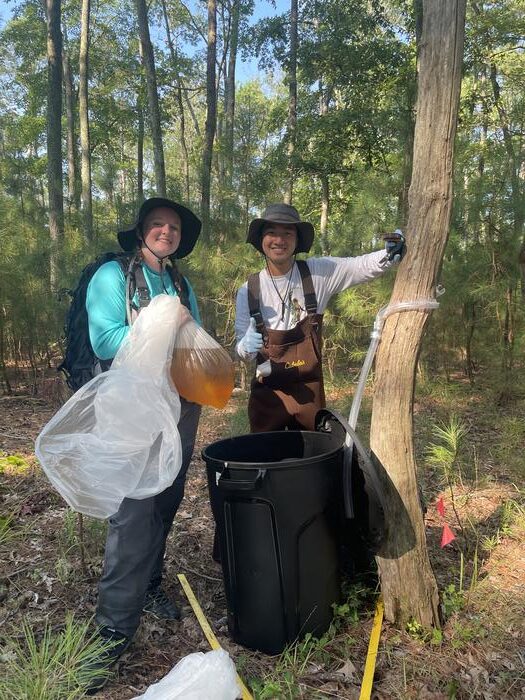
Researchers from the University of Delaware presented findings on March 26, 2026, in Atlanta, showing how “ghost forests” are reshaping coastal ecosystems. The phenomenon, driven by sea level rise along the eastern United States, is killing salt-sensitive trees and altering underground nutrient cycles. Scientists say studying water flow through these forests could help predict how coastal regions respond to climate change. The research was presented at the ACS Spring 2026.
Along stretches of the eastern United States coastline, the landscape is shifting in ways that are both stark and unsettling. Where dense green forests once stood, clusters of pale, lifeless tree trunks now rise from the soil. These are “ghost forests,” a visible imprint of rising seas pushing saltwater inland.
For researchers walking through these areas, the change is not abstract. It is immediate, physical, and accelerating.
“Walking through these coastal forests, surrounded by nature, is beautiful,” said Samantha Chittakone, an undergraduate researcher at the University of Delaware. “However, it is disheartening to see the healthy trees becoming less prevalent as you approach the shoreline.”
Her team’s work, presented this week at ACS Spring 2026, focuses on a less visible but critical process unfolding beneath those skeletal trees. It centers on how water moves through them and what that reveals about ecosystem health.
Ghost forests and saltwater intrusion along US coasts
Ghost forests form when saltwater from rising seas seeps into coastal soils, poisoning trees that cannot tolerate salinity. Over time, the trees die but remain standing, creating the haunting landscapes now increasingly common along the mid-Atlantic coastline.
The phenomenon has drawn attention as a clear signal of climate change’s local impact. But beyond their visual effect, these forests may hold deeper clues about how ecosystems respond to environmental stress.
The research team focused on sweetgum trees, a species common in these coastal regions. By comparing healthy, stressed, and dead trees, they sought to understand how forest systems transition under pressure from saltwater intrusion.
Their approach looked at “stemflow,” the rainwater that travels down a tree’s branches and trunk to the soil below. Scientists consider this flow a key pathway for delivering nutrients and organic material to the forest floor.
“Stemflow is basically injecting nutrients and really important chemicals into the forest ecosystem so the microbiome there can thrive,” said Yu-Ping Chin, a researcher involved in the study.
That process, the team suggests, begins to break down as forests transition into ghost forests.
Stemflow changes reveal disruption in forest carbon cycles
By collecting stemflow samples from trees in different stages of decline, the researchers identified measurable changes in how water and nutrients move through the ecosystem.
One finding stood out. Dead trees allowed significantly less stemflow to reach the forest floor. Instead, much of the water appeared to be absorbed into the decaying wood itself.
“The stemflow’s being absorbed by the dead trees. They’re acting like sponges,” Chin said.
That shift has cascading effects. When less water, nutrients, and dissolved organic carbon reach the soil, the entire ecological balance belowground can change.
The team also detected unexpectedly high sugar concentrations in the stemflow of stressed and dying trees. According to Delphis Levia, another researcher on the project, this could reshape microbial communities in the soil near tree trunks.
“Our results signify that the transition from healthy trees to ghost forests changes the magnitude and chemistry of stemflow,” Levia said. “Further research will better contextualize these changes in stemflow chemistry on the overall cycling of carbon in coastal forests.”
These changes matter because coastal forests play a role in carbon storage. Alterations in how carbon moves through these systems could influence how effectively they act as carbon sinks.
Why ghost forests matter for climate resilience planning
The implications extend beyond individual forests. As sea levels continue to rise, more coastal ecosystems are expected to undergo similar transitions.
Understanding which forests can adapt, and which are likely to collapse into ghost forests, is a growing priority for scientists and policymakers.
This research suggests that stemflow could serve as an early diagnostic signal. Changes in water flow and chemistry may indicate stress in forest systems before visible die-off becomes widespread.
The findings also connect to broader efforts to model climate resilience. Coastal forests act as buffers against storms, store carbon, and support biodiversity. Their decline could amplify the impacts of climate change in already vulnerable regions.
Chittakone said the work is part of a larger push to better understand these processes, including how factors like wildfires interact with stemflow and nutrient cycling.
“Stemflow is a significant transporter of nutrients and other important chemicals in these coastal forests,” she said. “It’s something that we should study more and not overlook whenever it comes to carbon cycling.”
The ghost forests now lining parts of the U.S. coastline are often described as warnings. This research suggests they are also records, capturing the hidden changes reshaping ecosystems from the ground up.
Also Read:
Brewing protein from greenhouse gases: A greener, more profitable alternative to farming, fishing
Global study finds the food commodities driving major global deforestation; Beef on top
climate change, coastal resilience, ghost forest, ghost forests climate change, impact of sea level rise on US forests, saltwater intrusion, saltwater intrusion trees Long-tail variants: how ghost forests affect coastal ecosystems, sea level rise forests, stemflow research, study on stemflow in coastal forests, US coastal ecosystems

Ghost Forests Reveal Hidden Climate Threats Along U.S. Coasts, Study Finds added by Arun Kumar N on
View all posts by Arun Kumar N →