
Feeding a growing global population has long depended on expanding farmland and harvesting marine resources, often at significant environmental cost. A new study suggests a different approach may be viable: producing protein by cultivating methane-consuming microbes in controlled systems.
The research, led by Yanping Liu and Ziyi Yang at the Beijing University of Chemical Technology, evaluates whether microbial protein can compete with conventional sources such as soybean meal and fish meal. The findings were published in Carbon Research.
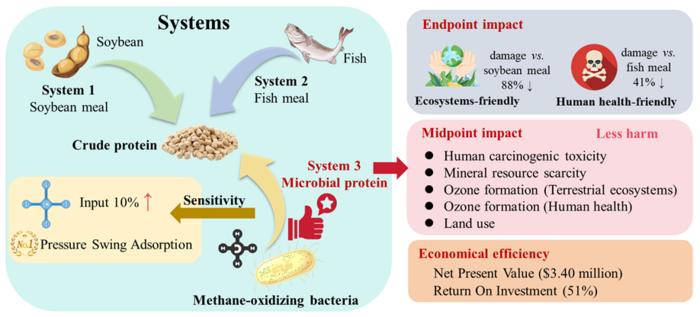
Using a life-cycle assessment framework, the team compared three supply chains, examining environmental impact, resource use, and financial performance. The analysis places microbial protein, derived from methane-oxidizing bacteria, alongside two of the most widely used protein inputs in agriculture and aquaculture.
The results indicate that the microbial approach could significantly reduce reliance on land and marine ecosystems while maintaining economic viability.
Life-cycle assessment compares soy, fish meal, and microbial protein
The study modeled the full production cycles of soybean meal, fish meal, and protein produced from methane-oxidizing bacteria, a class of microbes that consume methane as an energy source.
Soybean farming was associated with extensive land use and high agricultural inputs, including fertilizers and pesticides. These factors contribute to deforestation and environmental degradation in many producing regions.
Fish meal production, widely used in aquaculture feed, showed a different set of pressures. The process requires significant fuel consumption and has been linked to stress on marine ecosystems due to large-scale fishing.
In contrast, microbial protein production operates in controlled bioreactors. This setup removes the need for arable land and reduces dependence on freshwater resources. By relying on methane as a feedstock, the system also utilizes a greenhouse gas that would otherwise contribute to atmospheric emissions.
The researchers noted that while the process is energy-intensive, the trade-offs appear favorable when measured across the full life cycle.
Environmental gains include reduced ecosystem and health impacts
According to the study, shifting from soybean-based protein to methane-derived microbial protein could reduce overall ecosystem damage by 88 percent. The figure is based on the study’s modeling and has not been independently verified by a second source.
The analysis also found that microbial protein production could lower negative human health impacts by 41 percent compared to fish meal. These impacts include emissions and processing-related burdens associated with traditional supply chains.
The controlled production environment allows for more predictable and efficient resource use. It also avoids many of the externalities linked to conventional agriculture, such as land clearing and overfishing.
To optimize the process, the researchers evaluated different methane purification techniques. Pressure swing adsorption, a method used to separate gases under varying pressure conditions, was identified as the most effective approach.
The study reports that this method reduced resource depletion by more than 140 percent compared to membrane-based alternatives. This figure is drawn from the study’s findings and has not been confirmed by an independent source.
Economic analysis shows strong returns for microbial systems
Beyond environmental considerations, the research includes a techno-economic analysis to assess financial feasibility. The results suggest that microbial protein production could deliver competitive, and in some cases superior, economic outcomes.
The study reports a net present value of $3.40 million for the microbial protein system, along with a return on investment of 51 percent across the modeled scenarios. These figures are based on the study’s internal modeling and have not been independently verified.
The combination of reduced resource inputs and controlled production conditions contributes to the system’s economic performance. Unlike traditional agriculture, which is subject to weather variability and land constraints, microbial production can be scaled within industrial facilities.
For countries with limited farmland or degraded marine resources, this approach may offer a more stable and independent protein supply.
Implications for global food and feed systems
The findings reflect broader efforts to develop alternative protein sources that reduce environmental impact while meeting rising demand. Microbial protein, sometimes referred to as single-cell protein, has been explored for decades but is gaining renewed attention due to advances in biotechnology and sustainability concerns.
The study positions methane-based protein production as a potential complement or alternative to existing agricultural systems. By converting a greenhouse gas into usable protein, the process aligns with efforts to reduce emissions while supporting food security.
However, large-scale adoption would depend on several factors, including infrastructure development, regulatory approval, and market acceptance. The transition from pilot systems to industrial-scale production would require investment and coordination across sectors.
The researchers present their findings as a step toward quantifying both the environmental and economic case for microbial protein. By providing detailed life-cycle and financial data, the study aims to inform future decisions on sustainable food production.
Also Read:
Eating protein three times a day could make our seniors stronger
Young people who have AI meal plans might be consuming less calories, but missing a meal
agriculture, bacteria, farming, fertilizers, Fish Feed, fishing, green house effect, green houses gases, methane, microbial protein, pesticides, Soy

Brewing protein from greenhouse gases: A greener, more profitable alternative to farming, fishing added by Arun Kumar N on
View all posts by Arun Kumar N →