
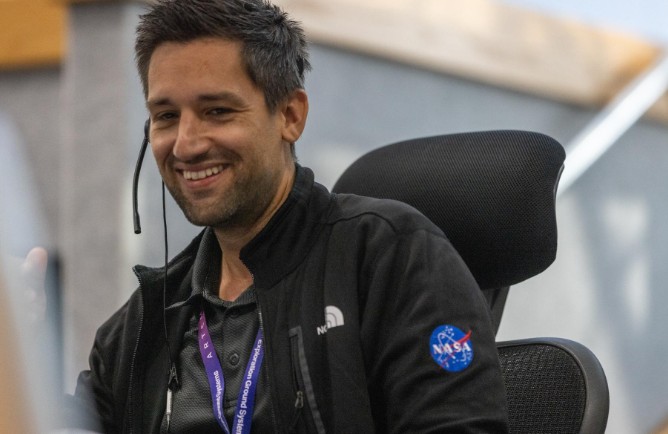
Dan Florez is one of the NASA test directors for the Exploration Ground Systems Program. The test directors are a group of 20 engineers at the agency’s Kennedy Space Center in Florida who plan and execute integrated testing for Artemis missions. Their work includes developing timelines and procedures for launch countdown, propellant loading, emergency egress, pad and launch abort scenarios, recovery operations, and more. They help lead the ground systems team in all areas of testing.
At the time of Artemis I launch, Florez and his fellow test directors had already developed the launch countdown timelines for Artemis II.
“We were really focused on loading that spacecraft with cryogenic propellants and successfully launching it. With Artemis II, we’re going to have to do all that again, but in the middle of that, we’re going to have to embed the crew timeline to get the crew safely inside the spacecraft, get all the systems checked out, and launch them into space,” Florez said. “And we have to do the same thing on the tail end through recovery. So, there’s a lot of complexities when you have the human element thrown into the operation.”
Since Artemis I, Florez has focused his work even more heavily on the human element, taking on rescue and recovery operations.
“We have to have a plan to go get to the crew if we have an abort, if we land anywhere in the world within 24 hours,” said Florez. “My role right now is to do a lot of that coordination to make sure we have all the assets and all the resources in place to get to the crew.”
When the Artemis II crew returns to Earth aboard the Orion spacecraft, Florez will be there, prepared and ready with NASA’s Landing and Recovery Team and the U.S. military.
“We have a great partnership with the military. We have the Human Spaceflight Support Office within the Air Force that support us directly for not just for recovery operations, but also for any of the rescue operations”.
Dan Florez, NASA Test Director, Exploration Ground Systems Program
Recovery operations are routinely verified and validated in what is called an underway recovery test. NASA and Navy teams board a U.S. Navy ship and travel off the coast of San Diego to test retrieving the capsule and getting the crew safely on the ship. In late February 2024, the Artemis II crew joined the recovery team’s eleventh iteration of testing called, URT-11.
“It was really great to have that perspective of having astronauts in the loop during our test operations,” said Florez. “Everywhere along the way, we got feedback from them.”
Artemis II launched at 6:35 p.m. EDT April 1, from Launch Complex 39B, sending NASA astronauts Reid Wiseman, Victor Glover, and Christina Koch, and CSA (Canadian Space Agency) astronaut Jeremy Hansen, on their approximately 10-day mission around the Moon.
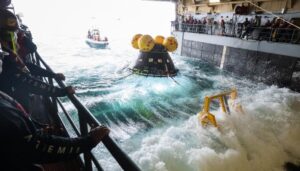
Florez and his colleagues are prepared and ready to apply everything they tested to recover the crew.
“Watching them launch is going to be great. I’m going to be happier when they land”.
Dan Florez, NASA Test Director, Exploration Ground Systems Program
Also Read:
Deep Space Network Establishes Contact With Artemis II Spacecraft
JPL’s Mission Control Steps Up For Artemis II Deep Space Operations

Who is Dan Florez in Artemis Mission Program added by Arun Kumar N on
View all posts by Arun Kumar N →