
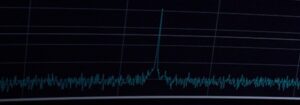
The acquisition of the radio frequency signal from the Artemis II crewed mission to the Moon by NASA’s Deep Space Network (DSN) is indicated by the peak in the data signal shown below on the computer screen.
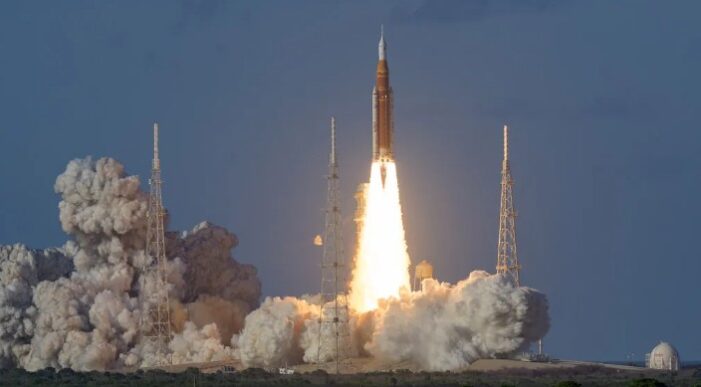
Soon after the mission’s launch on April 1, 2026, at 6:35 p.m. EDT, NASA’s Near Space Network led communications with the Orion capsule. Then, communications were handed off to the DSN, marking the first time in over 50 years that the network would be communicating with a crewed spacecraft traveling through deep space.
The Space Flight Operations Facility at NASA’s Jet Propulsion Laboratory in Southern California (where this photo was taken) operates the DSN, which comprises three complexes in Goldstone, California; Madrid, Spain; and Canberra, Australia. Each complex consists of several radio frequency antennas that communicate with dozens of robotic spacecraft exploring the solar system in addition to the Artemis II mission.
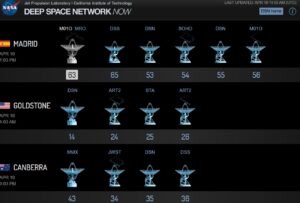
A graphical representation of the Deep Space Network’s radio frequency antennas indicate signal acquisition from NASA’s Artemis II mission to the Moon on April 1, 2026, inside the Space Flight Operations Facility at NASA’s Jet Propulsion Laboratory in Southern California. Two antennas at the Madrid Deep Space Communications Complex, Deep Space Station 54 and 56, can be seen communicating with Artemis II (the signals are labelled “EM2”, short for “Exploration Mission 2”; elsewhere they are labelled “ART2” for “Artemis II”).
A similar visualization can be found at DSN Now, which details all the missions that the network is communicating with 24 hours a day, seven days a week.
The DSN is managed by JPL for the agency’s Space Communications and Navigation program, which is located at NASA Headquarters within the Space Operations Mission Directorate. The DSN allows missions to track, send commands to, and receive scientific data from faraway spacecraft. JPL is managed by Caltech in Pasadena, California, for NASA.
Also Read:
Monitoring over deep space network before artemis II signal acquisition
JPL’s Mission Control Steps Up For Artemis II Deep Space Operations

Deep Space Network Establishes Contact With Artemis II Spacecraft added by Arun Kumar N on
View all posts by Arun Kumar N →