Scientists have developed a new smart oxide that not only stores energy but also visibly indicates how much charge it holds. The material changes colour depending on its charge level—turning blue when charged and becoming transparent as it discharges—offering a simple, real-time visual cue that the device needs recharging.
From smartphones to solar grids, modern systems depend heavily on efficient energy storage. Yet, most devices are typically designed either to store energy or display information, rarely combining both functions in a single material.
Researchers at the Centre for Nano and Soft Matter Sciences, an autonomous institute under the Department of Science and Technology, have addressed this gap by creating an oxygen-deficient bimetallic oxide made of molybdenum and tungsten (Mo₀.₁₁W₀.₈₉O₃₋ₓ). This compound enables both energy storage and visual indication of charge through its colour-changing property.
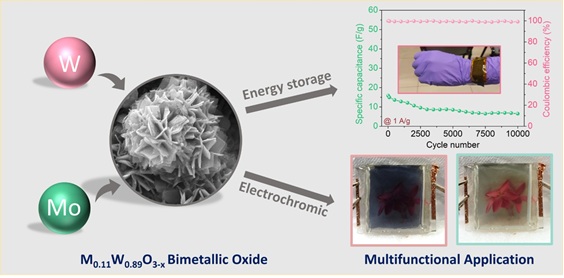
Led by Principal Researcher Ashutosh Kumar Singh, the team synthesised the material using a solvothermal process. Its unique behaviour stems from its oxygen-deficient structure. Missing oxygen atoms create extra space within the material, allowing ions to move more freely. As these ions shift during charging and discharging, they alter the material’s electronic structure—resulting in a visible colour transition that acts as a built-in charge indicator.
Morphology of Bimetalllic oxide and its application demonstration in energy storage and electrochromic devices
The researchers also tested the material in electrochromic applications, developing a 5×5 cm² device that demonstrated strong optical modulation of 43% at 700 nm and high colouration efficiency, indicating low power consumption. When used as a supercapacitor electrode, the material delivered a specific capacitance of 234 F g⁻¹ and an areal capacitance of 975 mF cm⁻², highlighting its strong energy storage capability.
The findings, published in Materials Chemistry A, show that the material maintains stability over 10,000 charge-discharge cycles and performs reliably under mechanical bending and varying environmental conditions. It also exhibited fast switching speeds and strong optical contrast. In practical demonstrations, devices built with the material were able to power an LCD timer and illuminate an LED, underscoring its potential for next-generation smart energy systems.