
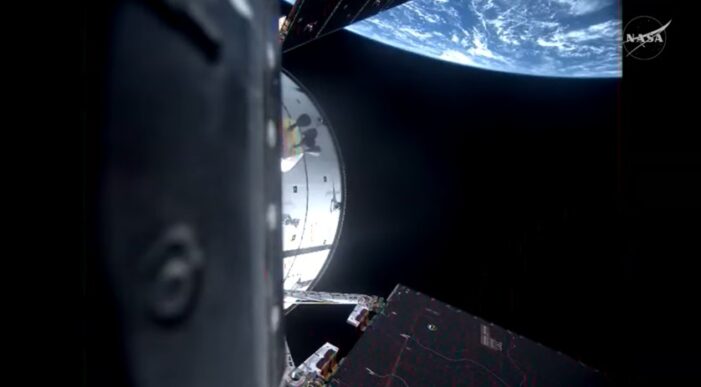
NASA confirmed the Artemis II crew completed the apogee raise burn on April 2, increasing Orion’s orbital high point. The mission now transitions toward a proximity operations demonstration that will test manual spacecraft control near another object. Engineers continue to monitor a minor onboard system issue as the crew prepares for the next phase.
The spacecraft climbed higher. The mission grew more precise.
The National Aeronautics and Space Administration confirmed that Artemis II successfully executed its apogee raise maneuver, a key step in refining the Orion spacecraft’s orbit around Earth. The burn, powered by the interim cryogenic propulsion stage’s RL10 engine, increased the spacecraft’s highest orbital point and aligned it for upcoming tests.
The maneuver follows earlier orbital adjustments and forms part of a carefully sequenced plan to prepare Orion for operations beyond low Earth orbit. NASA officials said the spacecraft remains in stable condition, with power generation and thermal systems operating within expected limits.
Artemis II apogee raise burn and orbit shaping
The apogee raise burn works in tandem with the previously completed perigee adjustment. Together, these maneuvers define the shape and altitude of Orion’s orbit, ensuring the spacecraft is positioned correctly for subsequent demonstrations and trajectory changes.
Mission controllers at Johnson Space Center continue to track performance data, confirming that propulsion and navigation systems responded as expected.
Ahead of the burn, astronauts also began configuring the spacecraft for sustained operations in orbit. That included routine system checks such as evaluating the onboard toilet system. During that procedure, the crew reported a blinking fault light, which engineers are now analyzing.
NASA has not indicated that the issue affects mission safety, but teams are working with the crew to identify its cause and resolve it.
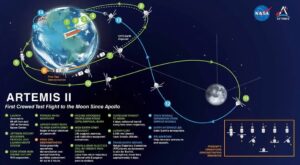
Proximity operations demonstration and manual control testing
The next phase of Artemis II will focus on proximity operations, a critical test of Orion’s ability to maneuver near another spacecraft.
The demonstration will use the detached upper stage of the Space Launch System as a reference target. Astronauts will guide Orion, named Integrity, through a series of controlled movements to evaluate how the spacecraft performs under manual control.
Before the maneuver begins, communications will transition from NASA’s Near Space Network to the Deep Space Network, systems that support spacecraft from launch through deep-space operations.
During the approximately 70-minute exercise, Orion will approach the upper stage to within about 300 feet before pausing. The crew will then take manual control, using onboard hand controllers to make precise adjustments and assess responsiveness.
At a closer range of roughly 30 feet, astronauts will evaluate the spacecraft’s fine handling capabilities. These maneuvers will rely on the reaction control system thrusters located on Orion’s European-built service module.
NASA said the demonstration also includes an automated backflip maneuver, allowing Orion to reorient and face the target stage. The test will generate detailed data on navigation and control systems, including measurements from the spacecraft’s docking camera.
These data points are expected to inform future missions that require rendezvous and docking in lunar orbit, where traditional GPS systems are not available.
Preparing for future lunar operations
At the conclusion of the demonstration, Orion will execute an automated departure burn to safely distance itself from the upper stage. The stage will then perform a disposal maneuver, re-entering Earth’s atmosphere over a remote region of the Pacific Ocean.
NASA said the spacecraft’s systems remain stable as the crew transitions into this next phase. Solar arrays continue to generate power, and environmental conditions inside Orion remain within predicted ranges.
Public interest in the mission’s technical milestones remains high. “This is the kind of test that proves whether astronauts can really control the vehicle in deep space,” wrote Reddit user LunarOpsWatcher in a post with more than 1,100 upvotes, highlighting the importance of manual maneuvering capabilities.
Artemis II is designed as a test mission, but each milestone carries implications for future exploration. The proximity operations demonstration, in particular, addresses a key requirement for sustained human activity beyond Earth orbit.
With the apogee burn complete, Orion now moves into one of its most intricate tests yet.
Also Read:
Artemis II Mission Launch: NASA Sends Crew on First Moon Flyby in 50 Years
Artemis II Update-1: Orion Completes Proximity Operations, Perigee Burn Next
Artemis II Update-2 : Perigee Raise Burn Completed with brief Communications Loss, NASA Probes
#Copper smelter plant, Artemis II, Artemis II apogee burn, Artemis II mission, Earth, Moon, Moon Mission, NASA, NASA mission progress, Orion spacecraft update, proximity operations test, SLS rocket, Space, space news, spaceflight systems, Sun

Artemis II Update-3: Apogee Raise burn complete, Crew prepares critical Proximity Test added by Sridhar P on
View all posts by Sridhar P →