
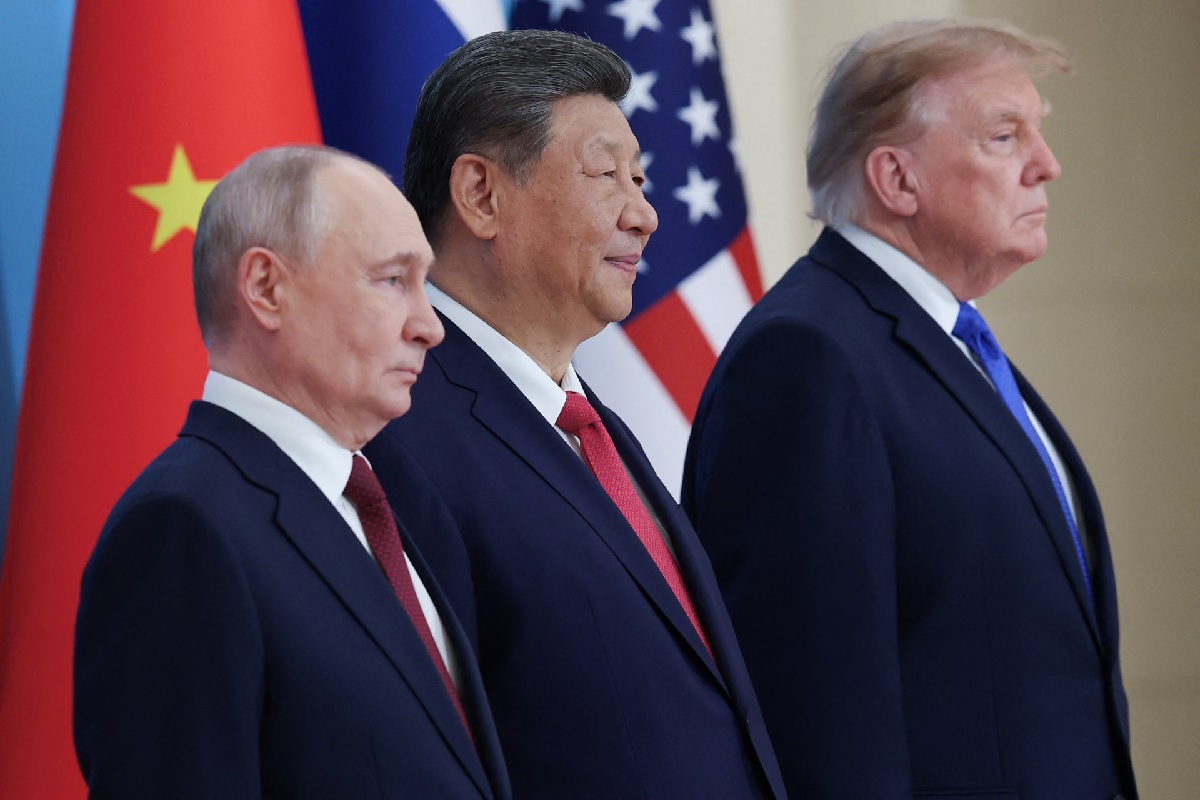
There was no agreement to reduce nuclear arsenals, no timetable for arms-control negotiations and no discernible breakthrough in either Russia’s war in Ukraine or the conflict involving the United States and Iran.
Instead, Trump, Chinese President Xi Jinping and Russian President Vladimir Putin emerged from their unprecedented three-way meeting in Shenzhen with a broadly worded peace declaration that affirmed shared principles without committing their governments to enforceable measures.
The contrast between the summit’s historic significance and its limited results became apparent almost immediately. Speaking to Reuters aboard his aircraft on the return journey to Washington, Trump acknowledged that his ambition to persuade the world’s leading nuclear powers to reduce their arsenals faced formidable obstacles.
“I love the concept of it but in terms of pure negotiation, it’s a very hard thing for me as a president to do,” Trump said.
The admission underscored the central contradiction of a summit intended to demonstrate that personal diplomacy among three powerful leaders could succeed where years of conventional negotiations had struggled.
Trump had secured the meeting he wanted. Whether he had brought the world closer to resolving its most dangerous conflicts was considerably less clear.
The gathering, held at Kylin Villa on the sidelines of the Asia-Pacific Economic Cooperation summit, placed the leaders of three countries that collectively possess the overwhelming majority of the world’s nuclear weapons at the same negotiating table.
“We are really making history,” Trump declared at the opening of the meeting. “The three of us have a great deal to discuss.”
He added: “No peace was ever forged by declining opportunities for engagement.”
For Xi, hosting the summit provided an opportunity to portray China as an indispensable participant in managing international crises. For Putin, appearing alongside the American and Chinese presidents reinforced Russia’s claim to great-power status despite its international isolation over Ukraine.
For Trump, the meeting offered a diplomatic centerpiece to an Asia tour dominated by elaborate ceremonies, high-profile encounters and trade announcements whose details remained incomplete.
Nuclear Disarmament: Ambition Meets Strategic Reality
The most consequential subject before the three leaders was nuclear arms control, an issue that has become increasingly urgent as Washington, Moscow and Beijing modernize their strategic forces.
The summit declaration reaffirmed that nuclear war must never be fought and pledged dialogue on reducing nuclear risks and preventing proliferation.
But it did not establish a negotiating framework, specify reductions or identify a deadline for reaching an agreement.
Trump’s remarks after the meeting suggested that the difficulty extended beyond diplomatic procedure to the fundamental reluctance of nuclear powers to surrender weapons they regard as essential to national security.
“President Xi agrees with me,” Trump told Reuters, referring to the broad concept of limiting nuclear weapons.
But he immediately described the practical obstacle. “We have 4,000 nuclear weapons, we’ll give up half,” Trump said, illustrating the scale of reductions that might be required. “It’s hard to do.”
He said he would continue pursuing the issue because it was important, while acknowledging that disarmament was difficult “psychologically.”
The underlying imbalance between the three countries complicates any attempt to establish a common formula.
The United States and Russia retain substantially larger nuclear arsenals than China, while Beijing has been expanding its stockpile and has resisted joining traditional bilateral arms-control arrangements.
Trump cited approximate figures of 3,800 weapons for Russia and between 400 and 500 for China in remarks ahead of the summit. Those were his own estimates, not a comprehensive accounting of deployed and stored warheads.
Even the definition of what should be reduced remains unsettled. Nuclear negotiations can distinguish between deployed strategic weapons, reserve warheads, delivery systems and weapons awaiting dismantlement.
Without agreement on those categories, verification procedures and reciprocal obligations, a general commitment to reduce nuclear risks cannot readily become an enforceable treaty.
Trump also indicated that he was open to inspections involving the three countries.
“I think it’s fine,” he said when asked about the possibility.
Yet the summit produced no announced inspection mechanism or verification arrangement.
The result was an opening for possible future negotiations rather than the beginning of a clearly defined disarmament process.
Ukraine, Iran and the Limits of Great-Power Diplomacy
The absence of Ukraine and Iran from the final declaration was particularly striking because both conflicts had figured prominently in the discussions surrounding the summit.
Trump had entered his meeting with Xi expressing confidence that the United States and China could cooperate in bringing Russia’s war in Ukraine to an end.
“We’re looking to both help with respect to the war with Russia and Ukraine,” Trump said during his bilateral meeting with Xi. “I’d like to see it ended.”
Xi did not mention Ukraine in his opening remarks, reflecting Beijing’s reluctance to take ownership of negotiations involving a war in which China has substantial strategic interests but is not a direct participant.
Putin, meanwhile, acknowledged that the three governments had shared interests in resolving regional conflicts, including Ukraine.
The divergence illustrated a fundamental weakness in the diplomatic exercise: the three leaders could discuss conflicts involving other nations without those nations being represented.
German Chancellor Friedrich Merz rejected the implication that major powers could settle Europe’s security arrangements among themselves.
“A ‘Yalta’ format will not bring peace,” Merz told reporters in Berlin, invoking the 1945 conference at which the leaders of the United States, Britain and the Soviet Union discussed the postwar order.
“The US understands that there can be no peace without us,” he said.
Trump, by contrast, told Reuters that the Shenzhen meeting was “bigger than Yalta,” a comparison that carried particular significance for European governments concerned about decisions being made over their heads.
The conflict involving Iran presented another challenge.
Trump and Xi discussed the importance of maintaining oil shipments through the Strait of Hormuz, a maritime passage whose disruption has affected global energy markets.
But the peace declaration did not set out a mechanism to end the fighting, restore unrestricted shipping or reconcile Washington’s demands with Tehran’s position.
Trump subsequently indicated that he was in no hurry to make a decision about further major strikes against Iran.
“We’ve got time,” he told Reuters, suggesting that a decision could be deferred until after the beginning of 2027.
For Asian economies heavily dependent on imported energy, the distinction between diplomatic assurances and actual shipping security is substantial. A declaration supporting reliable fuel supplies does not itself reopen a disrupted maritime route or eliminate the risk of further military escalation.
Putin’s Diplomatic Return Raises Questions in Europe
One of the clearest beneficiaries of the Shenzhen meeting appeared to be Putin, whose participation placed him alongside the leaders of the world’s two largest economies despite Western efforts to isolate Moscow over its invasion of Ukraine.
Russia remains subject to extensive sanctions, while the International Criminal Court has issued an arrest warrant for Putin over alleged war crimes involving the deportation of Ukrainian children. Moscow rejects the allegations.
The summit’s joint declaration included a commitment to uphold the immunity of state officials in international courts, a provision that drew attention because of Putin’s legal position.
Jonathan Eyal, international director at the Royal United Services Institute in London, said the declaration’s treatment of international legal norms was particularly significant.
“The big powers dictate, the small powers suffer,” he said.
The meeting also highlighted Trump’s willingness to maintain a warm public relationship with Putin despite objections from European allies.
Trump defended his description of the Russian president as a friend, arguing that personal relationships could reduce the danger of confrontation between nuclear-armed countries.
“It’s nice to have people that have 4,000 nuclear weapons as a friend as opposed to an enemy,” he told Reuters.
Supporters of direct engagement argue that communication between adversaries can reduce the danger of miscalculation. Critics contend that high-profile meetings risk granting diplomatic legitimacy without extracting meaningful concessions.
Daryl Kimball, executive director of the Arms Control Association, welcomed the reaffirmation of the principle that nuclear war must never occur but cautioned against treating declarations as substantive progress.
“We need much more than rhetoric. We need action on disarmament diplomacy,” he said.
The summit also prompted criticism in Washington, where Democrats had recently secured control of both chambers of Congress in the November midterm elections.
Senate Democratic leader Charles Schumer characterized the gathering as “a historic embarrassment,” reflecting opposition to Trump’s approach to Moscow and Beijing.
For Putin, however, the opportunity to participate in a summit with both Trump and Xi carried diplomatic value irrespective of the absence of binding agreements.
China’s Diplomatic Gains and Unfinished Trade Deals
Xi’s role as host placed China at the center of an international gathering that Beijing could present as evidence of its growing diplomatic influence.
The meeting took place in Shenzhen, a city closely associated with China’s transformation into a global manufacturing and technology power.
Xi used the occasion to emphasize cooperation among major states rather than confrontation.
“History tells us that when major powers live in harmony, the world is at peace,” he said. “When major powers clash, the world falls into turmoil.”
The formulation reflected China’s preference for a diplomatic framework in which the largest powers acknowledge their mutual interests while managing disagreements through direct engagement.
But beneath the carefully managed public appearances, Washington and Beijing remain divided over trade, technology restrictions, strategic competition and regional security.
The two governments had recently extended a trade truce, but disputes over advanced semiconductors and access to critical minerals remained unresolved.
Trump’s broader Asia tour also generated questions about the status of several commercial agreements.
He promoted an arrangement with Thailand even as formal negotiations continued, while his announcement of a major trade agreement with the Philippines was not accompanied by comprehensive public details.
Those gaps mattered because the economic significance of a trade deal depends on enforceable provisions, including tariffs, market access, investment commitments and implementation dates.
The summit therefore left a distinction between diplomatic announcements and completed agreements.
For Singapore and other Southeast Asian economies, that distinction has immediate commercial implications.
The region’s manufacturing networks are deeply integrated with both China and the United States. Changes in American technology export controls, Chinese industrial policies or regional trade arrangements can affect investment decisions, semiconductor supply chains and the movement of intermediate goods.
A stable relationship between Washington and Beijing could reduce uncertainty for regional businesses. But the Shenzhen meeting did not eliminate the structural disputes underlying their economic rivalry.
Spectacle, Political Setbacks and the Test Ahead
Trump repeatedly emphasized the elaborate welcome he received in China, including Xi’s decision to greet him at the airport, military ceremonies and large crowds assembled along his arrival route.
He presented the reception as evidence of the respect commanded by the United States and the strength of his personal relationship with Xi.
“That’s a big win for us. It’s a big win for China too,” Trump said in a Fox News interview.
After the trilateral summit, his assessment was even more enthusiastic.
“On a scale of zero to 10, I think it was a 12,” Trump told NBC. “Fantastic relationships built.”
The president’s emphasis on personal diplomacy came at a politically difficult moment.
Democratic victories in the November 3 midterm elections had deprived Republicans of control of Congress, creating new constraints on Trump’s domestic agenda and potentially increasing scrutiny of his foreign policy.
His return to Washington therefore marked a transition from the carefully choreographed diplomacy of Shenzhen to a more contentious political environment at home.
The next significant test could come at the Group of 20 summit that Trump plans to host in Florida.
Putin has indicated that he would consider attending, although his participation could provoke renewed objections from Western governments. Another meeting between Trump and Xi is also expected.
China’s Foreign Minister Wang Yi said officials from the three governments would maintain working-level coordination following the peace summit.
That commitment provides a potential channel for further discussions, but it does not resolve the central questions left open in Shenzhen: whether China will participate in formal nuclear arms-control negotiations, whether Russia will make concessions over Ukraine and whether the United States can turn its engagement with both powers into measurable security gains.
The summit demonstrated that the three leaders were prepared to meet, exchange views and acknowledge a shared responsibility to avoid nuclear catastrophe.
It did not establish that their governments were prepared to accept the political, military or economic costs of translating those principles into agreements.
For countries outside the three-power grouping, particularly smaller Asian states whose security and prosperity depend on predictable international rules, the distinction may prove more important than the summit’s historical symbolism.
The three presidents departed Shenzhen having agreed that the world should be more peaceful. The harder question, what each government would actually give up to make that happen, remained unanswered.