

Astronauts aboard Artemis II began Flight Day 5 by testing their Orion survival suits as the Orion spacecraft closed to within 65,235 miles of the Moon. The activities include a full suit evaluation, a planned trajectory correction burn, and entry into the Moon’s gravitational sphere of influence. The mission is transitioning into its final approach phase ahead of a scheduled lunar flyby.
*******************************************************************************
The day aboard Orion began with music and method.
As CeeLo Green’s “Working Class Heroes (Work)” played through the cabin, the four astronauts shifted quickly into one of the mission’s most practical tests: evaluating the suits designed to keep them alive if something goes wrong.
At this stage of the mission, the spacecraft is about 65,235 miles from the Moon. The distance marks a transition point, where lunar gravity begins to shape the trajectory more strongly than Earth’s pull.
The crew also heard a special message from Apollo astronaut Charlie Duke.
“John Young and I landed on the Moon in 1972 in a lunar module we named Orion. I’m glad to see a different kind of Orion helping return humans to the Moon as America charts the course to the lunar surface. Below you on the Moon is a photo of my family. I pray it reminds you that we and America and all of the world are cheering you on.”


Charlie duke, Apollo 16 Astronaut
Orion Crew Survival System suit test in microgravity
Commander Reid Wiseman, pilot Victor Glover, and mission specialists Christina Koch and Jeremy Hansen are conducting a full operational sequence using the Orion Crew Survival System suit.
The test is structured to mirror real mission scenarios. Astronauts will don the suits, pressurize them, and perform leak checks. They will then simulate entering their seats and assess how easily they can move, eat, and drink while fully suited.
NASA engineers are particularly focused on how the suits perform over extended periods in microgravity. Unlike earlier programs, Artemis missions are designed for longer durations, making comfort and mobility as critical as protection.
The suit itself serves multiple purposes. It is built to provide life support if the cabin loses pressure, protect astronauts during high-risk phases such as launch and reentry, and support survival operations after splashdown in the ocean.
Enhanced thermal regulation, improved communication systems, and greater flexibility are among the features being evaluated during this demonstration. The data collected will shape how future crews operate during longer missions beyond the Moon.

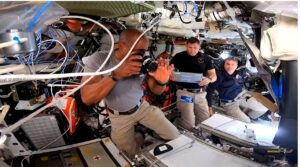
Victor Glover, Jeremy Hansen, and Reid Wiseman work together inside the Orion spacecraft on their way to the Moon.
Final trajectory adjustments and lunar approach phase
Later in the day, the crew is scheduled to execute an outbound trajectory correction burn, one of the final planned propulsion maneuvers before the lunar flyby.
These burns fine-tune the spacecraft’s path, ensuring that Orion reaches the correct position and orientation for its observation window around the Moon. Earlier in the mission, several planned burns were canceled due to the spacecraft’s precise trajectory. This maneuver is expected to proceed as scheduled.
The crew will also receive their final set of lunar science targets, completing the preparation phase for the flyby. These targets include specific surface features identified by NASA scientists for observation and imaging.
By the end of the day, Orion is expected to enter the Moon’s gravitational sphere of influence, a region where lunar gravity becomes the dominant force acting on the spacecraft.
This shift has both symbolic and operational significance. It marks the point where the mission transitions from transit to direct lunar interaction.


(The Artemis II crew took this photo on day 4 of their journey to the Moon. In it, the Moon is oriented with the South Pole at the top and are beginning to see parts of the lunar far side. Orientale basin is on the right edge of the lunar disk in this image. Artemis II marks the first time that humans have seen the entire basin. The Artemis II crew will continue to observe Orientale from multiple angles as they approach the Moon and throughout the lunar flyby. Orientale is the textbook multi-ring impact basin used as a baseline to compare other impact craters on rocky worlds from Mercury to Pluto.
NASA)
Mission operations continue under close ground coordination
Mission managers and scientists are scheduled to provide a detailed update during a briefing streamed on NASA’s official channels later in the day.
The briefings serve as a key link between the spacecraft and the public, offering updates on system performance, crew health, and mission progress.
Inside the capsule, the crew’s schedule remains tightly controlled. Each task, from suit testing to propulsion maneuvers, is timed to align with both spacecraft operations and communication windows with Earth.
The suit demonstration stands out as one of the more human-centered activities in the mission. It focuses not on where the spacecraft is going, but on how the crew will function if conditions change rapidly.
As Orion continues its approach, the astronauts are balancing technical precision with preparation for the unexpected. The systems being tested now, including the suits, are designed for scenarios that mission planners hope never occur but must be ready to handle.
The Moon is now close enough to influence the spacecraft’s path. Inside Orion, the crew is working through the final checklists that will carry them into the flyby phase, where observation, timing, and coordination will define the mission’s next milestone.
Also Read: