
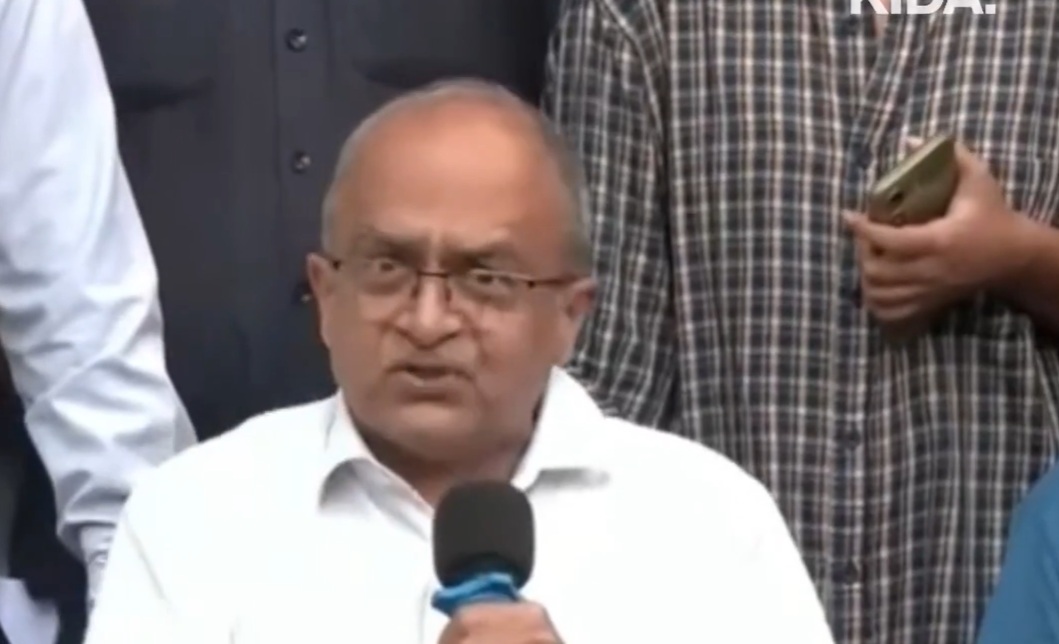
Senior advocate Prashant Bhushan has openly declared that the protests against the Election Commission’s Special Intensive Revision (SIR) of electoral rolls are now a fight for “regime change”, intensifying a political confrontation that began with demands for Chief Election Commissioner Gyanesh Kumar’s resignation.
“Yes, we want regime change,” Bhushan said at a press conference on Thursday evening, flanked by All India Students’ Association (AISA) activist Neha Bora and Cockroach Janta Party (CJP) founder Abhijeet Dipke. He argued that expressing disaffection against a government is not a crime in a democracy and accused the authorities of escalating the confrontation through their response to the protests.
BJP leaders have argued that the electoral-roll controversy is being used as a pretext for a campaign against Prime Minister Narendra Modi’s government. The opposition, meanwhile, has maintained that its challenge concerns the integrity of elections and the treatment of protesters demanding accountability from the Election Commission.
The dispute now extends beyond the merits of the SIR exercise. It has become a test of how far opposition groups can mobilise against a constitutional authority, how the government and police respond to demonstrations, and whether the political objective of removing an elected government is being conflated with allegations of electoral wrongdoing.
Bhushan’s Declaration Gives BJP a Political Opening
Bhushan’s statement marks a shift in the public framing of the agitation. The immediate demand has centred on Kumar’s resignation over alleged irregularities in the revision of electoral rolls. The declaration that the movement seeks regime change broadens that objective into an explicit challenge to the government.
The controversy has also revived scrutiny of Narendra Modi’s own pre-2014 campaign rhetoric. A review of his speeches from 2013 and 2014 suggests that he generally framed political change through terms such as “Parivartan” and calls to uproot the Congress-led government in Delhi, rather than using the specific phrase “regime change” as a description of his political programme.
The BJP has now circulated old campaign clips to counter Prashant Bhushan’s declaration, arguing that a change of government in a democracy must be secured by winning public support through elections, not by creating disorder through street protests. The comparison exposes a central distinction in the current confrontation: whether “regime change” means replacing an elected government through constitutional means or is being used to suggest a more disruptive political objective.
Bhushan’s statement alone does not establish the latter, but it has given the BJP an opportunity to challenge the opposition’s intentions while shifting attention away from the substantive allegations surrounding the SIR exercise.
The BJP has seized on the distinction. Party spokesperson Pradip Bhandari has argued that the SIR issue is a smokescreen for Rahul Gandhi and the opposition’s wider political agenda. The party has also invoked Bora’s comments about the youth-led movement in Bangladesh, which led to the removal of former prime minister Sheikh Hasina, to question whether sections of the protest movement want to reproduce that political upheaval in India.
But the political significance of Bhushan’s statement requires a distinction between opposing a government and seeking to overthrow it unlawfully. In a parliamentary democracy, campaigning to defeat an incumbent government, mobilising public opinion against it and demanding fresh political accountability are legitimate forms of political activity. A declaration favouring regime change does not, by itself, establish a conspiracy to seize power outside constitutional processes.
The crucial question is what the protesters mean by the term and what methods they intend to employ. Bhushan has framed the objective as a struggle against what he describes as a dictatorial government, arguing that continued suppression of demonstrations could deepen public resistance. The BJP interprets the same statement as confirmation that the movement’s real purpose extends beyond electoral-roll reform.
Neither interpretation settles the underlying dispute over SIR. That requires evidence about the revision process, the rules governing additions and deletions, the handling of objections and the safeguards available to affected voters.
The declaration nevertheless creates a political challenge for the opposition. Leaders who want to build a broad coalition around electoral integrity must explain how the demand for regime change relates to the specific grievances raised against the Election Commission. Otherwise, the BJP can argue that the original issue has been displaced by a wider campaign to remove the government.
SIR Dispute Moves Beyond the Election Commission
The Special Intensive Revision of electoral rolls has become the central institutional issue behind the protests. Critics have alleged that the exercise risks disenfranchising eligible voters and have questioned the manner in which names are scrutinised or removed. The Election Commission’s position is that electoral rolls must be revised to maintain their accuracy and remove ineligible entries.
The distinction between correcting a voter list and improperly excluding eligible citizens is central to the controversy. Large-scale revisions require transparent procedures, clear communication with voters and an effective mechanism for challenging deletions. The political dispute cannot be resolved by allegations alone; it requires scrutiny of the relevant electoral data and the procedures followed in individual cases.
Rahul Gandhi and other INDIA bloc leaders have challenged the Election Commission over SIR, bringing the controversy into the courts. The Supreme Court issued notice to the Election Commission, the chief election commissioner and the other election commissioners on petitions concerning the exercise, according to reports published on October 15. The judicial proceedings provide a separate channel for examining the legal issues, even as protests continue on the streets.
The controversy also raises a broader question about institutional accountability. The Election Commission must be able to revise electoral rolls without political interference, but its decisions must also withstand scrutiny where voters allege that the process has affected their rights. Demanding the resignation of the chief election commissioner is a political demand; establishing whether the revision has violated electoral law is a separate legal question.
A Test of Political Credibility and Democratic Accountability
Bhushan’s “regime change” declaration has shifted attention from the technical questions surrounding SIR to the broader political ambitions of the movement. That shift may help the BJP portray the agitation as an opposition campaign against Modi rather than a focused effort to improve electoral transparency.
Yet political motivation does not automatically invalidate a complaint. Opposition parties can seek electoral advantage while raising legitimate questions about public institutions. Equally, a legitimate grievance does not exempt its proponents from scrutiny of their claims, methods and objectives.
The decisive questions remain whether eligible voters have been improperly excluded, whether the Election Commission has followed the law, whether the courts identify grounds for intervention and whether police restrictions on demonstrations are necessary and proportionate.
For the BJP, the opportunity is to answer the substantive questions about SIR rather than rely solely on the opposition’s political language. For the opposition, the challenge is to demonstrate that its allegations are supported by evidence and that its campaign seeks change through constitutional and democratic means.
Bhushan has made the movement’s political ambition explicit. What remains unresolved is whether that declaration will strengthen public mobilisation or allow the BJP to shift the debate away from electoral-roll accountability.
The confrontation is no longer only about the resignation of one election official. It is now a contest over the credibility of electoral institutions, the limits of protest regulation and the opposition’s ability to turn allegations of procedural wrongdoing into a persuasive national political campaign.
FAQs
Why did Prashant Bhushan call for regime change?
Bhushan said the agitation had become a fight to replace what he described as a dictatorial government, amid protests over the Election Commission’s Special Intensive Revision of electoral rolls and the police response to demonstrations.
What is the BJP’s response to the statement?
The BJP argues that the SIR controversy is being used as a pretext for a wider campaign against the Modi government, citing the statement as evidence that the agitation extends beyond electoral-roll reform.
Has the CJP received permission to protest?
Mumbai police have authorised the CJP’s rally at Azad Maidan on October 16. In Delhi, police have offered to facilitate a group of 11 people at a suitable location in Central Park, while restrictions and security measures remain in force.
Does calling for regime change amount to an illegal act?
Not by itself. Seeking to replace an elected government through elections, peaceful protest and other constitutional means is part of democratic politics. The legality of any specific action depends on its conduct and the applicable law.
What is the central issue in the SIR controversy?
The dispute concerns whether the Election Commission’s revision of electoral rolls is being conducted accurately and fairly, and whether eligible voters are adequately protected against wrongful exclusion.