
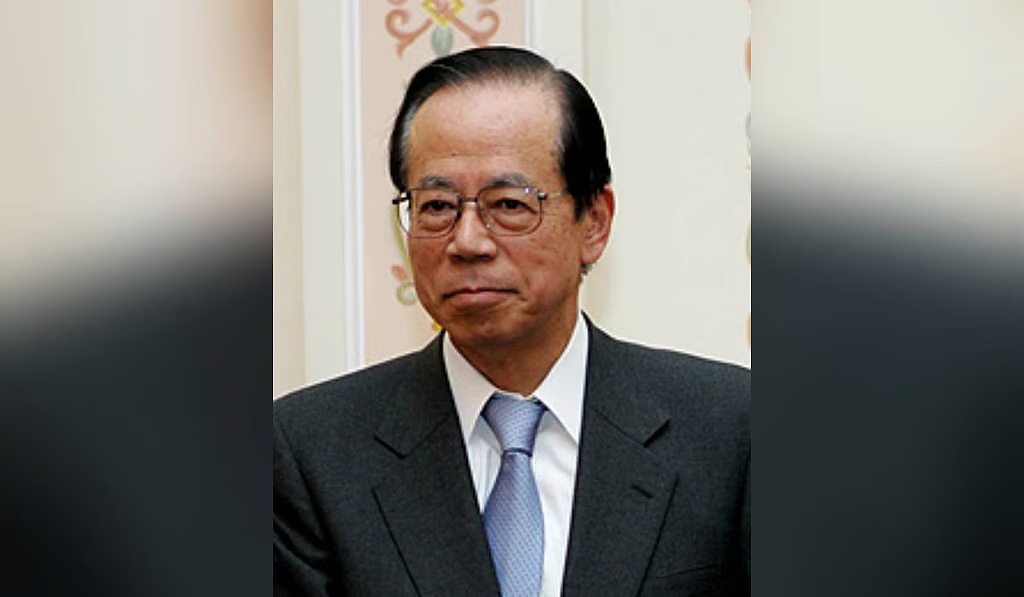
Former Japanese Prime Minister Yasuo Fukuda, who sought to strengthen ties with China and promote diplomatic cooperation with Asian neighbours during his brief tenure, has died at the age of 90, Japan’s ruling Liberal Democratic Party confirmed on Monday.
Fukuda died on October 22 from heart failure, according to the Nikkei business daily, which reported his death on Monday. He served as prime minister from September 2007 to September 2008, succeeding Shinzo Abe after Abe’s first government collapsed amid political and administrative difficulties.
Japanese Prime Minister Sanae Takaichi expressed “deep sorrow” over Fukuda’s death, praising his efforts to represent Japan on international issues and strengthen its standing in the global community.
Fukuda’s political legacy was shaped by two contrasting developments: his pursuit of more stable relations with China and his struggle to govern amid a divided parliament that repeatedly obstructed his legislative agenda.
China diplomacy defined his premiership
Fukuda sought to improve Japan’s relations with China at a time when historical grievances and territorial disputes complicated ties between the Asian powers.
One of the most significant developments during his tenure was Chinese President Hu Jintao’s visit to Japan in May 2008. It was the first visit by a Chinese head of state to Japan in a decade.
The two leaders issued a joint statement committing to a “mutually beneficial relationship based on common strategic interests”, signalling an effort to move beyond longstanding bilateral tensions.
Fukuda also chaired the Group of Eight summit held in Toyako, Hokkaido, in July 2008. Climate change and international cooperation featured prominently in the summit, which brought together leaders of major industrialised economies.
His diplomatic engagement with China continued after he left office. In 2014, Fukuda met Chinese President Xi Jinping as Tokyo and Beijing sought to ease tensions over a disputed island chain and historical issues. His efforts helped create conditions for a summit between Xi and Abe later that year, during Abe’s second premiership.
Fukuda was regarded as a diplomatic moderate who favoured dialogue with neighbouring countries, particularly China. His approach stood out in a bilateral relationship frequently strained by competing territorial claims and disagreements over the interpretation of wartime history.
Political deadlock forced his resignation
Fukuda became prime minister in September 2007 following Abe’s abrupt resignation. His government, however, faced a difficult parliamentary environment in which opposition parties controlled the upper house, complicating the passage of legislation.
The political stalemate restricted his government’s ability to advance its agenda and contributed to mounting frustration within the administration.
Fukuda resigned in September 2008, after approximately a year in office. His departure followed declining public approval and persistent difficulties in securing legislative cooperation.
Before becoming prime minister, Fukuda had established himself as a senior figure in the Liberal Democratic Party. He was elected to Japan’s lower house in 1990 and served as chief cabinet secretary from 2000 to 2004, becoming one of the country’s longest-serving occupants of that influential position.
Born on July 16, 1936, Fukuda graduated from Waseda University with a degree in economics. He spent nearly two decades working for an oil company, including a two-year posting in the United States, before entering politics as a secretary to his father, Takeo Fukuda, who became prime minister in 1976.
Yasuo Fukuda was the first son of a former Japanese prime minister to become prime minister himself. His father served from 1976 to 1978, making the family one of Japan’s notable political dynasties.
Fukuda retired from electoral politics in 2012. His son, Tatsuo Fukuda, is also a lawmaker and has been viewed as a potential future prime minister.
His death marks the passing of a leader whose short time in office was defined by efforts to improve regional diplomacy, even as domestic political divisions limited his government’s room for manoeuvre.