
The grant is equivalent to about $377 million and the credit line to about $1.24 billion, according to Reuters. The grant accounts for just under a quarter of the commitment. The larger amount is financing earmarked for energy. The joint statement said projects and arrangements for delivering the assistance would be “finalized through mutual consultations.” It did not set a disbursement timetable or allocate amounts to individual projects.
Flood recovery and the damage to Nepal’s power sector
The announcement comes almost three months after the 26 August floods. The disaster destroyed roads, bridges, homes, farms and power infrastructure. About 1,500 people were killed and more than 5,200 were reported missing, according to Associated Press. Nepali authorities estimated losses at $4.7 billion. That figure describes damage from the disaster, while India’s package covers both reconstruction and longer-term energy investment. The new pledge follows India’s earlier budget allocation for development aid to Nepal.


More than a dozen hydropower projects were damaged, taking about 10% of Nepal’s generating capacity offline, Reuters reported. Nepal suspended electricity exports after the floods and turned to India for supplies to meet domestic demand. The damage exposed the immediate cost of losing generating capacity and the role of cross-border power trade when domestic output falls. The two countries already have a long-term power trade agreement, which their joint statement cited as the basis for deeper cooperation.
Shah thanked India for its humanitarian and technical response to the flooding. In September, he told the United Nations General Assembly that Nepal’s recovery needs amounted to about 10% of national economic output and sought grant-based international support, Reuters reported. The UN Fund for Responding to Loss and Damage has also pledged about $20 million for the recovery, according to AP.
Rail, fuel and trade agreements during the visit
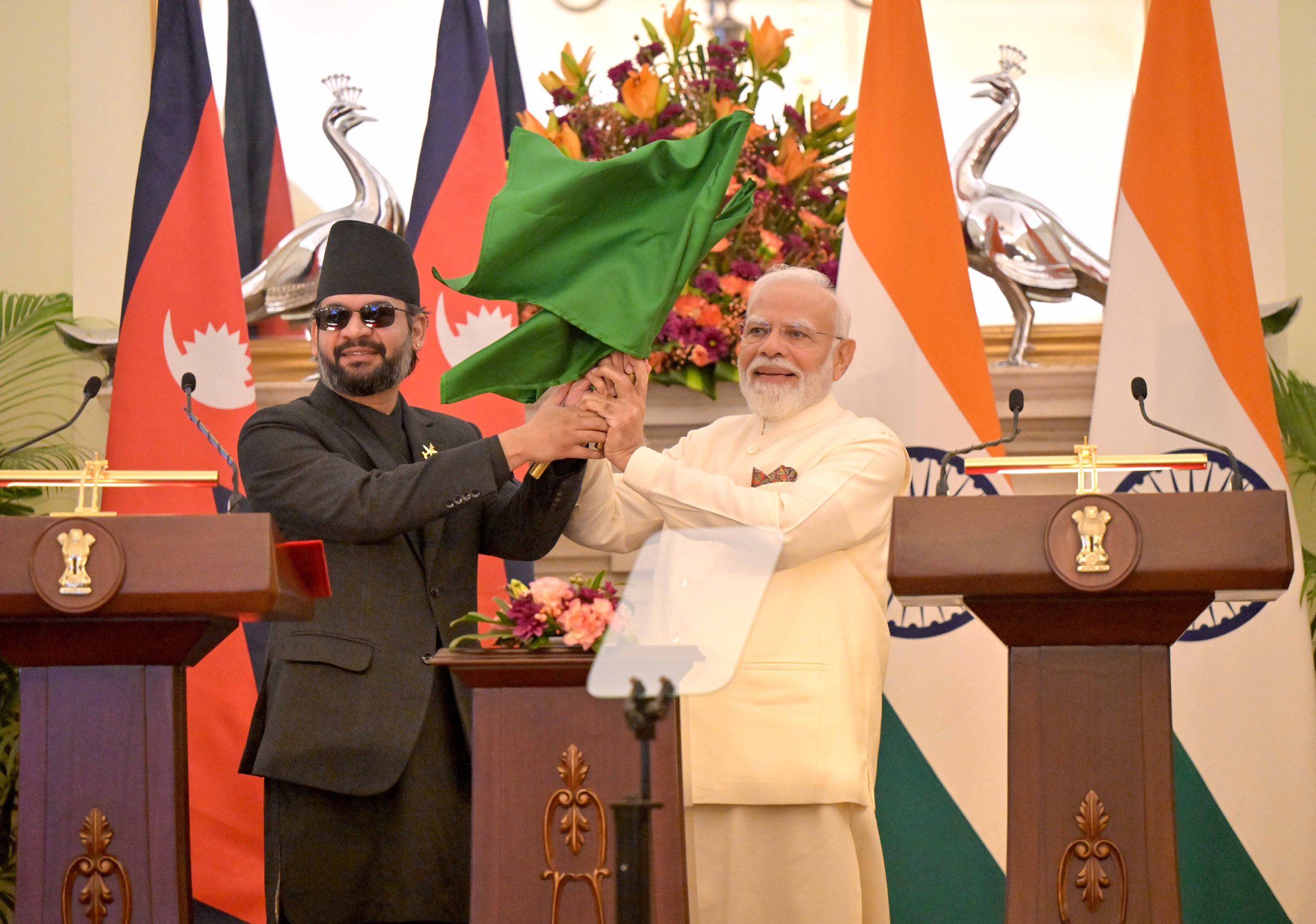
Modi and Shah flagged off the inaugural Sarayu–Kamala Express between Ayodhya and Janakpur. They also inaugurated the motorable bridge linking Darchula in Nepal with Dharchula in India and dedicated the second phase of the Motihari–Amlekhgunj petroleum pipeline. Separately, they laid foundation stones for the 669-megawatt Lower Arun hydropower project, a petroleum storage terminal in Jhapa and an integrated check post at Banbasa.
India announced a route for Nepal’s transit trade through Deendayal Port at Kandla, Gujarat. The joint statement says Nepal will also gain access to Paradip in Odisha once the required infrastructure is in place. The governments agreed to make the existing Kathmandu–Bhairahawa–Lucknow air route bidirectional, with officials to settle the technical details. They also announced completion of the field location survey for the proposed electrified Raxaul–Kathmandu railway. Both leaders welcomed plans for an agro-industrial park in Chitwan, to be set up with Indian grant assistance.
The leaders adopted a joint vision covering trade, energy, water, connectivity and disaster resilience. The joint statement gives the total package value in Nepalese currency as NPR 24,000 crore, including NPR 5,600 crore in grants and NPR 18,400 crore in credit. The leaders also asked responsible authorities to expedite the detailed project report for the Pancheshwar Multipurpose Project. For the recovery package, the next decisions are which reconstruction projects receive grants and which energy projects draw on the line of credit. Those allocations will determine how much of the commitment goes to restoring damaged facilities and how much supports new capacity.