
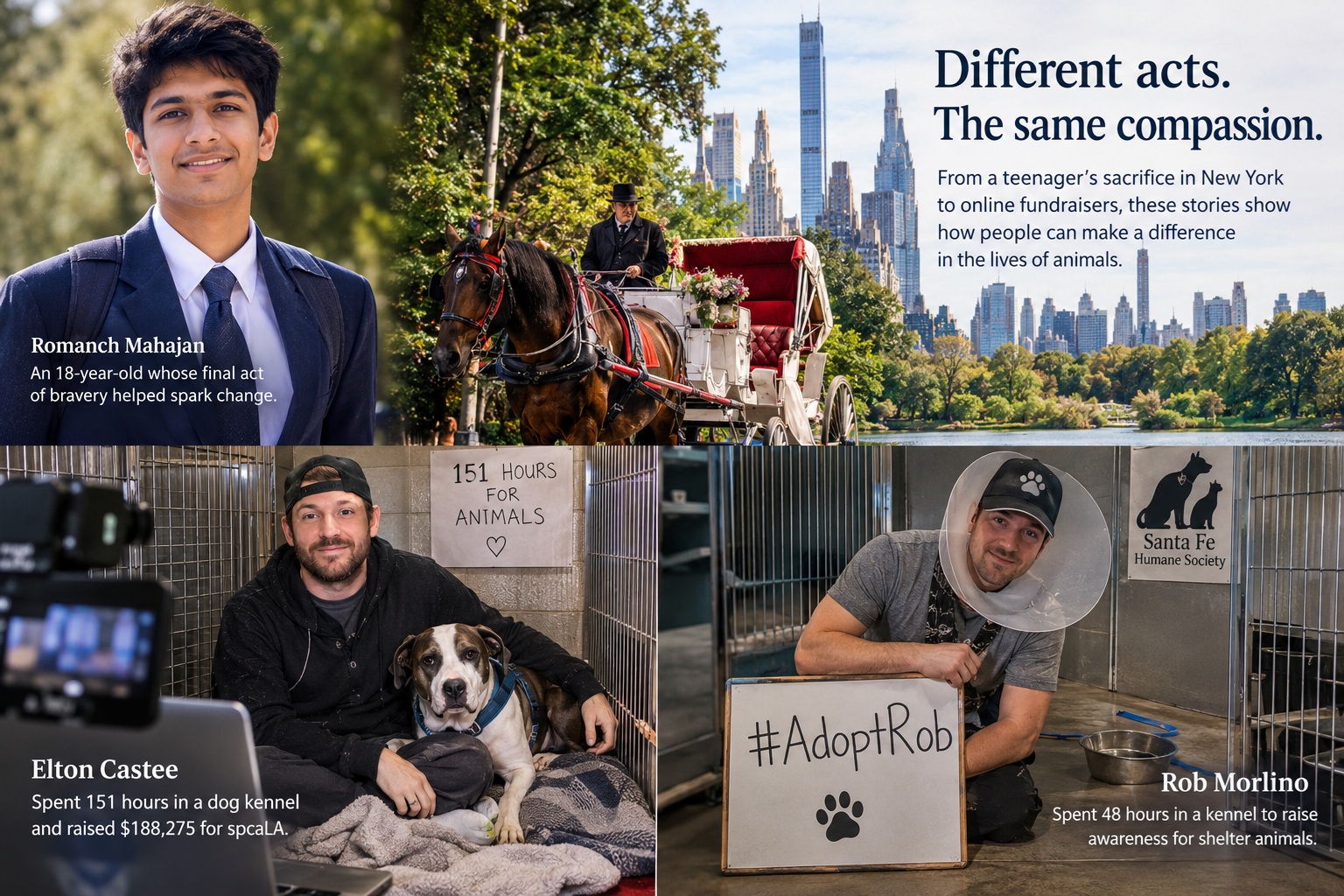
When an Indian teenager plunged towards his mother as a horse-drawn carriage overturned in New York’s Central Park, he was trying to save someone he loved. Romanch Mahajan struck his head on the ground and later died in hospital. His family’s visit to one of the world’s most recognisable urban parks ended in a tragedy that would become part of a much larger debate about human safety and the treatment of animals.
Months later, the New York City Council voted to pass a law bearing his name, seeking to bring an end to the city’s horse-drawn carriage industry. The measure, approved on October 22, will phase out the industry by June 1, 2028.
Romanch’s story is not simply about a tourist caught in a fatal accident. It is about how an individual tragedy can give fresh force to a cause that has struggled for years to command political action.
Across the United States, animal-welfare advocates have used very different approaches to make a similar point: suffering that remains distant or invisible can be difficult to confront, but a personal story can make it impossible to ignore.
In 2017, YouTuber Elton Castee spent 151 hours living inside a dog kennel to raise money for animal protection. A year earlier, animal-shelter worker Rob Morlino had spent a weekend in a kennel to draw attention to the needs of abandoned animals.
Their experiences were voluntary campaigns. Romanch’s death was an irreversible loss. Yet all three stories illuminate the relationship between personal sacrifice, public attention and the effort to change how animals are treated.
Romanch Mahajan: When a family tragedy became a public cause
Romanch, 18, had recently completed his higher secondary education at Angel’s Public School in Mamun, Pathankot. He was visiting New York with his parents and brother to celebrate his graduation.
The family was enjoying Central Park when the carriage driver stopped to take their photograph. The horse suddenly bolted, overturning the carriage and throwing Romanch’s mother, Priya, from the vehicle.
Romanch tried to save her. His head struck the ground, and he later died in hospital.
For his family, the loss was devastating. But his death also brought renewed attention to a dispute that animal-welfare groups and some city lawmakers had pursued for years: whether horse-drawn carriages belong in an increasingly congested urban environment.
The campaign had faced resistance from carriage operators and their union, whose members depend on the trade for their livelihoods. Previous efforts to end the industry had failed.
Romanch’s death gave the debate a human dimension that could not be reduced to arguments about tourism, tradition or commercial interests.
His uncle, Gaurav Mahajan, joined supporters of the ban outside City Hall before the Council vote. Speaking on behalf of the family, he appealed to New Yorkers not to forget the teenager.
“True justice means recognising that these gentle, majestic horses do not belong on the congested asphalt or trapped in dangerous traffic,” he said. “On behalf of his parents and his brother, I leave New Yorkers with one final sacred request: please do not forget Romanch.”
The Council approved Romanch’s Law by 40 votes to seven, with two abstentions. The legislation provides for a phased end to the industry by June 1, 2028, alongside measures intended to support workers and ensure the humane placement of the horses.
The law does not erase the family’s loss. It does, however, give Romanch’s name a place in a policy decision intended to reduce risks to people and animals.
Elton Castee: 151 hours inside a dog kennel
Eight years before New York’s vote, an American internet personality tried a very different way to get people to pay attention to animal welfare.
On August 27, 2017, YouTuber Elton Castee entered a kennel at spcaLA’s Pitchford Companion Animal Village and Education Center in Long Beach, California. His initial goal was to raise $100,000 for the organisation in memory of his dog Sparta, who had died the previous year.
Castee remained in the kennel while viewers watched his livestream. He reached his original fundraising target by Wednesday morning, but chose to continue.
His next goal was to raise an additional $50,000 for spcaLA’s Disaster Animal Response Team, with the campaign extending to relief efforts following Hurricane Harvey in Texas.
When he ended the livestream on September 2, the fundraiser had collected $188,275, according to spcaLA. The organisation said more than seven million people had tuned in during the campaign.
The money supported animal-cruelty investigations, disaster response, shelter, food and veterinary care for abandoned and abused animals.
Castee’s campaign drew attention because it transformed an abstract problem into a visible, sustained personal experience. Rather than simply asking people to donate, he placed himself in an environment associated with animals awaiting care and adoption, allowing viewers to follow the challenge in real time.
His decision to remain after reaching the initial target also demonstrated how a fundraising effort could evolve when public interest created an opportunity to help more animals.
It was not equivalent to the suffering of animals confined in shelters, nor did the experience reproduce the challenges faced by abandoned pets. Its significance lay in its ability to mobilise an online audience around a practical welfare objective.
Rob Morlino: Becoming the story to help shelter animals
Castee was not the first person to use the kennel as a fundraising platform.
In 2016, Rob Morlino, who worked with the Santa Fe Humane Society, spent 48 hours living in a kennel as part of an online campaign called #AdoptRob.
The challenge involved eating from a dog bowl, walking on a leash and wearing a protective cone, while using a livestream to engage viewers and encourage support for shelter animals.
The idea emerged during discussions about how the organisation could attract attention to an issue that often struggles to compete with other demands on public generosity.
Morlino later described the campaign as an attempt to rise above the noise surrounding animal welfare. The unusual format helped the shelter reach a much wider audience, with the campaign reported to have reached more than 4.5 million people.
The money raised was not enough to transform the organisation’s finances, according to the campaign account published by CrowdRise. But the initiative helped the shelter understand how online engagement could be turned into fundraising and greater awareness.
The parallel with Castee is clear: both used their own discomfort as a way to make animal welfare visible, while asking audiences to translate attention into support.
Their efforts also highlight a broader lesson for charities. A compelling human story can bring people to an issue, but lasting benefits depend on directing that attention towards concrete needs, from veterinary care and shelter capacity to rescue operations and adoption.
Three stories, one question about compassion
Romanch, Castee and Morlino occupy very different places in the story of animal welfare.
Romanch was an 18-year-old visitor whose attempt to save his mother ended in his death. Castee was an online creator who used a prolonged kennel stay to raise money for animal protection and disaster relief. Morlino was a shelter worker who turned a weekend in a kennel into a public-awareness campaign.
Their experiences should not be conflated. A fatal accident is not a fundraising challenge, and a temporary voluntary stay in a kennel does not reproduce the vulnerability of animals dependent on shelters for survival.
But the stories share a central feature: they made people look at an issue through an individual experience rather than an abstract argument.
In New York, the question was whether an old tourist tradition could continue amid concerns about public safety, animal welfare and the working conditions of carriage horses. The City Council’s decision to phase out the industry followed years of campaigning, with Romanch’s death providing renewed urgency.
For animal shelters, the challenge is often less dramatic but equally persistent: finding homes for abandoned animals, financing medical treatment and keeping rescue services running. Castee’s fundraiser demonstrated how an online audience could be mobilised to support those needs.
Morlino’s campaign offered another lesson: a striking act can generate attention, but the ultimate measure of success is what that attention enables an organisation to do.
Romanch’s Law will take time to implement, and the transition will affect workers as well as horses. The legislation therefore represents the beginning of a process, not the end of every dispute surrounding the industry.
For his family, the law carries a more personal meaning. A teenager who died trying to protect his mother will be remembered through a measure intended to change a longstanding city practice.
And for those working to protect animals, the three stories offer a reminder that compassion can take many forms: a family demanding that a death not be forgotten, a creator remaining in a kennel until a fundraising target grows, or a shelter worker turning himself into the subject of a campaign.
None of these acts alone can resolve every problem in animal welfare. But each shows how a personal story can move a wider public conversation towards action.
FAQs
1. Who was Romanch Mahajan?
Romanch Mahajan was an 18-year-old Indian tourist from the Pathankot area who died after a horse-drawn carriage overturned in Central Park in June 2026. He was visiting New York with his family to celebrate his graduation.
2. What is Romanch’s Law?
It is New York City legislation passed by the City Council on October 22, 2026, to phase out the horse-drawn carriage industry by June 1, 2028. It also includes provisions for workers and the humane placement of horses.
3. How much did Elton Castee raise by living in a dog kennel?
Castee raised $188,275 for spcaLA after spending 151 hours in a kennel in 2017. The fundraiser supported animal welfare work and disaster response, including relief efforts connected to Hurricane Harvey.
4. Who was Rob Morlino?
Morlino was an animal-shelter worker who spent 48 hours in a kennel in 2016 as part of the #AdoptRob campaign to raise awareness and funds for shelter animals.
5. What connects these three stories?
Each illustrates how an individual experience can draw public attention to animal welfare. Romanch’s death helped renew pressure for legislative change, while Castee and Morlino used voluntary challenges to encourage donations and support for animal-care organisations.