
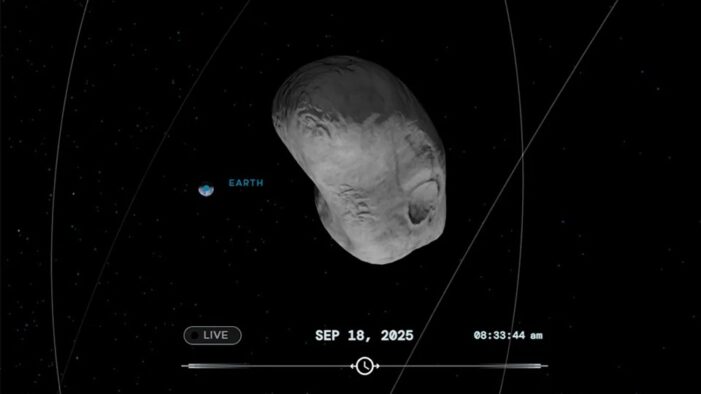
The night sky often brings a sense of awe, but every so often, a rocky visitor from deep space captures global attention. This week, astronomers are tracking asteroid 2025 FA22, which will sweep past Earth on Thursday, 18 September, 2025, in one of the year’s most closely monitored celestial events.
According to NASA, FA22 is about 520 feet (160 metres) wide and hurtles through space at over 24,000 miles per hour. On its closest approach, it will pass at a distance of 523,000 miles (841,900 km), tht is slightly farther than the Moon. While that might not sound close, in astronomical terms, it qualifies as a near miss.
The asteroid is part of the Aten group, a class of Near-Earth Objects (NEOs) whose orbits cross Earth’s path. Because of their trajectories, they are among the most carefully tracked objects in the solar system.
Despite its size, experts stress that FA22 poses no risk. NASA designates an asteroid as hazardous if it comes within 7.4 million kilometres of Earth and measures more than 85 metres across. Although FA22 fits the size category, its trajectory keeps it well outside the danger zone.
Still, scientists emphasise that close monitoring is essential. Even small shifts in an asteroid’s orbit, caused by gravitational nudges or solar radiation effects, can change its future path dramatically.
ALSO READ: London’s Far-Right Rally Sends Shockwaves Through South Asian Communities
NASA noted that shortly after its discovery in March 2025, FA22 briefly reached Torino Scale 1, a category that flags objects worth monitoring, though unlikely to impact Earth. Further observations quickly ruled out any threat.
2025 – A Busy Year for Sky Watchers
The September encounter comes during a year filled with notable asteroid activity.
-
January 2025: Asteroid 2025 AB10, a 200-foot rock, passed at 1.2 million kilometres, offering astronomers early tracking practice for the year.
-
March 29, 2025: FA22 was first spotted by the Pan-STARRS 2 telescope in Hawaii, triggering the global observing campaign now underway.
-
July 2025: A smaller asteroid, 2025 JX3, skimmed within 400,000 kilometres, just inside the Moon’s orbit, sparking public interest.
-
September 2025: FA22 now headlines as the largest close-approaching asteroid of the year.
-
Later in 2025: Astronomers also anticipate the flyby of 2025 QH5 in December, which, while smaller, will pass even closer than FA22.
These encounters remind us that the Blue Planet shares a dynamic neighbourhood with thousands of NEOs, most harmless, but all worth studying.
Why Should We Care About Every Flyby?
Even when no danger exists, each asteroid provides a chance to refine tracking systems and test planetary defense protocols. The International Asteroid Warning Network (IAWN) has organised a worldwide observing campaign around FA22. Telescopes across the globe will collect data on its orbit, size, spin, and surface features.
IAWN explained: “For the purpose of the exercise, we will treat this object as a current virtual impactor with a hypothetical impact on September 19, 2089.” In reality, updated orbital calculations show no risk of impact.
Beyond FA22, attention is building toward Apophis, a much larger asteroid due in 2029. In fact, ISRO chief S. Somanath recently outlined India’s plans to join NASA, ESA, and JAXA in asteroid exploration, including potential landing missions. The goal is to understand their makeup, test resource extraction technologies, and sharpen defense strategies.
Past close approaches, such as 2019 OK, which flew within 73,000 kilometres, and 2020 QG, which zipped by at just 3,000 kilometres—show how unexpectedly close asteroids can appear. While FA22 will pass at a safe distance, its visit underscores why constant vigilance is critical.
For amateur astronomers, the event is also a spectacle. On September 18–19, FA22 is expected to reach magnitude 13, visible through small backyard telescopes. The Virtual Telescope Project will livestream the passage for global audiences.
Though harmless, FA22’s arrival highlights a core truth about our place in the cosmos: the skies above are far from static. Each asteroid encounter is both a reminder of Earth’s vulnerability and a chance to sharpen humanity’s readiness for the unexpected.

Asteroid 2025 FA22 Set for Close Flyby on September 18 added by Sridevi K. on
View all posts by Sridevi K. →