
Dolphins have long fascinated scientists with their remarkable speed and fluid movement through water. Now, new research offers a clearer explanation of the physics behind their efficiency, shedding light on how these marine mammals generate powerful propulsion.
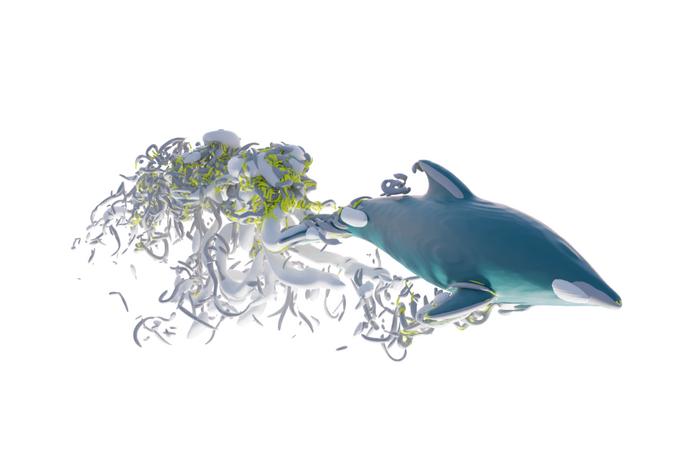
A study published in Physical Review Fluids by researchers at The University of Osaka identifies a crucial mechanism: the formation of large, energetic vortices driven by the dolphin’s tail motion. Using advanced numerical simulations, the team mapped how these swirling water structures influence propulsion under varying conditions.
As dolphins swim, they move their tails in a rhythmic up-and-down motion, pushing water backward. This action produces a turbulent wake filled with vortices of different sizes. Until now, the exact contribution of these complex flow patterns to forward motion remained difficult to isolate.
Lead author Yutaro Motoori explained that the team aimed to pinpoint which elements of this turbulence actually aid speed. By deploying supercomputer-based simulations, the researchers were able to break down the flow into components and identify the dominant forces at play.
The findings reveal that large-scale vortex rings generated by the oscillating tail are the primary drivers of thrust. These powerful structures push water backward, effectively propelling the dolphin forward. In contrast, smaller vortices—formed through what scientists call an energy cascade—play only a minor role in movement, despite being more numerous.
Senior researcher Susumu Goto noted that understanding this hierarchy of vortices is key. While turbulence appears chaotic, it follows an organized structure where the largest vortices do most of the work, and smaller ones are largely by-products.
The simulation-based approach allowed the team to observe fluid dynamics in extraordinary detail—something that is nearly impossible through direct experimentation. It also enabled them to test different swimming speeds, with results remaining consistent across scenarios.
Beyond explaining dolphin agility, the research holds practical promise. Insights into efficient propulsion could inform the design of faster, energy-efficient underwater robots and improve technologies that manage turbulent flows.
For now, the study offers a compelling reminder that nature’s most graceful swimmers are guided by deeply intricate physics beneath the surface.
Also Read:
Aquatic plant reduces antibiotics in water and genetic damage in fish, but risks remain
Scared of spiders? A world without them is true nightmare tale: Study
aquatic animals, Dolphins, fish, swimming, underwater, underwater creatures, underwater robots, Water

Why Dolphins Swim So Fast: Scientists Decode The Role Of Eddies added by Arun Kumar N on
View all posts by Arun Kumar N →